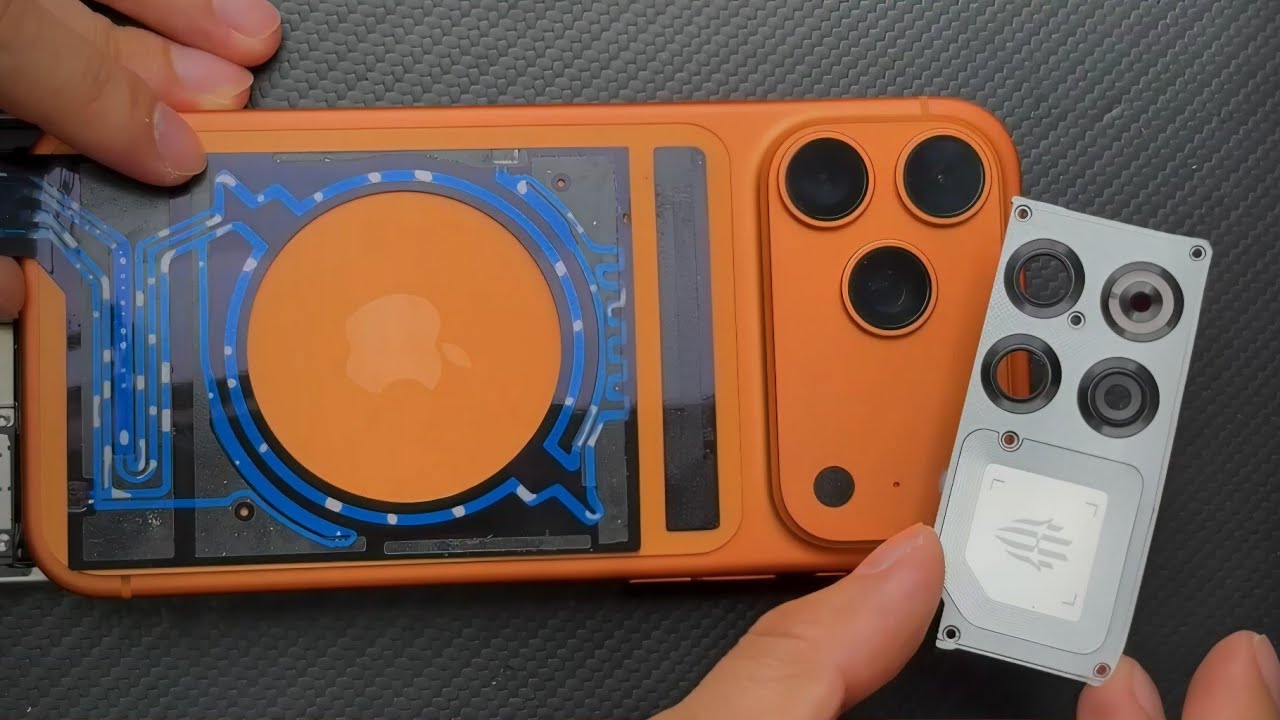
iPhone 17 Pro Max gets a surprising boost from DIY water cooling, but a gaming phone barely flinches
A new video from YouTuber Kingmi Mobile puts smartphone cooling to the test, comparing stock devices against heavily modified versions to see how thermal management affects performance. The headline result: retrofitting an iPhone 17 Pro Max with a water-cooling system delivered an 8% jump in its AnTuTu benchmark score, while removing liquid cooling from a gaming-focused RedMagic 11 Pro+ barely moved the needle.
Here’s what the tests showed
– iPhone 17 Pro Max, stock: 2,456,045 (no category breakdown shown)
– iPhone 17 Pro Max, with water cooling: 2,652,045 total
– CPU: 827,447
– GPU: 1,064,431
– Memory: 365,347
– UX: 394,820
That’s a gain of roughly 196,000 points, or about 8% overall, after the iPhone had its back removed and a water-cooling component transplanted from a RedMagic 11 Pro+.
– RedMagic 11 Pro+, stock with water cooling: 4,144,376 total
– CPU: 1,260,914
– GPU: 1,411,676
– Memory: 547,845
– UX: 923,897
– RedMagic 11 Pro+, with water cooling removed: 4,124,867 total
– CPU: 1,241,894
– GPU: 1,414,115
– Memory: 562,261
– UX: 906,597
For the RedMagic 11 Pro+, performance dipped by less than half a percent overall (about -0.47%). CPU and UX scores dropped modestly, while GPU and memory ticked up slightly, likely within normal variance. A third device, an iPhone XR, also showed minimal change with and without extra cooling.
What the results suggest
– The iPhone 17 Pro Max appears thermally constrained under short, synthetic loads. With better heat dissipation, it can sustain higher CPU and GPU performance, translating to a sizable uplift in AnTuTu.
– The RedMagic 11 Pro+ is engineered for gaming with robust cooling by design, so stripping out its liquid cooling had a negligible impact in a quick benchmark. Its chassis, vapor chamber, and airflow design seem to carry the load even without the added water-cooling element.
– AnTuTu runs for only a few minutes. Real-world gains from improved cooling are typically more pronounced during sustained workloads like extended 3D gaming sessions, long 4K video recording, or repeated photo processing where thermal throttling is more likely.
Why it matters for gamers and power users
If you push your phone hard, thermal management can be the difference between peak bursts and sustained performance. The modified iPhone’s 8% jump suggests that better cooling could help it maintain higher clocks under pressure. For gaming phones like the RedMagic 11 Pro+, it’s confirmation that their thermal designs are already optimized to keep performance steady without dramatic swings.
Important caveats
– This was a single-unit DIY experiment. Results can vary by device, ambient temperature, and test conditions.
– Hardware modifications void warranties and carry a real risk of damage, especially when liquids are involved.
– Synthetic benchmarks don’t tell the whole story. Actual gameplay and battery drain, frame stability, and device comfort over time are equally important.
Bottom line
– iPhone 17 Pro Max with a custom water-cooling mod posted an impressive 8% improvement in AnTuTu, highlighting how much heat management can influence short-burst performance.
– RedMagic 11 Pro+ proved remarkably resilient, losing less than 1% when its water-cooling system was removed, reinforcing its reputation as a purpose-built gaming phone with robust thermal engineering.
– Expect the benefits of superior cooling to grow during longer, heavier tasks where throttling is more likely to kick in.
If you care about sustained performance for mobile gaming or content creation, thermal design deserves just as much attention as chip specs.