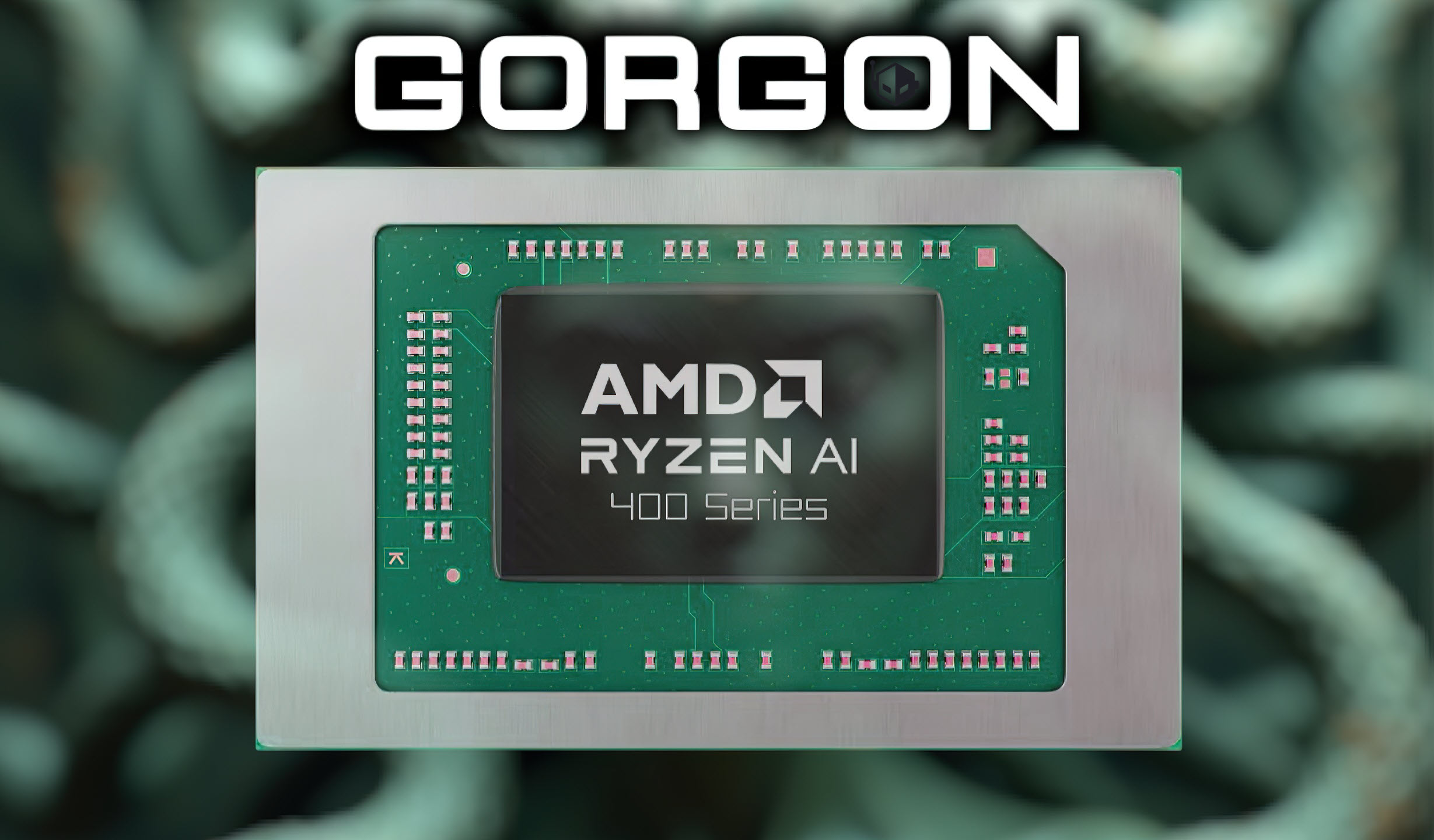
AMD’s next Zen 5 refresh for laptops is getting closer, and a fresh Geekbench entry is giving an early look at what to expect from one of the higher-end “Gorgon Point” chips. The processor in question is the Ryzen AI 9 465, positioned as the successor to the Ryzen AI 9 365 from the Strix Point family.
So far, Gorgon Point has mostly appeared in behind-the-scenes places like software driver references and a few lighter benchmark databases, which has made real-world performance hints relatively scarce. That’s why this Geekbench leak stands out: it provides a straightforward snapshot of how the Ryzen AI 9 465 performs in a commonly referenced CPU benchmark.
Based on the leaked listing, the Ryzen AI 9 465 sticks closely to the formula of the Ryzen AI 9 365. It’s shown with the same 10-core, 20-thread configuration, up to a 5.0 GHz boost clock, and the same integrated graphics solution: the Radeon 880M iGPU. In other words, this looks less like a traditional performance-focused refresh and more like a continuation of the same CPU and GPU platform.
That direction lines up with what’s been suggested about the broader Ryzen AI 400 series: the key upgrade is expected to be on the AI side. While some models may see small clock bumps, the main story is higher NPU capability measured in AI TOPS, rather than a major shift in CPU core counts or graphics hardware.
In the Geekbench results, the Ryzen AI 9 465 posts 2,780 points in the single-core test and 12,001 points in the multi-core test. Those numbers land in the same general range as recent Ryzen AI 9 365 results. Since Geekbench scores can swing depending on laptop power limits, cooling, memory configuration, and background tasks, it’s normal to see the predecessor scoring both below and above these figures across different systems. Still, taken as an early indicator, this leak suggests the Ryzen AI 9 465 delivers broadly similar CPU performance to the Ryzen AI 9 365, with its real value likely tied to AI acceleration improvements rather than dramatic CPU gains.
Looking bigger-picture, the Ryzen AI 400 “Gorgon Point” lineup is expected to be unveiled at CES 2026, where it will likely be positioned to compete against Intel’s upcoming Panther Lake laptop chips. The refreshed family is also shaping up to be more expansive, reportedly growing to around seven SKUs compared to the smaller set associated with Strix Point. AMD appears to be bringing more models under a single refreshed family label this time, making the overall lineup easier to understand on paper while covering more price points.
A preliminary list of Ryzen AI 400 Gorgon Point mobile chips includes:
– Ryzen AI 9 HX 470: 12 cores / 24 threads, up to 5.25 GHz boost, 55+ TOPS NPU, 16 RDNA 3.5 compute units, 16 PCIe Gen4 lanes, 15–45W
– Ryzen AI 9 465: 10 cores / 20 threads, up to 5.00 GHz boost, 50 TOPS NPU, 12 RDNA 3.5 compute units, 16 PCIe Gen4 lanes, 15–45W
– Ryzen AI 7 460: 8 cores / 16 threads, up to 5.20 GHz boost, 55+ TOPS NPU, 8 RDNA 3.5 compute units, 16 PCIe Gen4 lanes, 15–45W
– Ryzen AI 7 450: 8 cores / 16 threads, up to 5.15 GHz boost, 50 TOPS NPU, 8 RDNA 3.5 compute units, 16 PCIe Gen4 lanes, 15–45W
– Ryzen AI 5 440: 6 cores / 12 threads, up to 4.80 GHz boost, 50 TOPS NPU, 4 RDNA 3.5 compute units, 16 PCIe Gen4 lanes, 15–45W
– Ryzen AI 5 435: 6 cores / 12 threads, up to 4.70 GHz boost, 50 TOPS NPU, 4 RDNA 3.5 compute units, 14 PCIe Gen4 lanes, 15–45W
– Ryzen AI 5 430: 4 cores / 8 threads, boost clock TBD, 50 TOPS NPU, 4 RDNA 3.5 compute units, 14 PCIe Gen4 lanes, 15–45W
– Ryzen AI 3 420: 4 cores / 8 threads, up to 4.60 GHz boost, 50 TOPS NPU, 2 RDNA 3.5 compute units, 14 PCIe Gen4 lanes, 15–45W
For shoppers, creators, and anyone tracking the best laptop processors for 2026, the key takeaway is simple: early benchmarks indicate the Ryzen AI 9 465 is likely to feel very familiar in raw CPU speed compared to the Ryzen AI 9 365, while the bigger improvements should show up in AI-focused workloads powered by the upgraded NPU. As more benchmarks surface from retail-class laptops, we’ll get a clearer picture of whether any tuning, sustained boost behavior, or power profiles help the refreshed chips pull further ahead in everyday use.