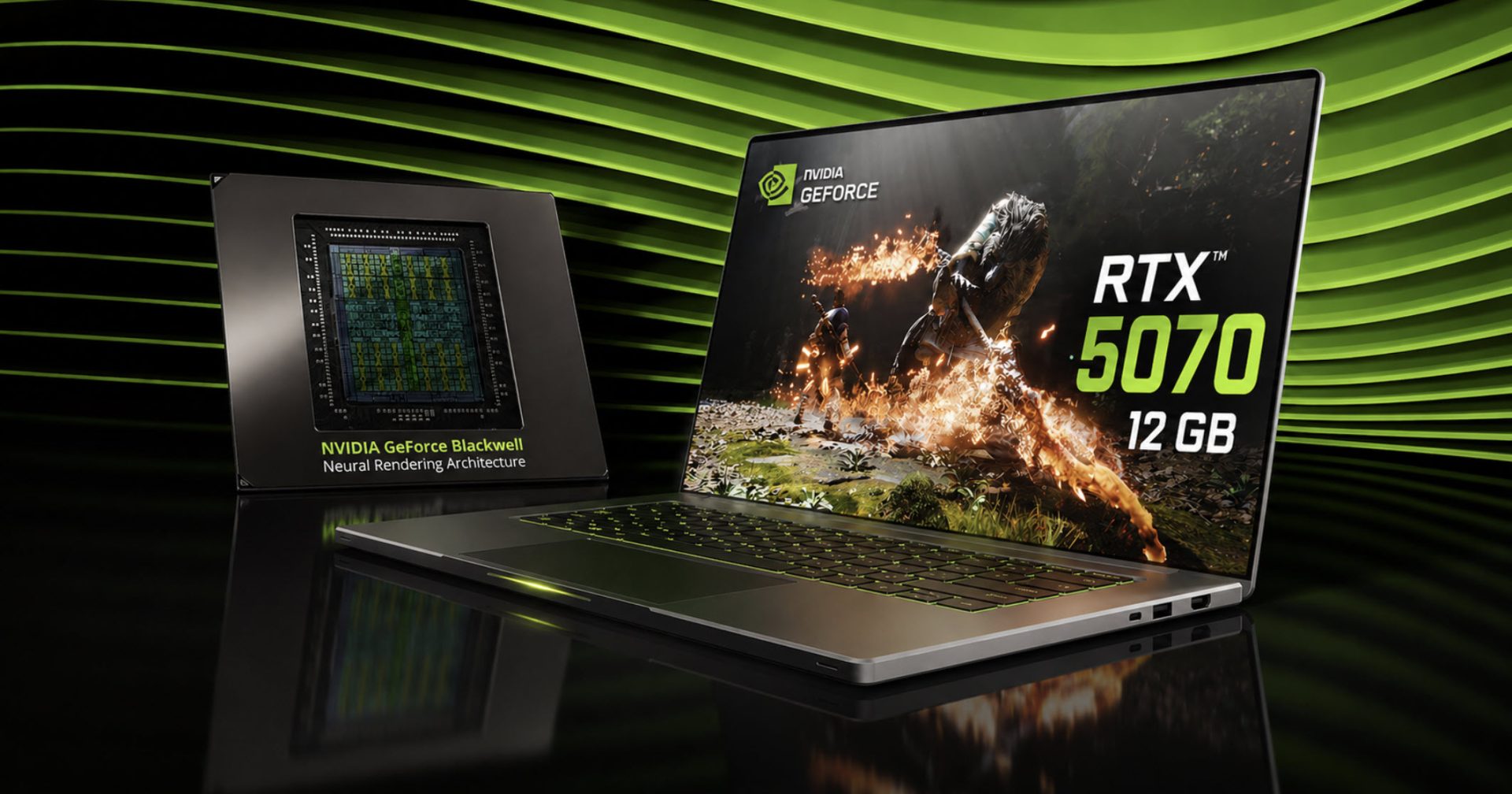
Don’t expect a big performance jump from the upcoming RTX 5070 Laptop GPU just because it comes with more VRAM. Early leaked benchmark results suggest that NVIDIA’s new 12 GB version performs almost exactly like the existing 8 GB model in most common synthetic tests, which isn’t surprising given that the rest of the hardware appears unchanged.
Leaked results for the GeForce RTX 5070 Laptop GPU (12 GB) have surfaced ahead of its broader availability, offering an early look at what the extra memory does—and doesn’t—deliver. NVIDIA is expected to ship this mobile RTX 5070 configuration with 12 GB of GDDR7 VRAM by using 3 GB memory modules, a shift from the current laptop RTX 5070 that typically ships with 8 GB of GDDR7. While the desktop RTX 5070 is a different story (with a stronger overall configuration), this update focuses specifically on the laptop GPU and its memory capacity.
On paper, moving from 8 GB to 12 GB is a clear upgrade. That extra 4 GB of VRAM can matter for memory-hungry tasks like certain creative workflows, heavy multitasking scenarios, large texture packs, and AI-related workloads that push beyond an 8 GB limit. But for pure performance in standard benchmarks, the leaked numbers indicate little to no change.
In the leaked synthetic testing, the RTX 5070 Laptop GPU 12 GB reportedly matches the 8 GB version in 3DMark Time Spy, comes in around 2% slower in Fire Strike Extreme, and appears effectively identical in Steel Nomad Light and Superposition 1080p Extreme. Taken together, these scores paint a consistent picture: when the GPU isn’t being limited by VRAM capacity, the additional memory doesn’t automatically translate into higher frame rates or better benchmark totals.
The reason is straightforward. The 12 GB RTX 5070 Laptop GPU is still believed to use the same GB206 silicon and the same core configuration as the 8 GB model, including 4608 CUDA cores, a 128-bit memory bus, and 384 GB/s of memory bandwidth. Without changes to the GPU’s compute resources, bus width, or bandwidth, most performance-sensitive scenarios will look nearly identical—especially in benchmarks that aren’t pushing beyond 8 GB of VRAM usage.
Where the extra VRAM may show real benefits is in AI workloads. In the leaked AI-related testing, both GPUs perform similarly in a Qwen 3.5 9B Q40 run. However, in a larger test (27B UD IQ2), the 12 GB version reportedly pulls ahead by a notable margin. That aligns with how many AI workloads behave: once memory capacity becomes the bottleneck, having 50% more VRAM can be the difference between a slow run, an optimized run, or being able to run the workload at all.
For gamers, though, the practical takeaway is that you should expect similar performance between RTX 5070 Laptop GPUs with 8 GB and 12 GB in most games, especially at settings where the 8 GB model is not hitting VRAM limits. The 12 GB version may help in a smaller set of scenarios—such as certain newer titles at higher resolutions, with higher texture settings, or in VRAM-heavy modded games—but it won’t magically turn an RTX 5070 Laptop into a different performance class.
It’s also worth noting that this 12 GB model is not expected to replace the 8 GB version. Both are expected to exist side-by-side in the laptop market. That means buyers will need to pay close attention to laptop spec sheets, because two systems labeled “RTX 5070 Laptop GPU” could ship with very different VRAM capacities—and potentially different pricing. Laptops featuring the 12 GB configuration are also likely to cost more, even if real-world gaming performance remains close.
If you’re shopping for a new RTX 5070 gaming laptop, the best approach is to choose based on your actual use case. For typical gaming and everyday acceleration tasks, the 8 GB and 12 GB versions may feel very similar. If you plan on AI experimentation, larger models, or workloads known to consume lots of VRAM, the 12 GB RTX 5070 Laptop GPU could be the more practical long-term pick—even if raw benchmark scores don’t move much.