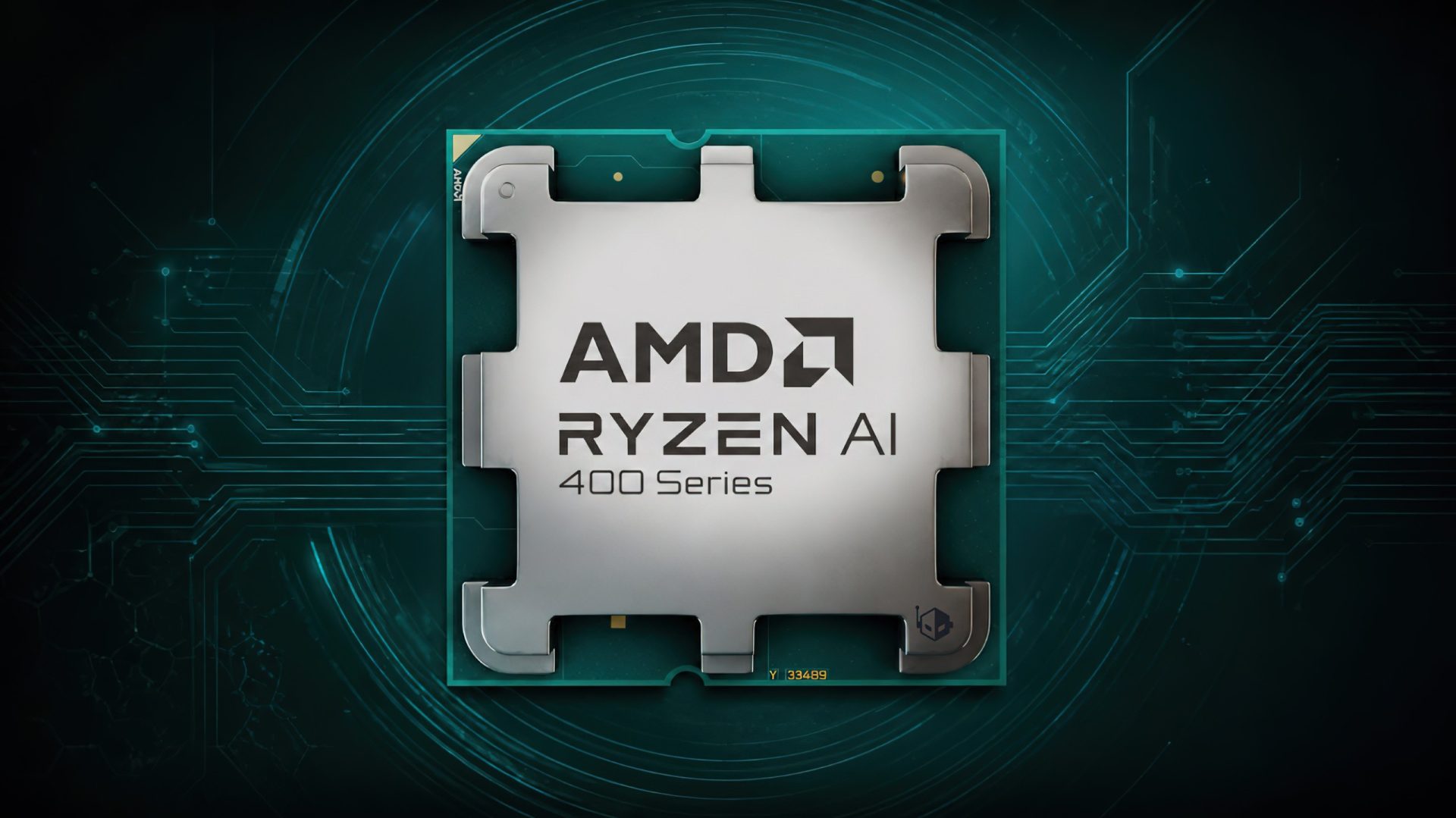
AMD’s next wave of desktop APUs is starting to leak, and early signs suggest the new Ryzen AI 400 series could land right around the performance territory of today’s Ryzen 8000G chips—while bringing newer CPU and graphics architectures to the AM5 platform.
The Ryzen AI 400 Desktop APUs are expected to roll out soon with modern “Zen 5” CPU cores, “RDNA 3.5” integrated graphics, and a built-in NPU rated at up to 50 TOPS for AI workloads. While these desktop parts reportedly won’t include the top-end configurations seen in higher-tier designs (such as 12 CPU cores and 16 GPU compute units), they still represent a notable generational shift compared to the older Ryzen 8000G lineup.
One of the first chips to show up in a public benchmark leak is the entry-level AMD Ryzen AI 5 435G. On paper, it’s a 6-core, 12-thread processor with a 2.0 GHz base clock and up to 4.5 GHz boost. It also lists 14 MB of total cache. For graphics, it includes Radeon 840M iGPU with 4 RDNA 3.5 compute units—clearly positioning it as a value-focused APU rather than an iGPU powerhouse. Even so, it keeps the headline feature of the lineup: the 50 TOPS-class NPU for AI acceleration. Power is listed at a standard 65W TDP, with configurability down to 35W for lower-power systems.
In the leaked test, the Ryzen AI 5 435G appeared in Geekbench 6 running on a B850M motherboard from Chinese vendor Jginyue, paired with 32 GB of DDR5 memory (though the memory speed wasn’t confirmed). An important detail: the benchmark data suggests the chip may not have been boosting properly, with a reported peak clock around 4094 MHz—well below the advertised 4.5 GHz maximum boost.
That matters because benchmark results can swing significantly depending on boost behavior, BIOS maturity, and power limits—especially for unreleased hardware on early motherboard firmware.
With that caveat, the Ryzen AI 5 435G scored 2620 points in single-core and 10,594 points in multi-core. For comparison, the Ryzen 5 8600G typically posts around 2493 single-core and 10,857 multi-core in the same benchmark. The leaked 435G result comes in slightly ahead in single-core but slightly behind in multi-core, which lines up with the idea that the chip may have been running at inconsistent or reduced clock speeds during the test.
Assuming final silicon and shipping BIOS updates allow the Ryzen AI 5 435G to sustain its intended boost clocks, expectations are that it should ultimately outperform the Ryzen 5 8600G and potentially land closer to a Ryzen 5 9600-class CPU, which is also a 6-core Zen 5 part (though without the same integrated graphics focus).
As for availability, the Ryzen AI 400 Desktop APUs are expected to arrive through OEM systems first. However, there’s growing speculation that AMD could later release at least some models for DIY desktop builders as well—something that would make these Zen 5 + RDNA 3.5 APUs especially interesting for compact builds, entry-level gaming PCs, and general-purpose desktops that benefit from strong integrated graphics and on-chip AI performance.
If more benchmark leaks appear—especially ones showing confirmed memory speeds and proper boost clocks—they should give a clearer picture of where Ryzen AI 400 desktop APUs truly land versus Ryzen 8000G in real-world performance.