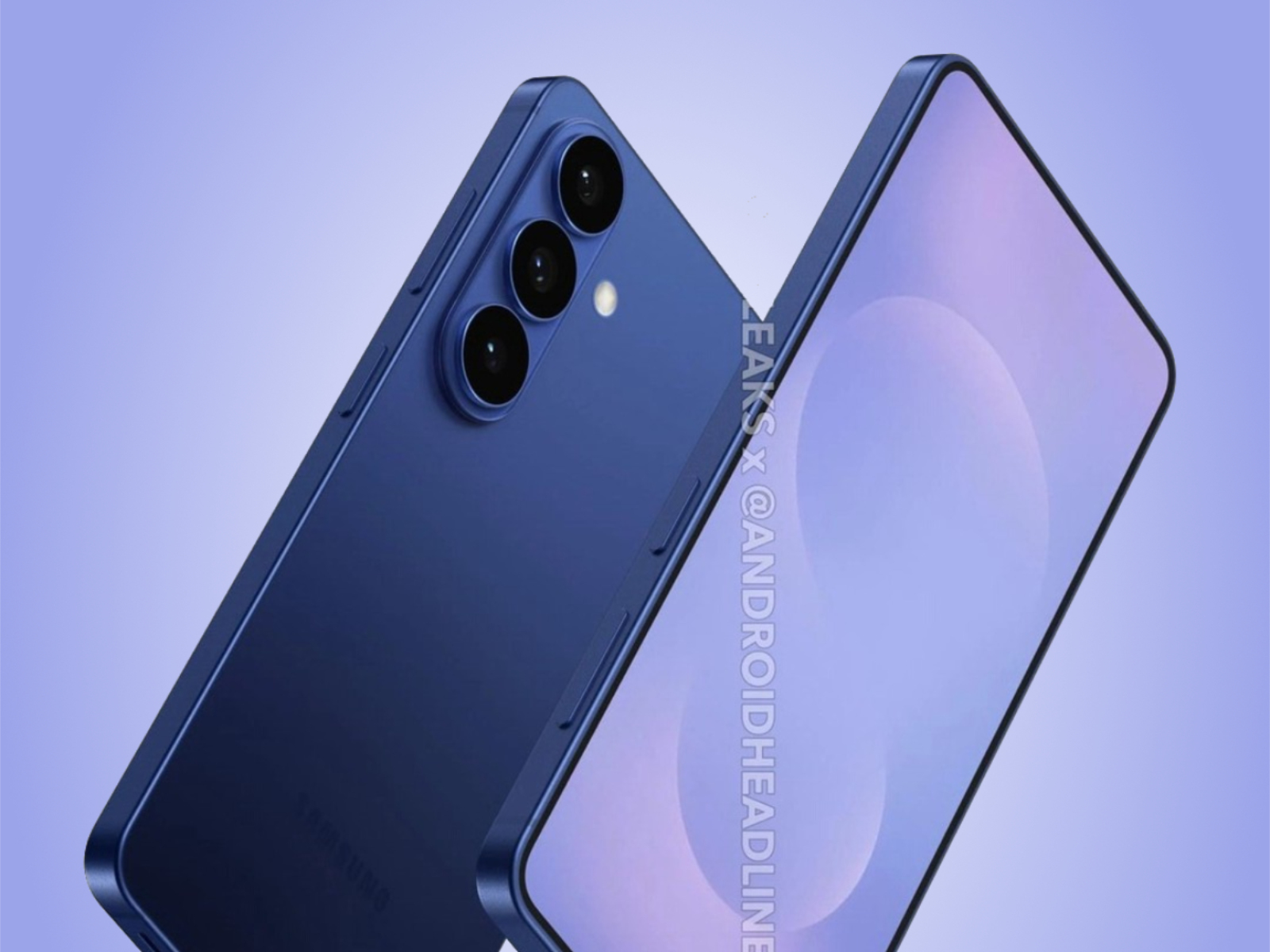
Samsung’s next compact flagship has been the subject of intense back-and-forth, from its name to its design. After weeks of chatter that alternated between Galaxy S26 and Galaxy S26 Pro, the consensus now points to Galaxy S26 as the direct successor to the Galaxy S25.
A major talking point has been thickness. The Galaxy S25 already comes in at a slim 7.2 mm. Early whispers claimed the Galaxy S26 could push that further to about 6.96 mm, but newer reports suggest a more conservative 7.24 mm measurement, not counting the triple-camera housing. For context, recent iPhone models are said to target around 8 mm for the standard version and an ultra-thin 5.6 mm for a lighter “Air” option.
According to South Korean media, Samsung originally planned a much thinner phone paired with a bigger battery—up to 4,900 mAh for a proposed “Pro” variant. That ambitious redesign was reportedly shelved last month. The reasoning? Keeping the new model competitive with the iPhone 17’s $799 tier while balancing rising component costs, particularly for the chipset and RAM.
Even with that strategic pivot, meaningful upgrades are still expected. Battery capacity is tipped to rise from 4,000 mAh on the Galaxy S25 to around 4,300 mAh on the Galaxy S26, a practical bump that should translate into longer runtime without a dramatic change in form factor. Performance will also get a generational lift: the phone is anticipated to ship with the Snapdragon 8 Elite Gen 5 in some regions and the Exynos 2600 in others. Meanwhile, the Galaxy S26 Ultra is still rumored to debut a new privacy-focused display feature called Flex Magic Pixel.
What this means for buyers is a more measured evolution rather than a headline-grabbing leap in thinness. The focus appears to be on real-world gains in battery life and performance while keeping pricing in a competitive lane.
Key takeaways based on current rumors:
– Name appears to settle on Galaxy S26, not Galaxy S26 Pro
– Thickness expected around 7.24 mm (excluding camera bump), versus earlier 6.96 mm rumors and 7.2 mm on Galaxy S25
– Battery capacity likely increasing to about 4,300 mAh from 4,000 mAh
– Regional chip strategy: Snapdragon 8 Elite Gen 5 or Exynos 2600
– Flex Magic Pixel privacy display feature still expected for the Galaxy S26 Ultra
– Pricing strategy reportedly influenced by the $799 iPhone 17 segment and rising component costs
If these reports hold, the Galaxy S26 is shaping up to be a thoughtful refinement—balancing design, battery life, and next-gen performance—rather than a radical rethink of Samsung’s compact flagship formula.


