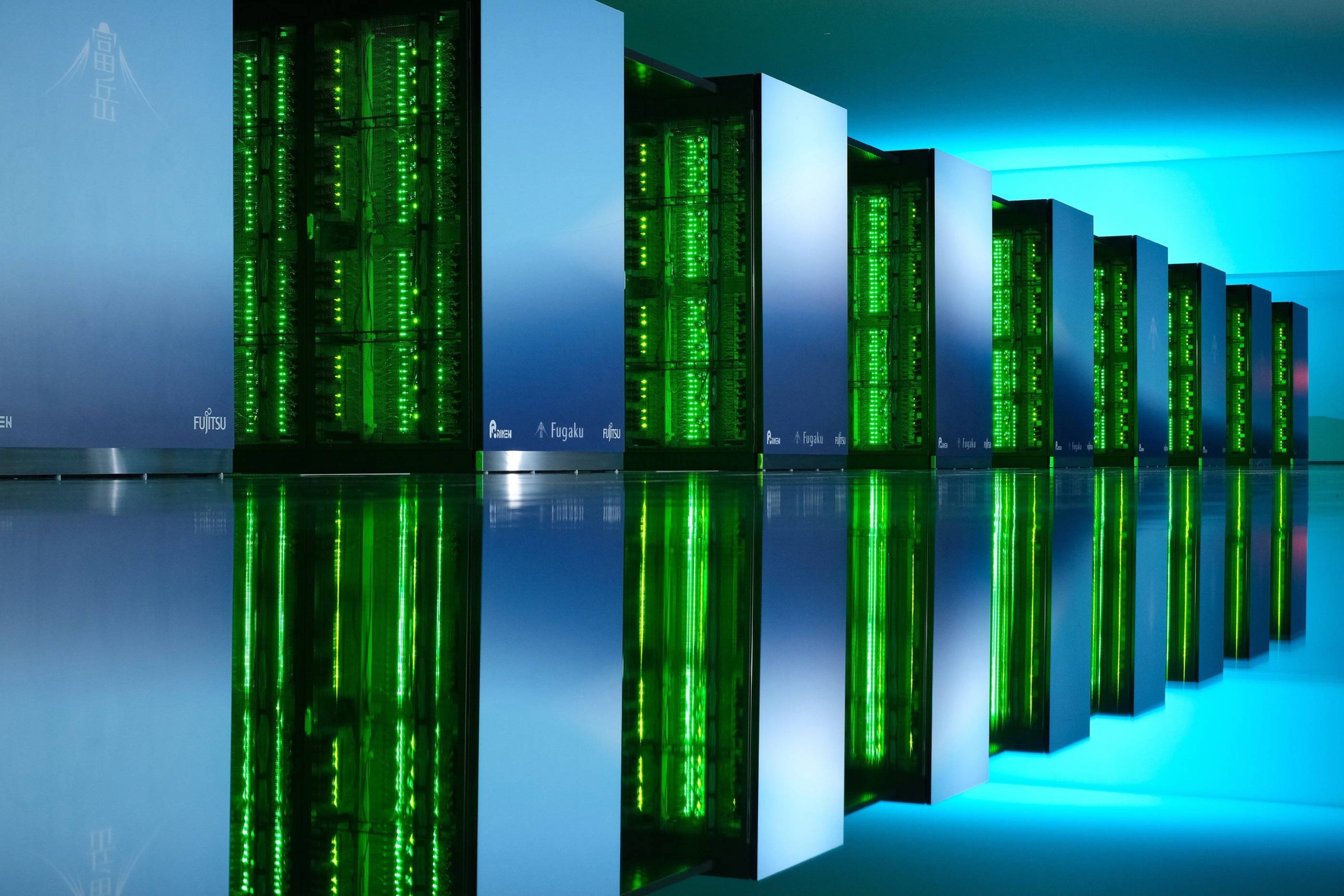
The race for technological supremacy is heating up as Japan embarks on an ambitious mission to construct the Fugaku Next supercomputer, which will be the world’s first with Zetta-class performance. Slated for completion by 2030, this groundbreaking machine is expected to reach unprecedented speeds of one zettaFLOP, equivalent to one sextillion floating-point operations per second.
Fugaku Next is poised to be a monumental leap forward, succeeding the existing Fugaku supercomputer, which currently stands among the top contenders globally. Powered by Fujitsu’s 48-core Arm-based microprocessor and manufactured using TSMC’s 7nm process node, Fugaku can already achieve a formidable 442 petaFLOPS, propelling it to the fourth spot on the TOP500 list of supercomputers.
However, Fugaku Next took the ambition several notches higher. It will be over 2000 times faster than its predecessor, with expected performance levels towering at zettaFLOPS. In comparison, today’s fastest supercomputer, Frontier, maxes out at 1.206 exaFLOPS— a performance Fugaku Next will dwarf by approximately 1000 times.
Japan’s Ministry of Education, Culture, Sports, Science, and Technology (MEXT) is at the helm of this colossal project, earmarking a budget of around $750 million. For the first year, an investment of $29 million is planned, with spending set to escalate as development progresses. This funding highlights Japan’s commitment to staying at the forefront of high-performance computing.
Intriguingly, the race to zettaFLOPS supremacy isn’t Japan’s alone. Oracle recently threw its hat in the ring with its OCI Supercluster, projected to achieve a staggering 2.4 zettaFLOPS. This feat will be powered by deploying 131,072 of NVIDIA’s upcoming Blackwell datacenter GPUs, nearly tripling the number used by Frontier. If realized, Oracle’s machine could become the fastest supercomputer, surpassing even the Fugaku Next.
One of the significant challenges for Fugaku Next, however, is its extraordinary energy requirements. To operate efficiently, it will demand the power output equivalent to 21 nuclear power plants. This gargantuan energy need underscores the immense scale of what Japan aims to achieve.
Despite these challenges, Japan’s vision for Fugaku Next extends far beyond mere speed. The supercomputer aims to revolutionize numerous fields, including AI, machine learning, astrophysics, energy research, medical applications, and climate modeling. Leveraging Fujitsu’s technological expertise, Fugaku Next will likely maintain compatibility with its predecessor, ensuring a seamless transition.
In summary, Japan’s bid to develop the Fugaku Next supercomputer marks a pivotal moment in the future of high-performance computing. As nations and corporations vie for zettaFLOPS dominance, what’s certain is that the next era of supercomputing will break boundaries and unlock new possibilities across various scientific and technological domains.