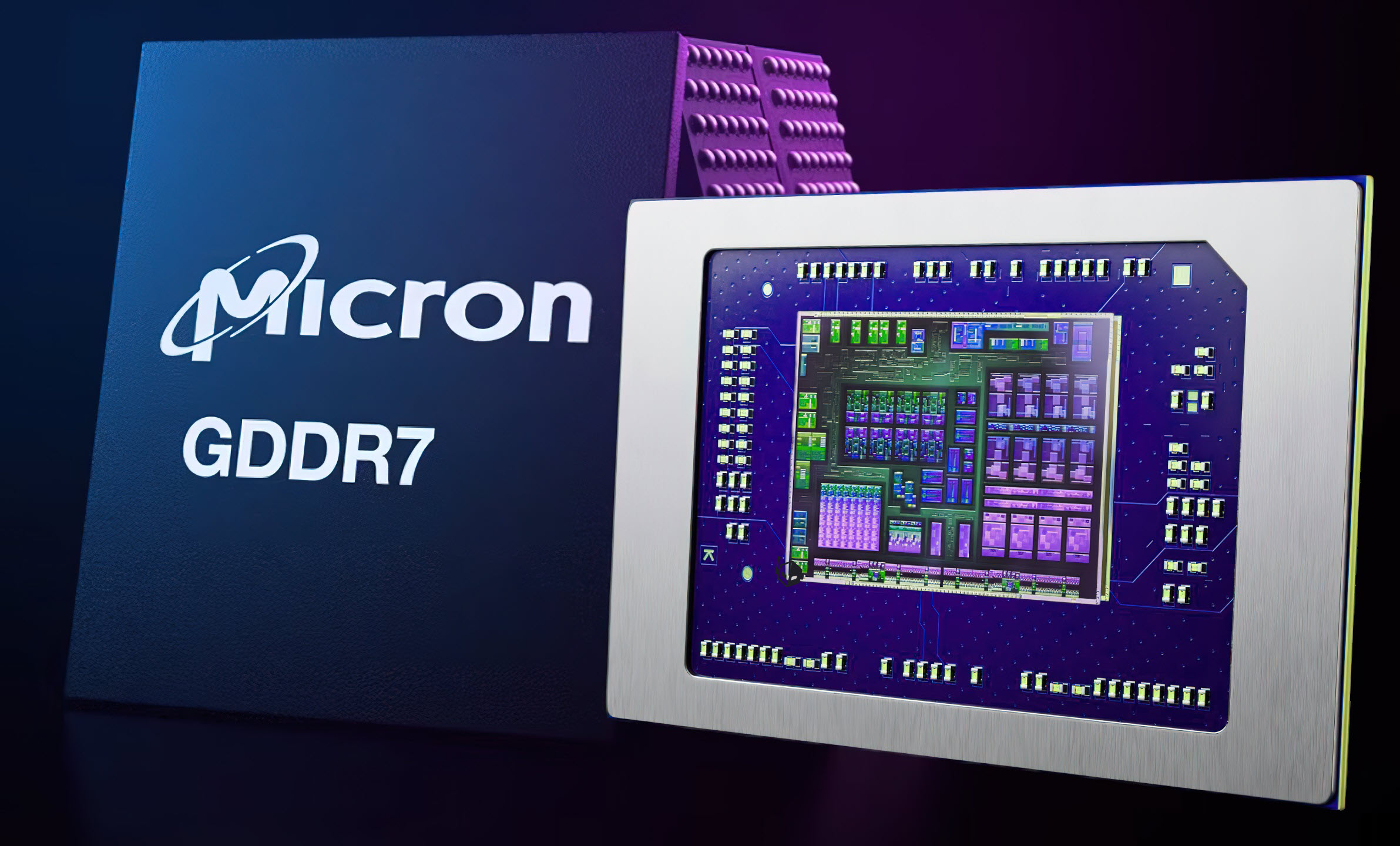
A recent entry in the NBD logistics and shipping database has sparked intrigue by listing GDDR7 memory from Micron as part of a forthcoming CPU. This revelation has led to speculation that AMD—or perhaps another tech giant—might be gearing up to introduce an APU equipped with on-package GDDR7 memory.
The new GDDR7 DRAM substantially boosts bandwidth, nearly doubling the capacity of its predecessor, GDDR6. This next-gen memory is set to become the standard for upcoming GPUs, including NVIDIA’s anticipated Blackwell-based RTX 50 series. Micron’s GDDR7 memory, unveiled a few months ago, offers impressive speeds of 32 Gbps, delivering up to 1.5 TB/s of bandwidth. Notably, it also promises a 30% improvement in game performance across various PC resolutions and is designed for cutting-edge applications, including AI at the Edge and AI PC platforms.
Currently, AMD is a frontrunner in the “AI PC” SoC space, making waves with its innovative “Phoenix” APUs that include an AI chip with an NPU. The company continues to refine its technology with the Hawk Point APUs and the upcoming Strix series, which boasts up to 55 TOPS of AI compute. The Strix Halo APUs, for instance, are expected to feature a chiplet design incorporating up to 16 Zen 5 cores and 40 RDNA 3.5 GPU cores. This significant number of GPU cores necessitates substantial bandwidth, and while the Strix Halo chips include an onboard LLC solution with 32 MB MALL, additional bandwidth will be crucial for the high-performance integrated GPU. These chips are also set to support LPDDR5X-8533 memory, offering a considerable bandwidth boost, though there have been no reports of these chips featuring an on-package memory solution yet, despite listings of capacities up to 128 GB.
Speculating on future configurations, it’s plausible that we might eventually see GDDR7 memory integrated into specific AMD APUs. Furthermore, AMD is rumored to be utilizing its latest RDNA graphics architecture for the upcoming Sony PlayStation 5 Pro, which is anticipated to launch soon. Early leaks hint at a larger GPU and faster memory for the PlayStation 5 Pro, suggesting that GDDR7 could be the next logical step following the current GDDR6 memory used in standard PlayStation 5 models.
Performance upgrades for the PlayStation 5 Pro are reported to include:
– A 45% improvement in rasterized rendering due to a larger GPU and faster memory.
– A significantly enhanced ray tracing architecture, delivering 2-3x speedup on average, with peaks up to 4x.
– A custom machine learning architecture supporting 300 TOPS at 8-bit, powering the PlayStation Spectral Super Resolution (PSSR) upscaling technique. This is Sony’s version of Multi Frame Super Resolution based on the PlayStation Machine Learning (PSML) algorithm.
– PSSR, an ML-enhanced variant of Temporal Anti-Aliasing Upscaling (TAAU), which requires inputs similar to NVIDIA DLSS or AMD FSR and fully supports High Dynamic Range (HDR) pipelines without the need for per-game training akin to the latest DLSS version.
Although it’s anticipated that AMD will continue to use the existing GDDR6 memory standard, with speeds up to 20 Gbps pin speeds, for its upcoming RDNA 4 “Radeon RX 8000” GPUs, the transition to GDDR7 memory is expected with the RDNA 5 series. While these developments remain speculative at this stage, the prospect of a high-end APU with numerous GPU cores and on-package GDDR7 memory is an exciting possibility that could revolutionize gaming experiences for enthusiasts.