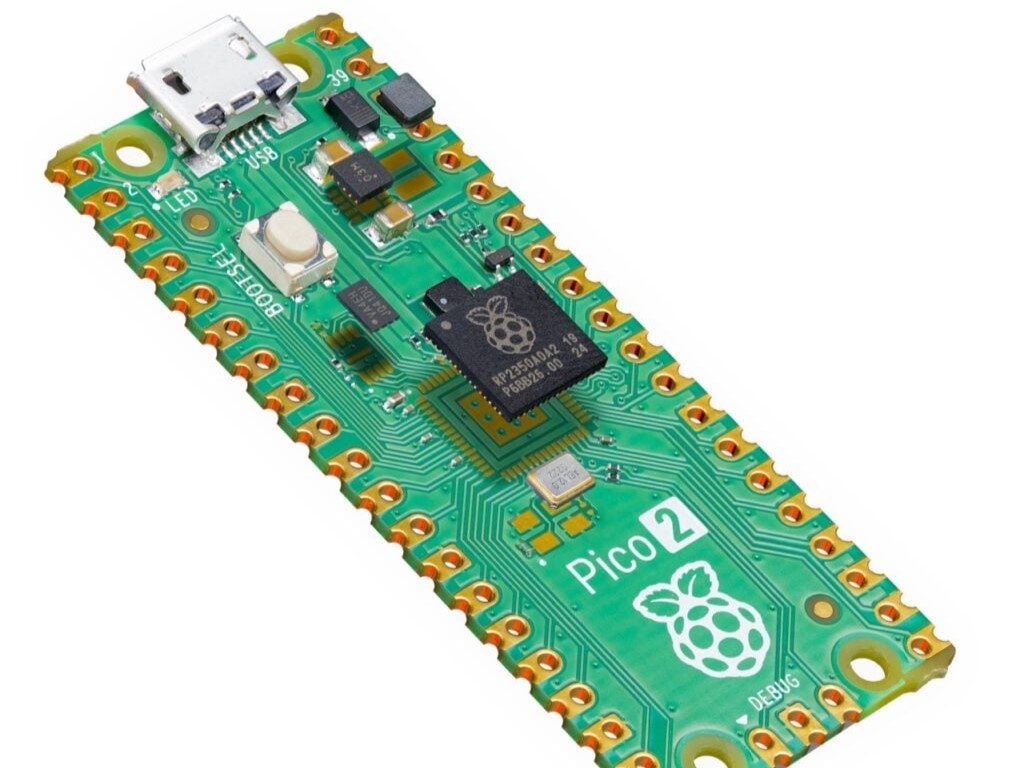
The Raspberry Pi Pico 2 has officially been launched, signaling the next step in the evolution of developer boards. This affordable solution is designed to empower users to bring their inventive projects to life with flexibility and ease. The Pico 2 expands upon its predecessor’s foundations, offering new advances in its hardware, making it a versatile choice for hobbyists and professionals alike.
The Raspberry Pi Pico 2 stands out with its unique computing chip, the RP2350, which boasts a dual-core CPU featuring both Cortex-M33 and RISC-V cores. However, the two architectures cannot function simultaneously; users must choose which core to operate at any given time. Despite this, the board is designed with smart recognition capabilities, enabling it to detect the architecture in use based on the libraries stored.
Operating at a frequency of 150 MHz, the board is equipped with 520 kilobytes of SRAM and 4 megabytes of QSPI flash memory for robust performance in various applications. Impressively compact, the Pico 2 measures only 21 x 51 millimeters. It is built to withstand a wide range of operating temperatures, from -20 °C to 85 °C, and features a variable input voltage range of 1.8 to 5.5 volts, making it suited for demanding environments.
The board offers 26 accessible connections, catering to a variety of sensors and actuators to expand project capabilities. Communication protocols include UART and SPI, and it is also outfitted with a USB 1.1 controller for additional connectivity options.
Priced competitively at $5, the Raspberry Pi Pico 2 is an affordable option for those seeking a capable and adaptable development board. The release of the Pico 2 has prompted several third-party manufacturers, such as 4D Systems, Adafruit, Pimoroni, and Seeed, to announce forthcoming products based on the RP2530. This ensures a future ecosystem of compatible components that will further enhance the Raspberry Pi Pico 2’s utility, including integrated displays and expanded input interfaces.
In terms of practical implications, the Raspberry Pi Pico 2 can be a tremendous asset for educational purposes, DIY projects, and even in professional prototyping where cost-effective and customizable computing platforms are required. With its dual-core architecture offering a choice between Cortex-M33 and RISC-V, users have the opportunity to explore different programming environments and optimize their projects for performance or power efficiency.
The Pico 2’s introduction comes in a time where modular and customizable computing solutions are increasingly relevant. Users who engage with this technology may find that it opens doors to developing new skills, understanding embedded systems, and fostering innovation in areas such as IoT devices, home automation, and bespoke gadgets.
Adopting the Raspberry Pi Pico 2 promises to be an enriching experience for enthusiasts and developers who seek to transform their computational concepts into tangible realities. With its mix of capability, affordability, and support from a growing ecosystem, the Pico 2 is poised to become a staple in the world of development boards.