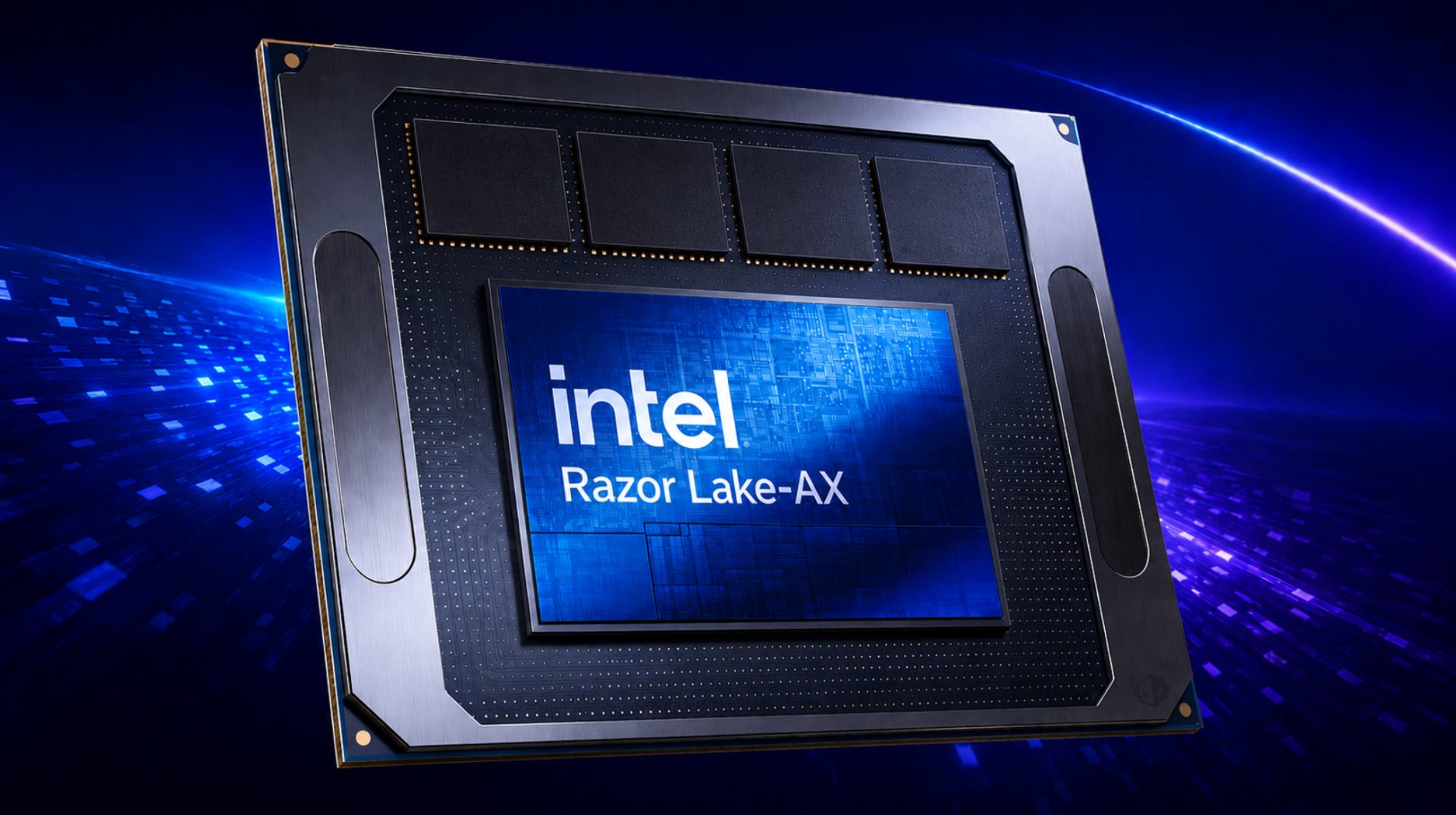
Intel appears to be preparing a major shift for its future high-end laptop chips, with new claims suggesting the company will bring back on-package memory for its next-generation Razor Lake-AX processors. If accurate, this would position Razor Lake-AX as a direct rival to AMD’s upcoming Medusa Halo-class APUs, while also signaling that Intel is leaning into tighter, more efficient system-on-chip designs for premium mobile performance.
On-package memory means the system’s DRAM sits alongside the processor on the same package, rather than being placed separately on the motherboard. Intel last used this approach in Lunar Lake, a low-power mobile-focused design that delivered strong performance within a tight power budget. Now, the same concept could return in a much bigger way—this time aimed at higher-end laptops where bandwidth, efficiency, and compact layouts can translate into real-world benefits.
The main appeal is simple: moving memory physically closer to the chip can improve efficiency and reduce latency, while also enabling slimmer and more power-conscious device designs. It can also simplify motherboard layouts, which is often valuable in thin-and-light premium laptops and compact performance machines.
While the specific memory type hasn’t been confirmed, expectations point toward either LPDDR5X or next-generation LPDDR6. Given that Razor Lake-AX is rumored for a later window—potentially around 2028—LPDDR6 feels like the more natural fit. Higher bandwidth would be especially useful if Razor Lake-AX ships with a significantly larger integrated GPU than typical mainstream laptop CPUs. There’s also speculation that Intel could use its own evolving memory approach, sometimes referenced as ZAM (“Z-Angle Memory”), as a way to showcase newer memory technology and performance advantages in an all-in-one package.
What makes Razor Lake-AX particularly interesting is how it’s being framed compared to standard Razor Lake. Regular Razor Lake is expected to land across desktop and mobile segments around 2027, and it’s described as an optimized variant of Nova Lake. That broader Razor Lake lineup is rumored to use Griffin Cove performance cores paired with Golden Eagle efficiency cores, building on Intel’s ongoing hybrid CPU strategy.
Razor Lake-AX, however, sounds like a different beast. Rather than simply fitting into the usual S, H, and HX laptop categories, AX is expected to target a unique high-end mobile segment with an emphasis on a full SoC-style layout. The expectation is a heavy mix of high CPU core counts and a powerful iGPU, along with embedded cache and additional controllers—choices that can drive strong performance in demanding creator workflows, modern gaming at reasonable settings, and AI-accelerated applications without requiring a discrete GPU in every configuration.
On the graphics side, there’s still uncertainty. Nova Lake is expected to incorporate Xe3 and Xe3P-class integrated graphics, and Razor Lake could follow with a refined Xe3P “Celestial” approach or potentially move forward to Xe4 “Druid,” depending on timing and platform goals. Either way, the rumors point to Intel treating integrated graphics as a centerpiece for the AX line, not an afterthought.
The competitive target is clear: AMD’s Halo-class APUs. AMD currently positions its Strix Halo products at the top of its AI PC APU stack, with additional refreshes expected before Medusa Halo arrives in the 2027–2028 timeframe. If Razor Lake-AX launches in a similar window, it could set up a direct showdown in the “no-compromises” APU category—systems that aim to deliver high CPU and GPU performance with fewer tradeoffs in power and size than traditional laptop designs.
There’s also talk that Intel’s broader strategy could include other custom SoC efforts around the same era, potentially pairing x86 CPU designs with more powerful graphics solutions. Even if those plans evolve, Razor Lake-AX adopting on-package memory suggests Intel is exploring more vertically integrated ways to boost performance per watt and deliver more capability in smaller laptops.
For now, it’s important to treat the details as early information rather than confirmed specifications. Still, the overall direction is compelling: on-package memory, a larger integrated GPU, and a high-end mobile-first SoC design all point to Intel trying to redefine what “integrated” can mean in the premium laptop space—just as AMD is preparing its next Halo generation.