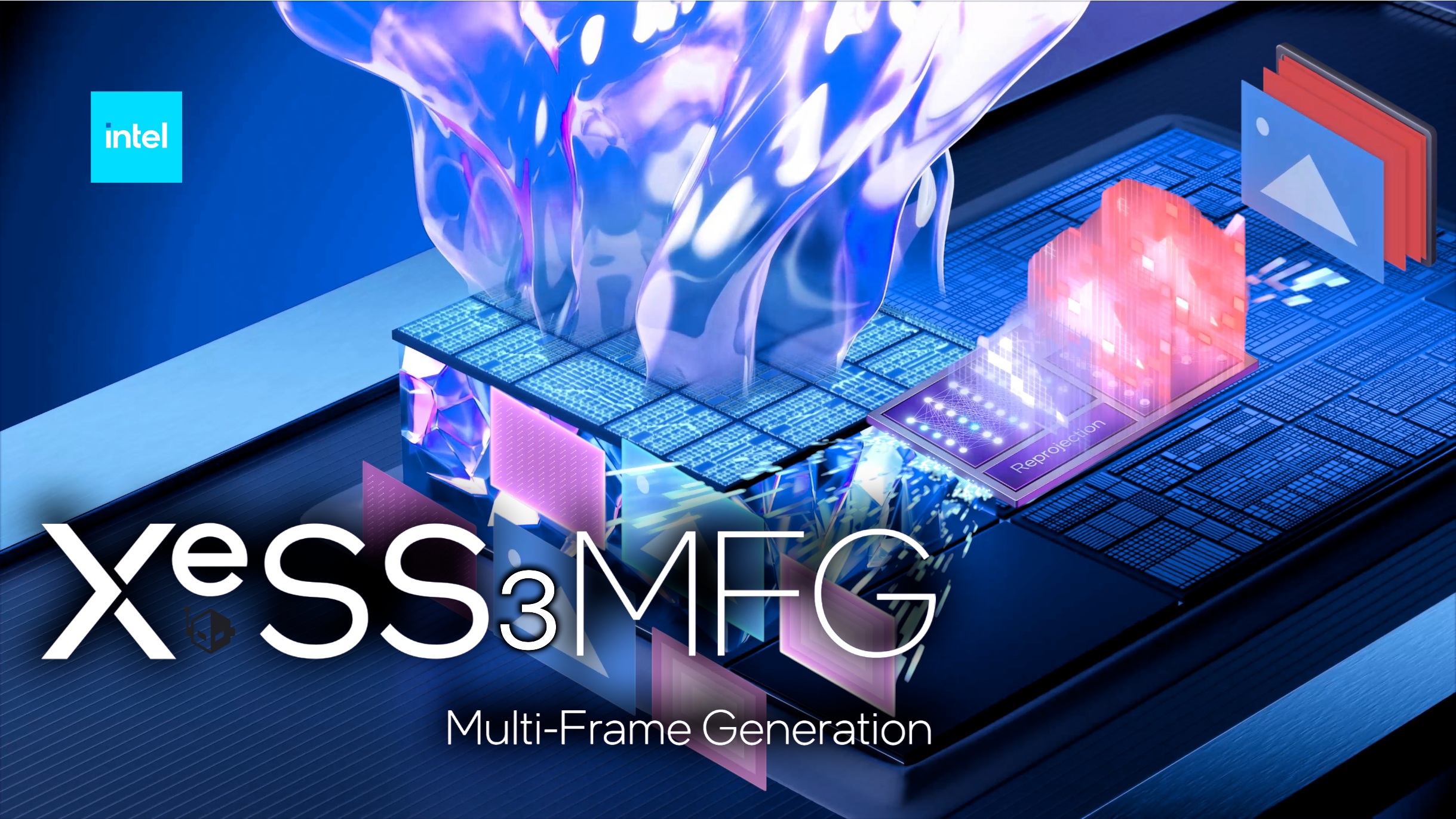
Intel has just taken a big step toward smoother PC gaming with the release of its newest Arc Graphics driver, version 32.0.101.8425/8362. This update officially brings XeSS 3 Multi-Frame Generation (MFG) to Intel’s GPU lineup, and it arrives as a launch driver for the recently released Panther Lake platform featuring Xe3-based integrated graphics like the Arc B370 and Arc B390.
So what is XeSS 3 Multi-Frame Generation, and why does it matter? Intel’s MFG builds on the existing XeSS Frame Generation feature, but pushes performance further by generating more “in-between” frames. Traditional frame generation typically inserts a single synthetic frame between two fully rendered frames. With Multi-Frame Generation, Intel can insert three synthetic frames between every two rendered frames. The goal is straightforward: when a game can’t naturally hit high frame rates, MFG can dramatically boost the perceived FPS, making gameplay feel much smoother and more responsive.
Of course, frame generation isn’t magic, and it doesn’t come without trade-offs. Because MFG relies on generated frames rather than fully rendered ones, you may see visual side effects such as ghosting or artifacts, especially in fast-moving scenes or where image clarity is critical. And since Intel’s XeSS 3 MFG is just rolling out, early versions may show some visual instability depending on the game and settings. Still, when it works well, the 3:1 generated-frame approach can deliver an extremely fluid experience that many players will appreciate, particularly on hardware that struggles to maintain high native frame rates.
One of the most important details is compatibility. Intel’s Multi-Frame Generation support is limited to Intel Arc graphics hardware, which includes both discrete GPUs and supported integrated GPUs across Arc families like Alchemist and Battlemage. The upside is that Intel is enabling this feature across a wider range of products rather than restricting it to only the newest generation.
Even better for gamers, XeSS 3 keeps API backward compatibility. That means games that already support XeSS 2 should be able to work with XeSS 3 features, including Multi-Frame Generation, without needing special game updates. With nearly 50 games already supporting XeSS 2, a sizable library could gain XeSS 3 MFG support right out of the gate—making this driver update particularly meaningful for players looking for immediate performance improvements.
In short, Intel’s latest Arc driver doesn’t just add another checkbox feature. It marks the official start of XeSS 3 Multi-Frame Generation, aiming to deliver higher frame rates and smoother gameplay across a broad set of Arc GPUs, including Panther Lake’s new Xe3-based integrated graphics.