Intel Starfire Space-Grade SoCs Debut With 18A Technology, AI Acceleration, and 10-Year Support
Intel has introduced a new family of space-ready system-on-chips codenamed Starfire, designed to deliver long-term reliability, radiation protection, and modern AI performance for government and aerospace applications. Built with Intel’s advanced 18A process technology, these chips are engineered for environments where standard commercial processors simply cannot survive.
Space-grade computing demands far more than raw performance. Hardware used in orbit, satellites, defense systems, and other mission-critical platforms must endure radiation exposure, severe temperature swings, and years of uninterrupted operation. Intel’s Starfire SoCs are built specifically for those conditions, combining ruggedized design with efficient processing and graphics capabilities.
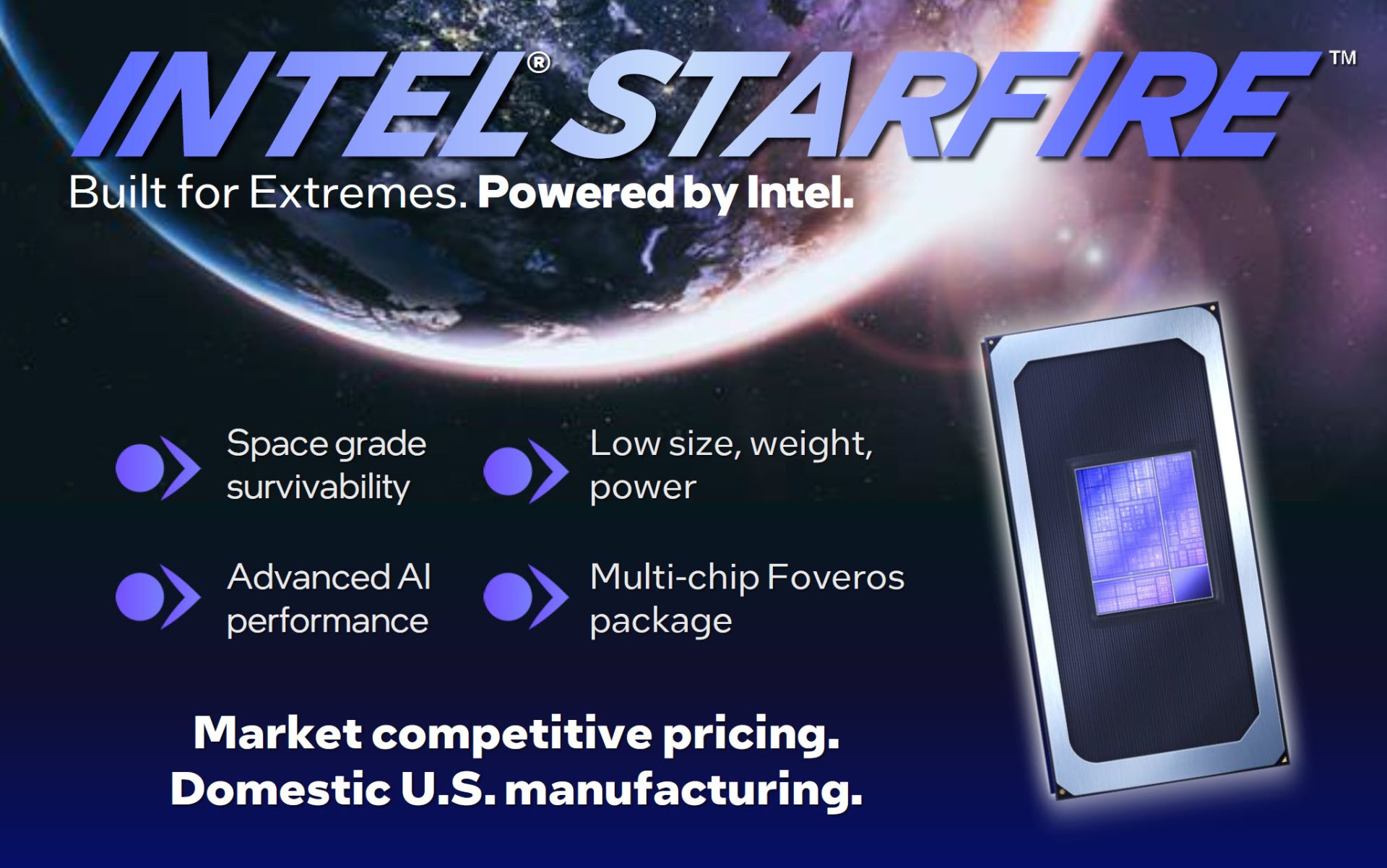
The Starfire platform is manufactured in the United States and is aimed at U.S. government use. Intel says the chips are designed to offer competitive pricing while meeting demanding space-grade requirements. Key priorities include survivability, compact size, low weight, reduced power consumption, AI performance, and advanced multi-chip packaging using Intel’s Foveros technology.
Intel will offer Starfire in two versions: a Low-Power SKU and a Performance SKU. Both versions feature an 8-core CPU layout made up of 4 performance cores and 4 low-power efficiency cores. This hybrid design allows the chips to balance compute capability with energy efficiency, which is especially important in spacecraft and embedded systems where power availability is limited.
The Low-Power Starfire variant runs its performance cores at up to 1 GHz, while its low-power efficiency cores operate at up to 850 MHz. This model is rated at 10 watts, making it suitable for systems where thermal and power limits are strict.
The Performance variant raises the clock speeds significantly, with performance cores reaching up to 3.1 GHz and low-power efficiency cores running at up to 2.1 GHz. This version is rated at 35 watts and targets workloads that require higher compute throughput while still maintaining space-grade durability.
Both Starfire chips are based on a design related to Intel’s Panther Lake 4Xe3 configuration. For graphics, each SoC includes 4 Xe3 integrated GPU cores. The Low-Power model clocks the GPU at up to 1 GHz, while the Performance model increases GPU frequency to up to 2 GHz.
AI acceleration is another major part of the Starfire platform. The chips include an NPU built on Intel’s 18A process, while the integrated GPU is based on Intel 3 technology. In total AI performance, the Low-Power SKU delivers up to 45 TOPS, while the Performance SKU reaches up to 75 TOPS. This gives the platform enough AI capability for edge processing, sensor analysis, autonomous decision-making, and other advanced workloads that may need to happen directly onboard a spacecraft or defense system.
Intel has also focused heavily on protection against radiation-related failures. Starfire includes safeguards for TID, SEL, and SEE effects, all of which are critical concerns in space environments. These protections help reduce the risk of data corruption, system crashes, or permanent hardware damage caused by radiation exposure.
The chips are rated to operate in extreme temperatures ranging from -55°C to 125°C. That wide operating range makes them suitable for harsh environments where thermal conditions can change dramatically.
Connectivity and memory support are also modernized. Starfire SoCs include 12 PCIe Gen4 lanes and support both LPDDR5 and DDR5 memory. This allows system designers to pair the chips with high-speed storage, sensors, accelerators, and memory configurations depending on mission requirements.
Another major advantage is platform longevity. Intel says Starfire chips come with support for more than 10 years, which is essential for aerospace and government programs that often require extended development cycles and long operational lifespans.
With Starfire, Intel is bringing advanced semiconductor technology into one of the most demanding computing markets. By combining 18A manufacturing, hybrid CPU cores, Xe3 graphics, AI acceleration, radiation hardening, and long-term support, the company is positioning these SoCs as a durable and efficient option for future space-grade computing systems.