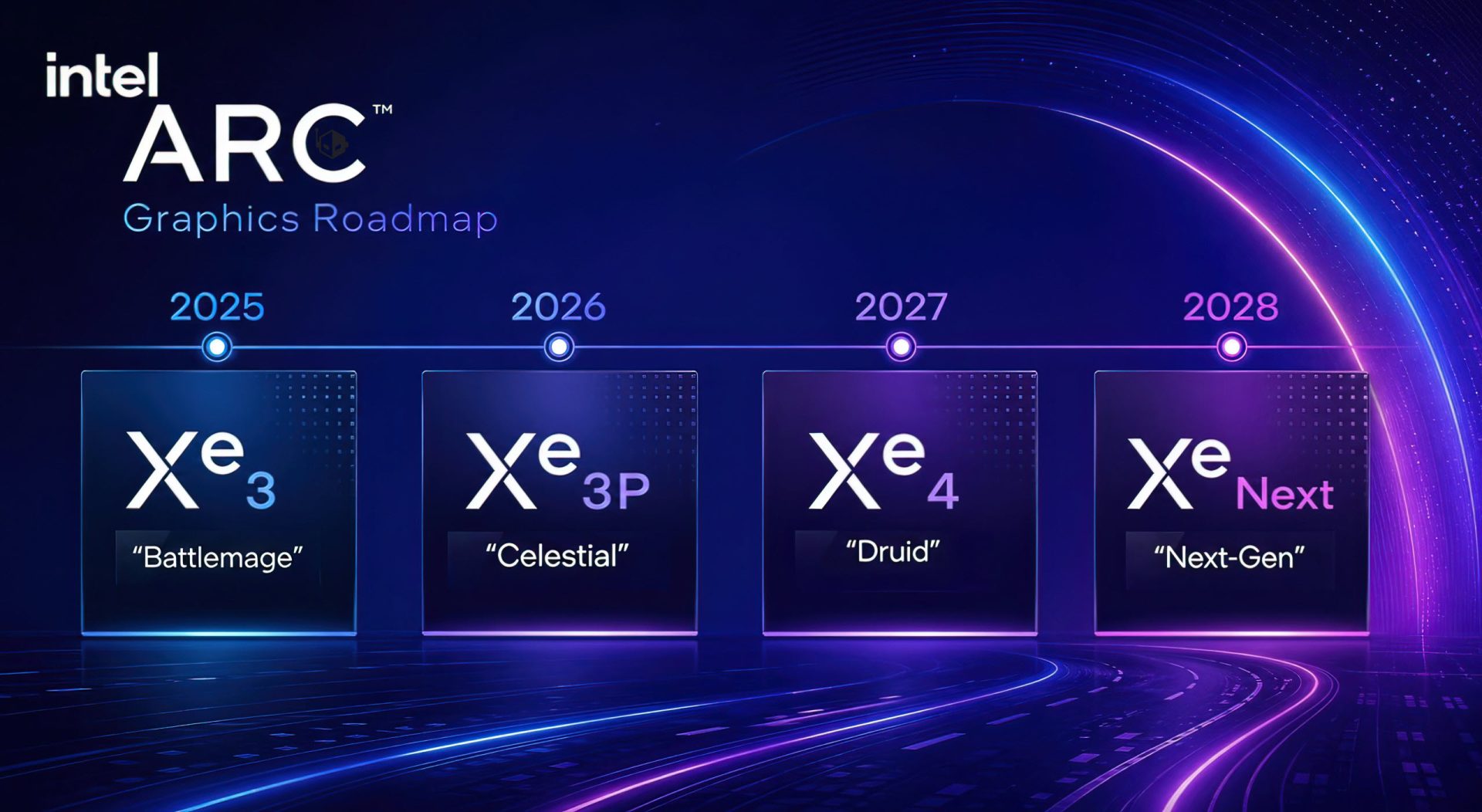
Intel’s next wave of graphics technology is coming into focus, with new details pointing to three upcoming Xe GPU architectures that will shape the company’s integrated graphics and discrete accelerator lineup through 2028. The big takeaway so far: Intel appears to be leaning heavily into iGPUs and AI/workstation-class discrete GPUs, while the future of dedicated Arc gaming cards remains uncertain.
Xe3P in 2026: integrated graphics and AI-focused discrete GPUs, but no gaming card
The first major step on the roadmap is Xe3P, positioned as a follow-up to Xe3 and expected to land in 2026. This architecture is tied to Intel’s “Celestial” graphics direction and is planned to show up in both integrated GPUs (iGPUs) and discrete GPUs (dGPUs), but with a notable omission: there’s no clear sign of a consumer-focused discrete gaming graphics card based on Xe3P.
On the integrated side, Xe3P is expected to play a central role in Intel’s next-generation Nova Lake platform. The roadmap points to multiple mobile configurations and even a desktop option that can scale up to 12 Xe cores. That combination suggests Intel wants stronger built-in graphics performance across laptops and desktops, with a specific goal of competing more aggressively against AMD Ryzen APUs in the mainstream desktop market.
On the discrete side, Xe3P is associated with “Crescent Island” and “Crescent Island Workstation,” which are aimed at AI and professional workloads rather than gaming. A key detail here is memory: these discrete solutions are said to rely on LPDDR5X (LP5X) instead of HBM, a move that would reduce costs and could help Intel deliver more power-efficient AI acceleration for certain deployment types. This positioning mirrors Intel’s recent push into professional graphics and AI-oriented products rather than chasing high-end enthusiast gaming performance with every generation.
Xe4 in 2027: the “Druid” era and a serious AI accelerator push
After Xe3P, Intel’s Xe4 architecture is expected to arrive in 2027. This generation is linked to future platforms such as Titan Lake (and possibly Hammer Lake) and is associated with the “Druid” series branding.
Where Xe4 gets especially interesting is the discrete AI side. The architecture is also expected to power Intel’s next-generation Jaguar Shores rack-scale AI accelerator. Unlike the cost-optimized approach described for Crescent Island, Jaguar Shores is expected to go straight for high-bandwidth memory, with HBM4 mentioned as a key component, paired with an advanced manufacturing node (likely Intel 18A). That combination signals a clear intent to compete more directly in data-center and large-scale AI infrastructure, where memory bandwidth and performance-per-watt matter as much as raw compute.
As for gaming GPUs based on Xe4, the outlook is still unclear. The information suggests it’s not fully decided, though the possibility of some gaming-oriented options hasn’t been ruled out.
A new Xe architecture in 2028 (not necessarily “Xe5”)
Looking further ahead, Intel is also planning a successor to Xe4 targeting mid-to-late 2028. Interestingly, it may not be called “Xe5” at all. The naming is still undecided, and updates may not surface until Intel is closer to launch.
This next step is also described alongside successors to Crescent Island and Jaguar Shores in a similar 2028 window, with the Jaguar Shores follow-up expected later in 2028 and expanding into rack-scale deployments.
Why Intel’s GPU naming and roadmap feels messy
Part of what makes Intel’s GPU timeline difficult to follow is that the company’s architecture names and product codenames have shifted over time. Earlier expectations pegged Xe2 as Battlemage, Xe3 as Celestial, and Xe4 as Druid, with an additional next-gen effort using another codename. But subsequent changes blurred those lines, including references suggesting Battlemage ended up spanning more than one architectural step and that “Celestial” became associated with Xe3P rather than a straightforward Xe3-to-Xe4 progression.
The result is a roadmap where the numbering doesn’t always align neatly with the branding, and where the same label may have been used in different contexts over time. That said, the Arc era’s earlier naming has been more consistent, with Xe1 tied to Alchemist, and Xe4 still most commonly connected to Druid.
What this means for PC gamers and creators
If these plans hold, Intel’s near-term momentum looks strongest in two places: integrated graphics inside mainstream CPUs, and discrete GPUs aimed at AI and workstation markets. For everyday users, better iGPUs in upcoming laptop and desktop chips could be meaningful—especially if Intel’s 12 Xe-core configurations deliver strong real-world gains in games, creative apps, and media workloads without needing a separate graphics card.
For gamers waiting on clear next-generation Arc gaming GPUs, the roadmap is less satisfying. Xe3P appears to skip a consumer gaming dGPU, and Xe4 gaming plans remain uncertain. Even so, Intel’s continued investment in Xe architectures through 2028 suggests the company is still building toward a larger graphics future—just one that, at least for now, prioritizes AI acceleration and integrated performance improvements over a predictable cadence of gaming graphics cards.