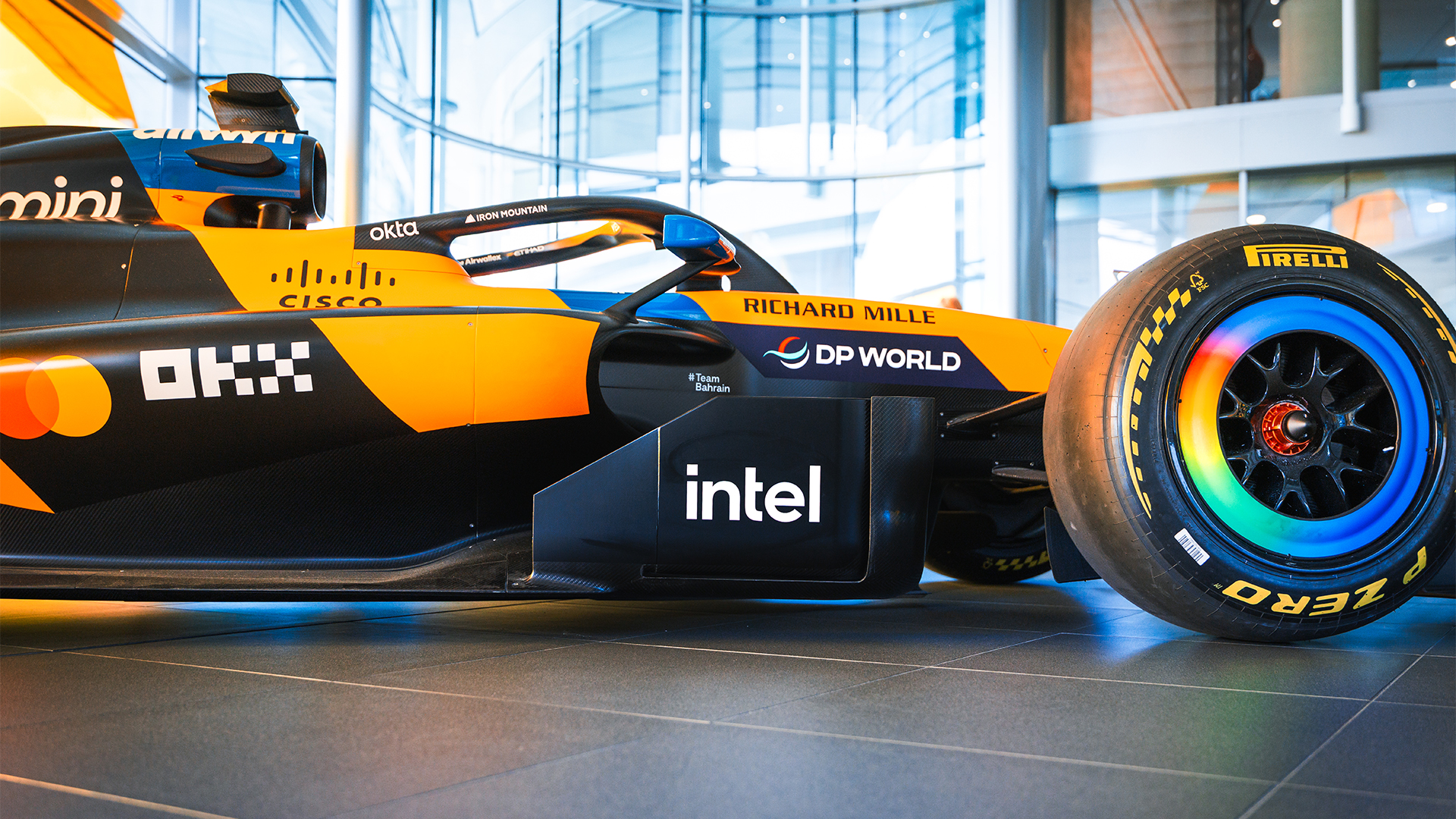
Intel Returns to Formula 1 as Official Compute Partner for McLaren Racing
Intel is heading back to the Formula 1 paddock through a new multi-year strategic partnership with McLaren Racing, bringing its x86 computing technology to one of the most data-driven environments in global motorsport.
Under the agreement, Intel has been named the Official Compute Partner of the McLaren Mastercard Formula 1 Team, the Arrow McLaren IndyCar Team, and the McLaren F1 Sim Racing Team. The partnership will see Intel processors and computing platforms support McLaren’s demanding workloads across race strategy, simulation, aerodynamics, vehicle development, and real-time trackside operations.
The deal highlights just how important advanced computing has become in modern racing. Formula 1 and IndyCar teams depend on massive amounts of data collected from sensors, simulations, telemetry systems, and race-day analytics. Every lap generates information that can influence strategy, car setup, tire management, and driver performance. In a sport where milliseconds can decide a podium finish, faster computing can translate directly into a competitive advantage.
Intel Xeon and Intel Core Ultra processors will be used to power key McLaren workloads, including computational fluid dynamics, aerodynamic modeling, vehicle dynamics simulation, predictive analytics, and digital twin technologies. These systems help engineers test ideas, analyze car behavior, and make rapid decisions without always needing to rely on physical track testing.
A major focus of the collaboration will be real-time decision-making. During a race weekend, McLaren engineers at the track and at the McLaren Technology Centre in Woking need to process information instantly. Intel’s compute platforms are expected to support low-latency edge computing, allowing race teams to analyze live data and respond quickly to changing track conditions, tire degradation, weather shifts, safety car periods, and competitor strategies.
Artificial intelligence will also play a key role in the partnership. Intel’s technology will help McLaren accelerate design cycles, improve predictive modeling, and enhance simulation workflows. AI-driven insights can assist engineers in identifying performance opportunities earlier, refining aerodynamic concepts, and improving the efficiency of race preparation.
The partnership comes as technology alliances become increasingly important across Formula 1. Racing teams are no longer competing only on engines, aerodynamics, and driver skill. They are also competing on data infrastructure, software platforms, AI models, and computing performance. From the factory to the pit wall, advanced technology is now deeply connected to race-day results.
Intel and McLaren plan to co-engineer solutions designed to improve performance, efficiency, and sustainability. This could include more optimized computing systems for simulations, better energy efficiency in data-heavy workloads, and smarter infrastructure for race operations.
As part of the agreement, Intel branding will appear on McLaren Formula 1 cars beginning with the Montreal race next weekend. The branding will also be featured on Arrow McLaren IndyCar cars at the Freedom 250 in Washington, D.C., and at the Indianapolis 500 in 2027. Starting next season, Intel branding will also appear on the virtual McLaren F1 Sim Racing Team car and its on-stage simulator.
The partnership also adds another interesting layer to the technology rivalry in motorsport. While McLaren is teaming with Intel for compute power, Mercedes has a technology partnership involving AMD. That makes the competition between major chip companies visible not only in data centers and consumer PCs, but also on the world’s fastest racing circuits.
For McLaren, the Intel partnership represents another step toward deeper integration of AI, simulation, and high-performance computing in motorsport. For Intel, it is a high-profile opportunity to showcase its processors in an environment where speed, reliability, and precision are essential.
In modern Formula 1 and IndyCar racing, performance is no longer found only in the engine bay or wind tunnel. It is also found in the data center, at the trackside edge, and inside the systems that help teams turn information into winning decisions. With Intel now powering McLaren’s compute platform, the race for speed extends far beyond the circuit.