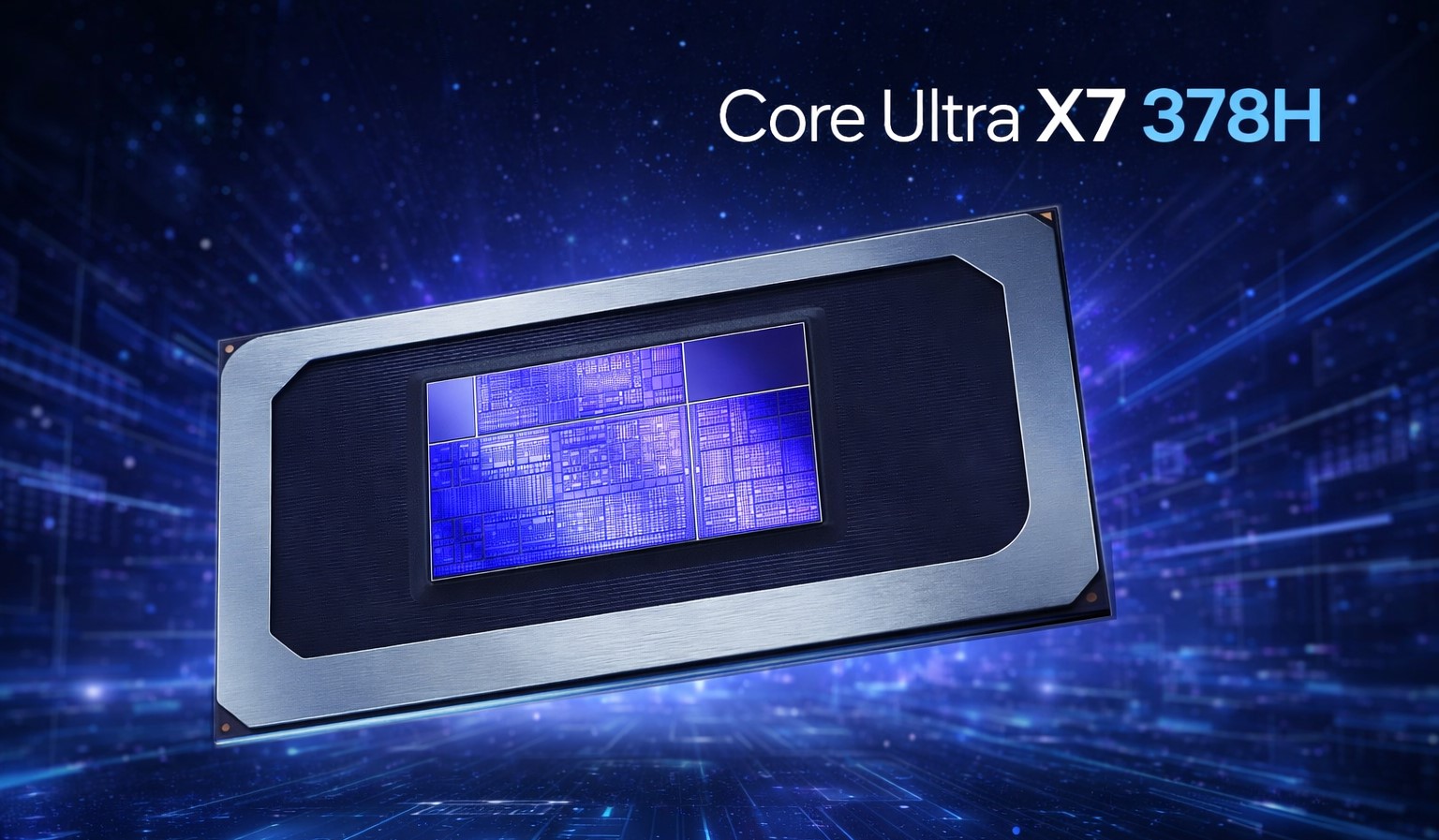
Intel is expanding its Panther Lake processor lineup again, and the latest addition is a new Core Ultra X7 model that looks familiar in almost every way. The newly listed Intel Core Ultra X7 378H has appeared on Intel’s official product pages, joining the growing family of Core Ultra laptop chips that are expected to power next-generation consumer notebooks.
What makes the Core Ultra X7 378H interesting isn’t a big leap in performance or a new feature set. Instead, it’s how closely it mirrors an existing processor. Based on the published specifications, the Core Ultra X7 378H sits above the Core Ultra X7 368H and below the Core Ultra X9 388H in naming and positioning, but on paper it’s essentially the same silicon as the 368H.
The key difference is market focus. While the Core Ultra X7 368H includes support for embedded usage, the Core Ultra X7 378H does not. In practical terms, that means the 378H is intended strictly for consumer platforms such as mainstream laptops, rather than embedded systems aimed at industrial, commercial, or long-lifecycle deployments. For buyers, it’s a reminder that Intel’s model numbers don’t always indicate different performance tiers; sometimes they signal different platform eligibility and sales channels.
Looking at the specs, the Core Ultra X7 378H is a 16-core, 16-thread processor using a hybrid core setup. It includes 4 performance cores (P-cores), 8 efficiency cores (E-cores), and 4 low-power efficiency cores (LP E-cores), a configuration designed to balance fast burst performance with better efficiency during lighter workloads. Intel lists a maximum boost clock of up to 5.0 GHz, along with 18 MB of L3 cache.
Power targets match what you’d expect from a high-performance H-class laptop chip. The processor is rated for 25W base power, scaling up to 80W maximum turbo power depending on laptop cooling and manufacturer tuning. That wide power range is important for real-world performance, because the same chip can behave very differently in a thin-and-light laptop versus a larger performance notebook with stronger thermal headroom.
Graphics are also unchanged compared to the Core Ultra X7 368H. The Core Ultra X7 378H includes Intel’s Arc B390 integrated GPU with 12 Xe3 cores, positioning it as a capable option for modern media workloads, creative tasks, and light-to-moderate gaming without requiring a dedicated graphics card in some systems.
For now, the Core Ultra X7 378H reads like a consumer-only version of the Core Ultra X7 368H, sharing the same core count, clocks, cache, power limits, and integrated graphics configuration. If you’re shopping for upcoming Panther Lake laptops, the takeaway is simple: don’t assume the higher number automatically means higher performance—check whether the model’s differences are about usage categories (consumer vs embedded) rather than raw specs.