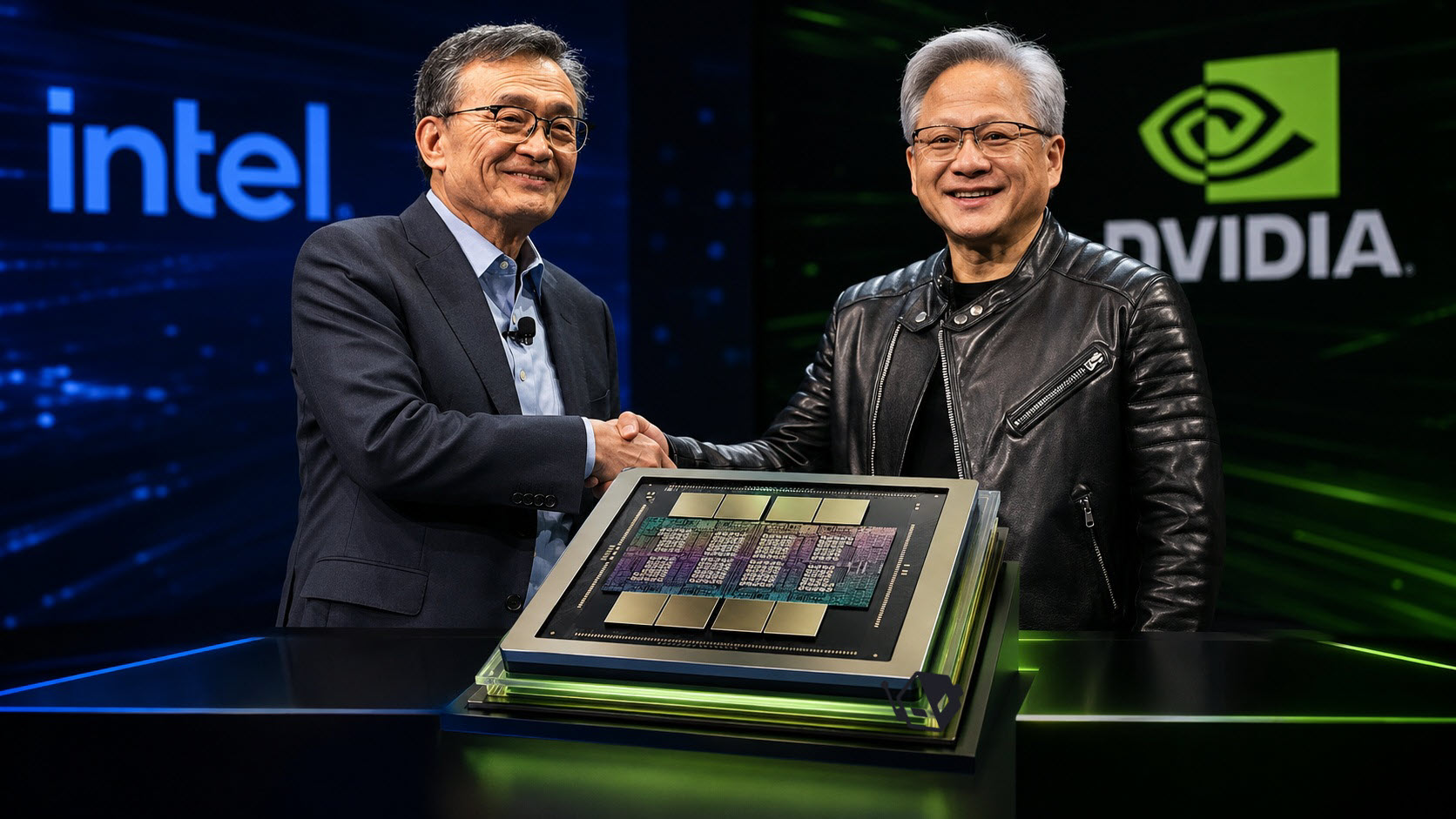
Intel Foundry could score a major NVIDIA deal for next-generation Feynman AI GPUs
Intel Foundry may be closing in on one of its most important customer wins yet, with NVIDIA reportedly expected to use Intel’s wafer supply and advanced packaging technologies for its future Feynman GPUs. If the deal moves ahead as rumored, it could mark a major turning point for Intel’s contract manufacturing ambitions and give NVIDIA more production flexibility for its fast-growing AI hardware roadmap.
The Feynman GPU generation is expected to arrive after NVIDIA’s Rubin platform, with a possible launch window around 2028. These chips are widely expected to play a major role in NVIDIA’s next wave of data center and artificial intelligence accelerators, making the manufacturing partnership behind them especially important.
Intel Foundry may support both wafers and advanced packaging
The reported agreement is not just about basic chip production. Intel is said to be in line to provide both wafer support and advanced packaging services for NVIDIA’s Feynman GPUs. That combination would be a significant win because future AI accelerators are becoming increasingly dependent on complex multi-chip designs, high-bandwidth memory integration, and advanced interconnect technologies.
Intel CEO Lip-Bu Tan recently discussed the company’s increased capital spending during Intel’s earnings call, explaining that the investment reflects confidence in customer demand across multiple business units. He also pointed to long-term agreements as a reason Intel is preparing more capacity for the years ahead.
While Intel has not named the customer involved, the timing and nature of the investment have fueled speculation that NVIDIA could be one of the major names behind the push. Tan also emphasized that Intel is investing in advanced packaging, including EMIB-T, which is expected to be a key technology for future high-performance chip designs.
Why NVIDIA Feynman GPUs matter
NVIDIA’s Feynman generation is expected to follow Rubin and Rubin Ultra, placing it several years ahead on the company’s AI GPU roadmap. While exact specifications remain unconfirmed, Feynman is expected to bring major architectural changes, including possible 3D die stacking, a new generation of high-bandwidth memory, and a new host CPU platform reportedly known as Rosa.
That would make Feynman far more than a simple GPU refresh. It could become a highly advanced AI computing platform designed for massive data centers, large language models, scientific computing, and next-generation accelerated workloads.
NVIDIA’s current and upcoming roadmap is already packed with major platforms. Blackwell is driving the current AI accelerator cycle, Rubin is expected to take over afterward, and Feynman could represent the next major leap. Because demand for AI compute continues to rise sharply, NVIDIA will likely need every manufacturing and packaging option available to keep supply aligned with customer demand.
Intel’s EMIB-T and Foveros Direct3D could be key technologies
One of the biggest reasons Intel Foundry may be attractive to NVIDIA is its advanced packaging portfolio. Intel has been developing EMIB-T and Foveros Direct3D, two technologies aimed at connecting and stacking chips efficiently in high-performance designs.
Foveros Direct3D enables vertical chip stacking, allowing different dies to be placed on top of each other. This is important for future AI processors because it can improve density, bandwidth, and performance while helping manage space and power efficiency.
EMIB-T is designed to connect multiple chiplets with high-speed interconnects. For a massive AI GPU platform, this kind of technology can help bridge compute tiles, memory interfaces, and other components in a more flexible way. Reports suggest Intel’s EMIB-T may offer attractive cost, yield, and design flexibility advantages, especially as AI chips become larger and more complex.
For NVIDIA Feynman, a combination of EMIB-T and Foveros Direct3D could support a more advanced chiplet-based GPU design. Instead of relying on a single large monolithic die, NVIDIA could connect multiple tiles and stack components in ways that improve performance and scalability.
Intel 14A could compete for next-generation AI chips
Another important part of the rumored deal is the process node. NVIDIA Feynman is expected to arrive around the time when new angstrom-class manufacturing technologies become available. Intel 14A and TSMC A14 are both expected to be part of that future competition.
Intel has reportedly accelerated its 14A plans, with volume production now expected around 2028. That timing lines up closely with the expected arrival of NVIDIA Feynman. If Intel can deliver 14A on schedule with competitive performance, power efficiency, and yields, it could become a serious option for advanced AI chips.
This would be a major achievement for Intel Foundry. The company has been working to prove that it can compete for top-tier external customers, especially in high-performance computing and artificial intelligence. Landing NVIDIA for a future AI GPU platform would send a strong message to the semiconductor industry.
NVIDIA may want more supply beyond TSMC
NVIDIA has relied heavily on TSMC for its most advanced GPUs, and TSMC remains one of the most important semiconductor manufacturers in the world. However, AI chip demand has grown so quickly that supply constraints have become a major challenge.
Advanced wafers and packaging capacity are now among the most valuable resources in the tech industry. NVIDIA’s AI accelerators require not only cutting-edge process nodes but also complex packaging solutions for high-bandwidth memory and multi-die integration. As demand continues to surge, having a second major manufacturing and packaging partner could help NVIDIA reduce bottlenecks.
Intel may be offering exactly what NVIDIA needs: additional advanced capacity, competitive packaging technology, and manufacturing based in the United States. That could make Intel Foundry an appealing partner, especially as governments and major technology companies look to diversify semiconductor supply chains.
Intel and NVIDIA are already working more closely
The rumored Feynman agreement would not come out of nowhere. Intel and NVIDIA have already been building a closer relationship.
Intel is expected to develop custom Xeon processors that integrate NVIDIA’s NVLink interconnect technology. NVIDIA has also introduced systems that pair its AI platforms with Intel Xeon CPUs, showing that the two companies are increasingly willing to collaborate where it makes business sense.
There have also been reports of Intel client chips featuring NVIDIA RTX graphics technology in future designs. If these partnerships continue to expand, a foundry and packaging agreement for next-generation AI GPUs would be a natural next step.
A potential milestone for Intel Foundry
For Intel, winning NVIDIA’s Feynman business would be one of the biggest validation moments for its foundry strategy. Intel has spent years trying to rebuild confidence in its manufacturing roadmap, and the company has made advanced packaging a central part of its comeback plan.
Under Lip-Bu Tan’s leadership, Intel has taken a more disciplined approach to capital spending. The company has repeatedly suggested that major investments will be tied to real customer demand rather than speculative expansion. That makes the recent increase in spending more notable, especially with Intel pointing to long-term customer agreements and advanced packaging capacity.
If NVIDIA is indeed one of those customers, Intel Foundry could gain a powerful endorsement from the world’s leading AI chip company.
When could an official announcement happen?
Even if the deal is progressing, an official announcement may still be far away. NVIDIA is currently focused on its Blackwell and Rubin platforms, with Feynman expected later in the decade. Any formal confirmation may not arrive until 2027 or 2028, closer to the product’s launch window.
Still, the direction appears clear: next-generation AI GPUs will require more advanced packaging, more wafer capacity, and more flexible manufacturing partnerships. Intel wants to be a major player in that future, and NVIDIA may need the extra capacity to keep up with explosive AI demand.
If the rumored agreement becomes reality, Intel Foundry could secure its most important external customer win yet, while NVIDIA would gain another powerful supply chain option for its future AI GPU roadmap. For the semiconductor industry, it would be a landmark partnership with major implications for AI computing, advanced chip packaging, and the next era of high-performance processors.