Apple’s innovative Hearing Health features for the AirPods Pro 2 have stirred up quite the buzz. With its most recent 7B19 firmware update, the AirPods Pro 2 was packed with features like Hearing Test, Hearing Aid, and Hearing Protection. However, these new functionalities come with a catch—they’re geographically restricted due to regulatory mandates. Unfortunately, fans and users in India find themselves excluded from trying out these much-anticipated features as India is not yet on Apple’s availability list.
But where there’s a will, there’s a way—as demonstrated by a tech-savvy group who wouldn’t take no for an answer. Spearheaded by Rithwik Jayasimha, they embarked on a mission to bypass Apple’s strict geo-restriction as soon as the iOS 18.1 update hit the devices. After acquiring the AirPods Pro 2 for his grandmother, Rithwik realized the functionality he had been excited about wasn’t available in India. Undeterred, he and his dedicated team navigated through Apple’s location-checking methods to devise an ingenious workaround.
The key to their success lay in understanding how iOS determines its geographical presence. It turns out that iOS depends on a GET request to Apple’s servers, the user’s Apple Store location, and the device’s time zone and regional settings to affirm its location. For devices with cellular capabilities, Apple’s system additionally uses GPS data and an internal database of mobile codes (MCC/MNC) matched with the cellular network.
Their initial approach involved a 10th-generation iPad, which only featured Wi-Fi and GPS, eliminating the hassle of MCC/MNC signals. However, manipulating the device’s location proved complex. Altering locale settings, simulating the location through Xcode, and spoofing the GET request all fell short, as the iPad seemed aware of the deception.
A deeper dive revealed that the iPad was pinpointing its locale using GPS, Wi-Fi SSIDs, and MAC addresses of nearby devices—a more challenging task to fake. Despite their attempts to use projects like Skylift ESP32 to mimic Californian SSIDs, the iPad steadfastly recognized it was still in India.
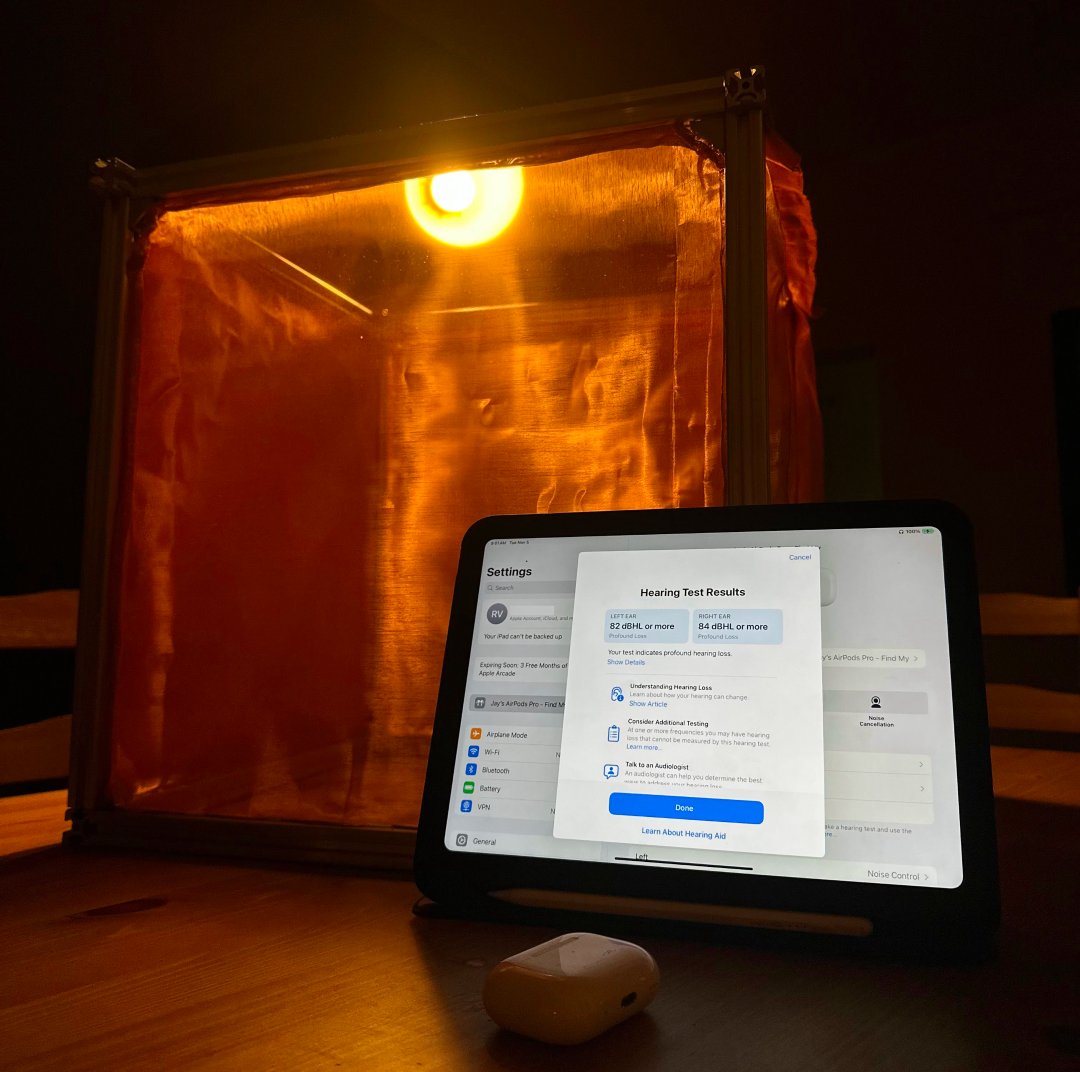
The eureka moment came with the creation of a Faraday cage—a device that blocks electromagnetic waves, widely used in household microwaves. The team crafted their version by wrapping a cardboard box with aluminum foil, placing it over a less-than-perfect microwave. This cage broadcasted Californian SSIDs to the iPad, fooling it into detecting a change in location, finally allowing the AirPods Pro 2’s Hearing Assistance features to activate.
Interestingly, the hearing aid feature turned out to be an accessible equalizer preset, a replacement for the transparency mode available even on older firmware. The breakthrough didn’t stop there. Once activated, the features worked across all devices connected via iCloud without having to repeat the tricky procedure.
To further assist the community, the team developed a more robust Faraday cage and began a small camp at Lagrange Point, offering their insights and assistance to anyone in need. For those holding back on purchasing AirPods Pro 2 due to the cost, Rithwik’s inventive workaround makes them a compelling and affordable alternative to traditional hearing aids.
So if you or someone you know has been eyeing these AirPods for their potential health benefits, reaching out to Rithwik and his team might just be the tech boost you need.