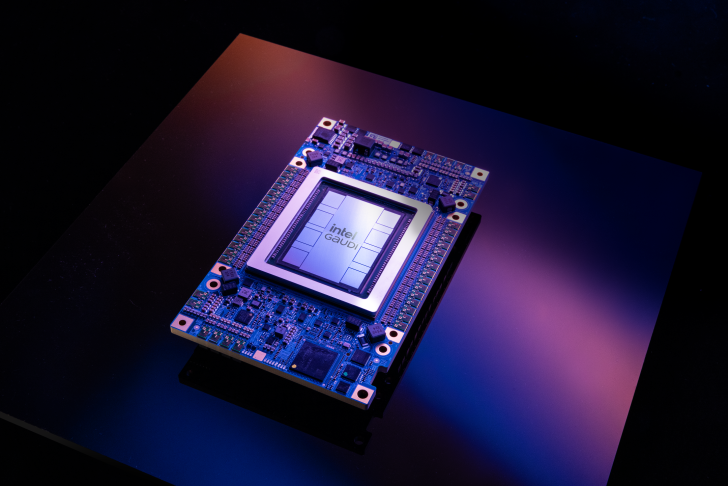
Intel is making waves with its Gaudi 3 AI accelerator, which has now been embraced by IBM Cloud. This marks a pivotal moment as IBM Cloud becomes the first Cloud Service Provider to integrate Gaudi 3 into its offerings, bringing a fresh, cost-effective alternative to the AI market traditionally dominated by NVIDIA.
Intel has faced challenges in the AI sector, struggling to gain significant traction due to its late entry into the AI race. Despite these hurdles, Intel’s partnership with IBM Cloud signifies a strategic move to carve a niche in the industry. IBM Cloud’s decision to include Intel’s Gaudi 3 AI accelerators is aimed at delivering economical AI solutions to its clients and reflects a commitment to making AI advancements more accessible globally.
With the introduction of Gaudi 3, IBM Cloud plans to enhance the scalability of generative AI workloads by optimizing performance specifically for inferencing and fine-tuning tasks. Saurabh Kulkarni, a Vice President at Intel, emphasized the shared mission of making AI more affordable and accessible for enterprises worldwide.
Clients interested in harnessing the computational prowess of the Gaudi 3 AI accelerators can do so via IBM’s Cloud Virtual Servers. Notably, the platform Signal65 has already tested Gaudi 3 alongside NVIDIA’s H100 and H200 GPUs. This marks the first thorough evaluation of Gaudi 3 outside of Intel’s internal tests, revealing its potential to challenge NVIDIA’s position in the AI segment.
Benchmark tests conducted by Signal65 show Intel’s Gaudi 3 surpassing NVIDIA’s H100 and H200 accelerators when running IBM’s Granite (8B) and Meta’s Llama-3.1 models. While these benchmarks are conducted under specific parameters, they indicate that with the right conditions, Gaudi 3 could perform impressively in real-world scenarios.
The tests highlight that Gaudi 3 delivers competitive performance across various configurations, proving its versatility in numerous AI applications. Furthermore, Intel’s Gaudi 3 is offered at a lower price point in IBM Cloud compared to NVIDIA’s options, making it an appealing choice for budget-conscious clients seeking efficient computational power.
In essence, Intel’s Gaudi 3 represents a promising alternative in the AI acceleration arena, especially if accompanied by effective marketing strategies and widespread adoption. While it may not currently rival NVIDIA in terms of fame or sheer performance, Intel’s Gaudi 3 stands as a viable option in the evolving landscape of AI technology.


