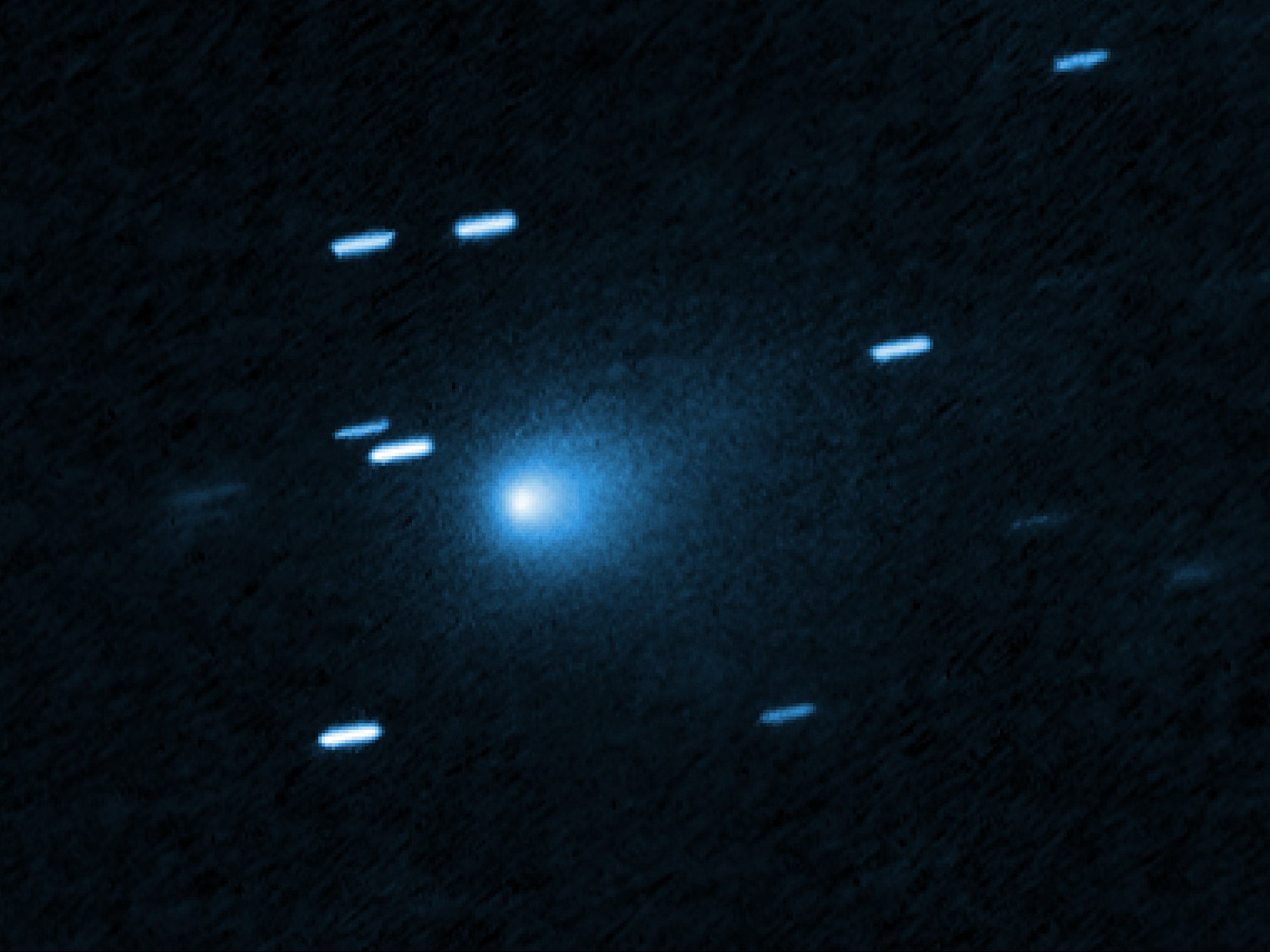
In an exciting astronomical discovery, the interstellar comet 3I/ATLAS made headlines when it was first spotted on July 1, 2025, by the Asteroid Terrestrial-impact Last Alert System (ATLAS), a NASA-backed project developed by the University of Hawai’i. Initially observed with the Gemini North Telescope at a distance of 420 million miles from the Sun, it was the NASA/ESA Hubble Space Telescope’s observations on July 21 that offered a clearer picture of the comet’s properties.
Hubble’s detailed data revealed that the nucleus of 3I/ATLAS may range between an impressive 3.5 miles (5.63 km) in diameter to a more modest 1,000 feet (304.8 m). The telescope captured striking images of the comet, highlighting a dust plume emanating from its Sun-facing side and suggesting a trailing dust tail.
Interestingly, the dust-loss rate identified in Hubble’s findings aligns with typical comets first seen about 300 million miles from the Sun. As these icy bodies approach the Sun, they heat up, causing their frozen material to vaporize and stream away—a phenomenon beautifully illustrated by the dust around 3I/ATLAS.
What sets 3I/ATLAS apart is its breathtaking speed of 130,000 miles per hour (209,215 km/h), a record among its peers. This astonishing speed points to its long journey through interstellar space, with celestial bodies like stars and nebulae gradually boosting its velocity over billions of years.
While there’s much intrigue surrounding this comet, its nucleus remains elusive. NASA is planning further missions to uncover more about its composition and potential secrets. Adding to the intrigue, Harvard professor Avi Loeb has even speculated on the possibility that 3I/ATLAS could be an alien probe.
This discovery not only enriches our understanding of celestial phenomena but also fuels the imagination with its potential insights into the wonders of the universe.