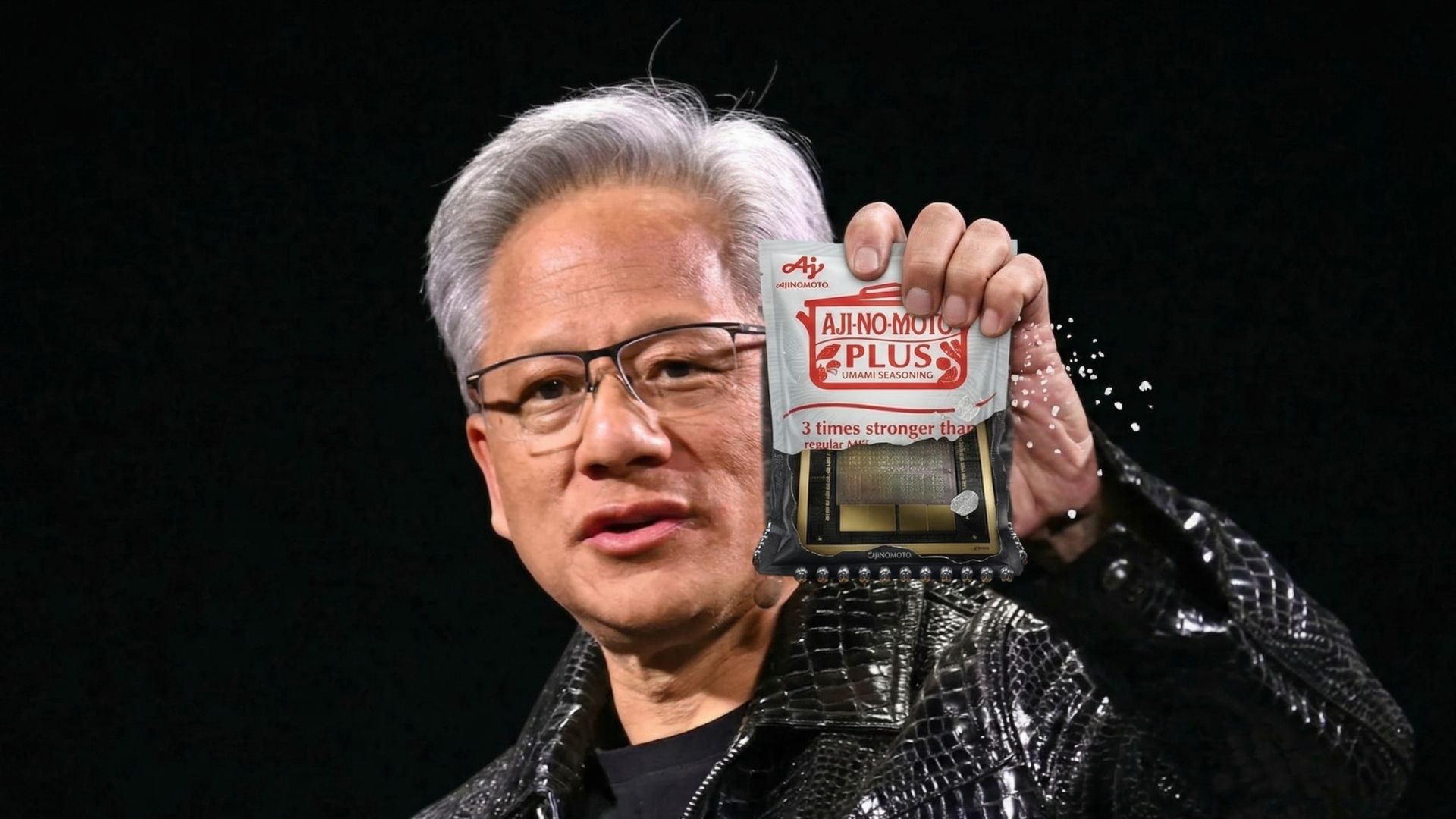
A little-known bottleneck is quietly shaping the pace of the AI boom, and it comes from an unexpected place: the company best known for making MSG. Ajinomoto sits at the center of a material shortage that’s now impacting the advanced packaging needed to ship today’s most powerful AI accelerators.
The material is called ABF, short for Ajinomoto Build-up Film. In simple terms, ABF is a thin insulating film used in advanced semiconductor packaging. It helps connect the silicon die to the package and ultimately to the circuit board, while maintaining the signal integrity and connection density required for modern high-performance chips. As AI GPUs and accelerators push into multi-gigahertz operation and increasingly complex designs, ABF becomes more than a behind-the-scenes component—it becomes essential infrastructure.
Why does ABF matter so much right now? Because AI accelerators consume far more of it than many traditional chips. Compared with other components, AI accelerator packages can use roughly 15 to 18 times more ABF, largely because these packages often require 8 to 16 or more ABF layers depending on size and complexity. As next-generation chips grow larger and more demanding, they typically need more layers and more advanced packaging techniques, making ABF an even tighter constraint.
The supply chain behind ABF-based substrates is complicated, involving multiple companies across different steps. But the critical reality is straightforward: the film itself is the gating item. Ajinomoto’s specialty unit produces the ABF material, substrate makers then build it into the package substrate, and other suppliers handle additional stages before the final accelerator can ship. If the ABF film supply can’t keep up, the rest of the packaging chain can’t fully compensate—finished AI accelerators can’t be delivered without it.
Scaling ABF production isn’t as easy as simply turning up the volume. Increasing output requires new production lines, time, capital, and confidence that demand will stay high enough to justify long-term expansion. Suppliers also face risks tied to manufacturing yields as packages expand in size and complexity. Multi-layer builds can become harder to produce consistently, and advanced processes can introduce yield challenges that ripple through the entire substrate manufacturing flow.
With AI infrastructure demand accelerating faster than traditional planning cycles, major datacenter players have already moved to protect their access to ABF supply. One of the most notable tactics is prepayments and long-term agreements designed to secure allocation and support capacity expansion. But even with those measures, supply is not expected to loosen overnight. When demand spikes this aggressively, not every buyer gets what they want—allocation tends to favor the biggest customers with the longest commitments.
Industry expectations point to ABF demand growing at a double-digit annual rate, with constraints likely lingering across a multi-year window. That makes ABF one of the most important “quiet” shortages in the AI hardware world: not as publicly discussed as GPUs, advanced nodes, or foundry capacity, yet increasingly decisive in determining how quickly the industry can scale advanced packaging and ship the next wave of AI compute.