HomeClaw Max wants to make Home Assistant easier with built-in AI automation
Home Assistant is one of the most powerful smart home platforms available, but its biggest strength can also be its biggest challenge. It offers deep customization, broad device support, and nearly endless automation possibilities, yet setting everything up often requires patience, technical knowledge, and a willingness to tinker.
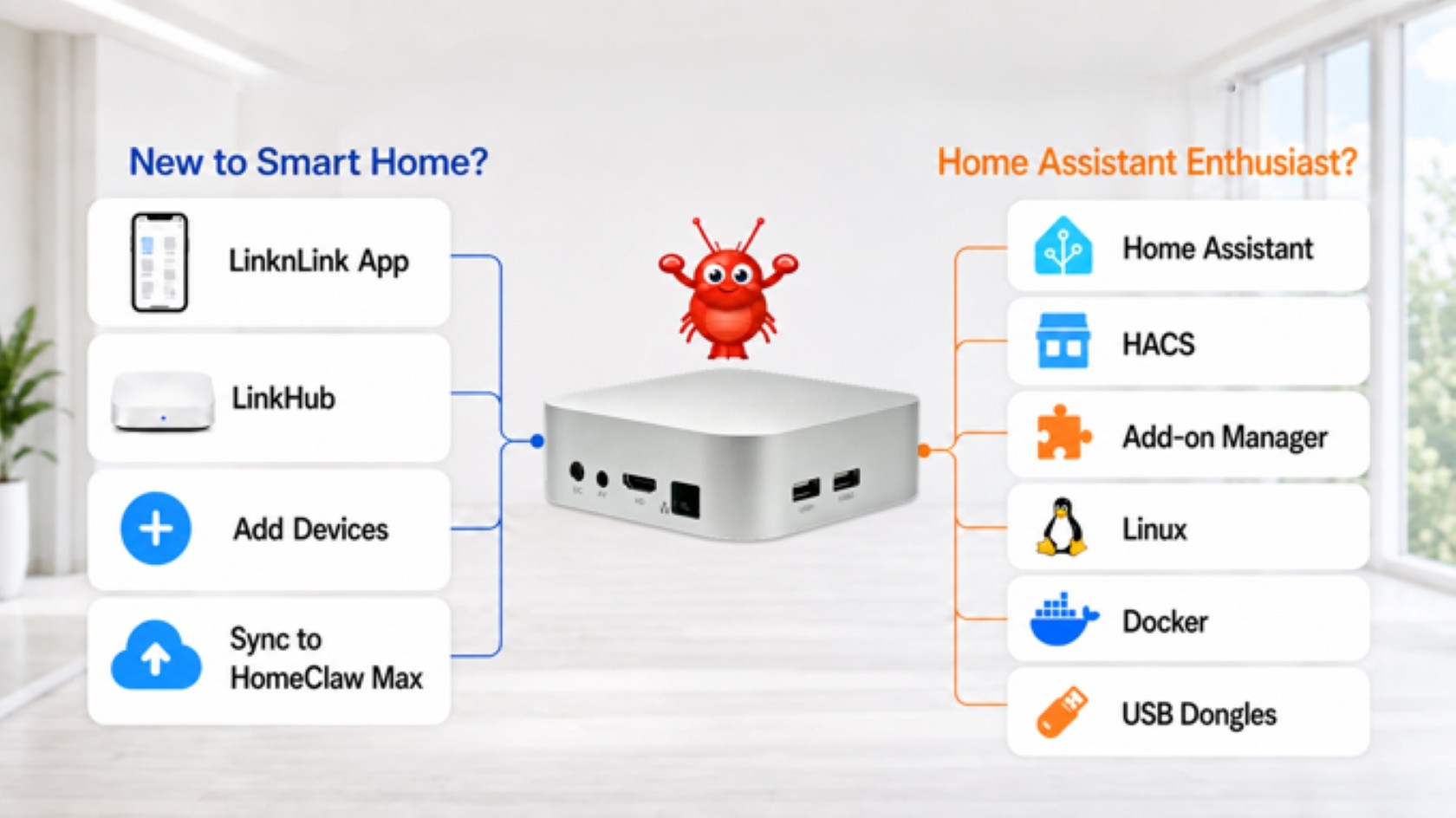
LinknLink is trying to solve that problem with the HomeClaw Max, a compact mini PC designed to combine Home Assistant with an AI-powered setup experience. Instead of manually creating automations or writing configuration code, users should be able to describe what they want their smart home to do, while the built-in AI assistant handles the setup in the background.
The main idea behind the HomeClaw Max is simple: bring the flexibility of Home Assistant to more users by removing some of the complexity. For people who want a smart home hub that can control lights, sensors, climate devices, security hardware, and other connected products without constant manual tweaking, this could be an interesting option.
The device supports AI agents such as Hermes Agent and OpenClaw. These tools are intended to help users create smart home routines through natural language prompts. For example, instead of manually building an automation for nighttime lighting, a user could simply ask the assistant to dim certain lights after sunset, lock compatible doors, and adjust the thermostat. The AI would then attempt to create the needed automation inside the Home Assistant environment.
In terms of hardware, the HomeClaw Max is closer to a basic mini PC than a high-performance computer. It comes with 4 GB of RAM and a quad-core processor running at up to 1.8 GHz. Storage options include 64 GB and 256 GB models. The lower-cost version includes a 100 Mbps Ethernet port, while the higher-end version upgrades that to Gigabit Ethernet.
While these specifications are modest, they should be enough for many Home Assistant installations, especially since smart home hubs typically do not require powerful hardware. One of the strongest advantages is energy efficiency. The HomeClaw Max is designed to consume only around 3 to 5 watts, making it suitable for always-on use. Since a smart home controller is expected to run day and night, low power consumption can be a major benefit over time.
LinknLink also makes it clear that technically skilled users can build a similar setup themselves using a standard mini PC and their own software configuration. The selling point of the HomeClaw Max is not raw hardware value, but convenience. It is aimed at people who want a ready-made Home Assistant mini PC with AI features already integrated, reducing the time needed to get started.
The HomeClaw Max is currently being offered through a crowdfunding campaign. The entry-level model is priced at around $100, while the upgraded version with larger storage is listed at about $170. Shipping is expected to add roughly $17, with deliveries planned to begin near the end of October.
As with any crowdfunded product, buyers should be aware of the risks. Delivery is not guaranteed, final specifications can change, and shipping timelines may shift. Anyone who prefers a more established smart home hub may want to consider premium alternatives, although those usually come at a noticeably higher price.
For users who love the power of Home Assistant but dislike the setup process, the HomeClaw Max could be a practical middle ground. It promises a compact, low-power smart home hub that uses AI to simplify automation, making advanced home control more accessible to users who want flexibility without spending hours on configuration.


