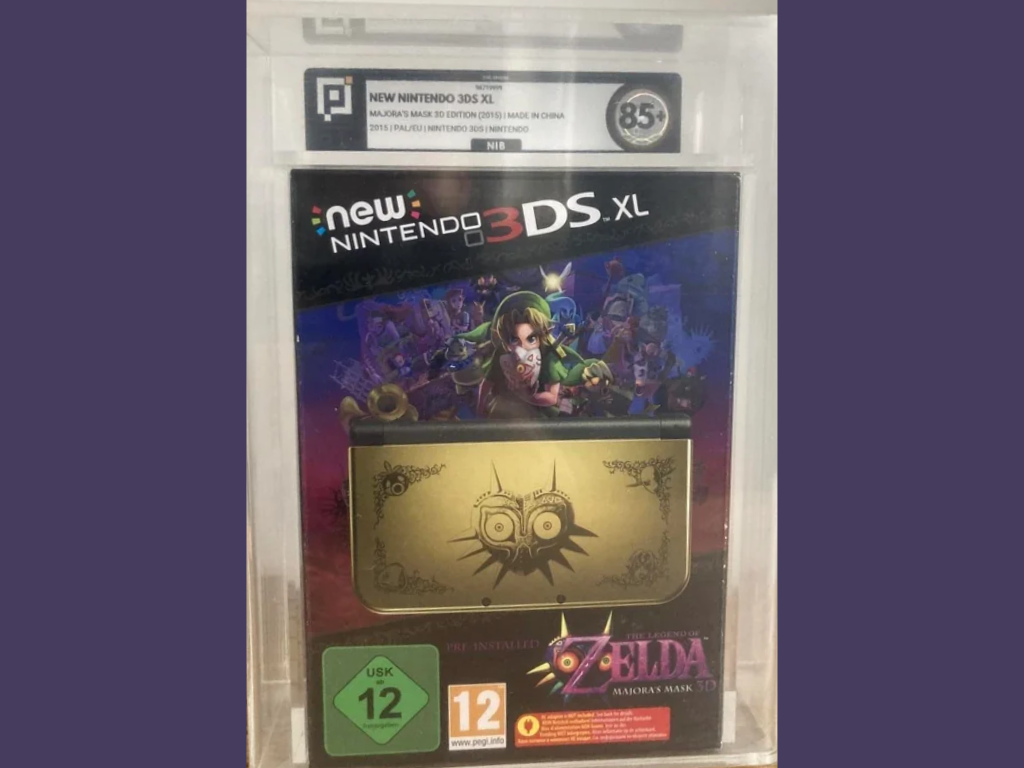
Nintendo 3DS prices have already been climbing fast on the resale market, but some collectors and scalpers are now pushing the trend into even more controversial territory: grading and sealing unopened handheld consoles in acrylic display cases. For many longtime Nintendo fans, it’s a frustrating move that makes a beloved, discontinued system even harder to find at a fair price—and in usable condition.
The latest wave of criticism kicked off after a Reddit post showed two graded and sealed New Nintendo 3DS XL Majora’s Mask Editions bought at a premium. While the buyer didn’t reveal what they paid, similar listings for a Legend of Zelda: Majora’s Mask-themed 3DS XL with a high “silver” grade have been seen in the $1,200 to $1,500 range. That’s a huge leap compared to the already-inflated prices of normal secondhand units, and it’s sparked backlash from gamers who feel the hobby is being reshaped by speculation rather than play.
What really has people upset isn’t only the money. It’s the risk. Unlike trading cards, comics, and game cartridges, portable consoles contain lithium-ion batteries. Locking a battery-powered device inside a sealed acrylic case for long-term storage can be dangerous if the battery swells over time. In worst-case scenarios, swelling can lead to leakage or even an explosion, which is why many gamers argue that sealing brand-new handhelds “for preservation” may actually invite damage instead.
Video game grading has exploded in popularity in recent years, fueled by eye-popping sales of rare games and mint-condition collectibles. Grading companies evaluate an item’s condition and authenticity, then encase it in a hard plastic shell designed for display and long-term “protection.” That approach is common for cards and paper goods, and it has also become common for sealed video games. But applying the same treatment to a battery-powered handheld has raised serious concerns across the community.
In the Reddit example, the featured Majora’s Mask systems were PAL-region units, still fully boxed, now permanently locked behind acrylic after grading. To many fans, it’s the worst of both worlds: working consoles are removed from circulation and turned into untouchable trophies, while the remaining supply of playable systems gets thinner—and more expensive.
That frustration is amplified by the current spread of 3DS pricing. Depending on model and condition, some units can still be found for a few hundred dollars, while rare and limited editions can climb toward four figures. When sealed, graded handhelds start selling at luxury-collectible prices, it can distort the entire market, making it harder for everyday buyers to pick up a 3DS to do what it was designed for: play games.
The reaction online has been blunt, with critics calling the practice wasteful and risky, and others mocking the idea that something becomes “more valuable” only after its primary function is effectively removed. The core complaint is simple: a handheld console isn’t just a museum piece—it’s meant to be played, shared, repaired, and enjoyed. Sealing it away may raise its resale value, but it also pushes the 3DS further from the fans who want it for gaming, not investing.
As interest in retro handhelds keeps growing, this debate isn’t going away. For collectors, the appeal of a pristine, display-ready console is obvious. For players, it feels like another step toward a future where classic gaming hardware becomes a locked-away asset instead of a living part of gaming culture.