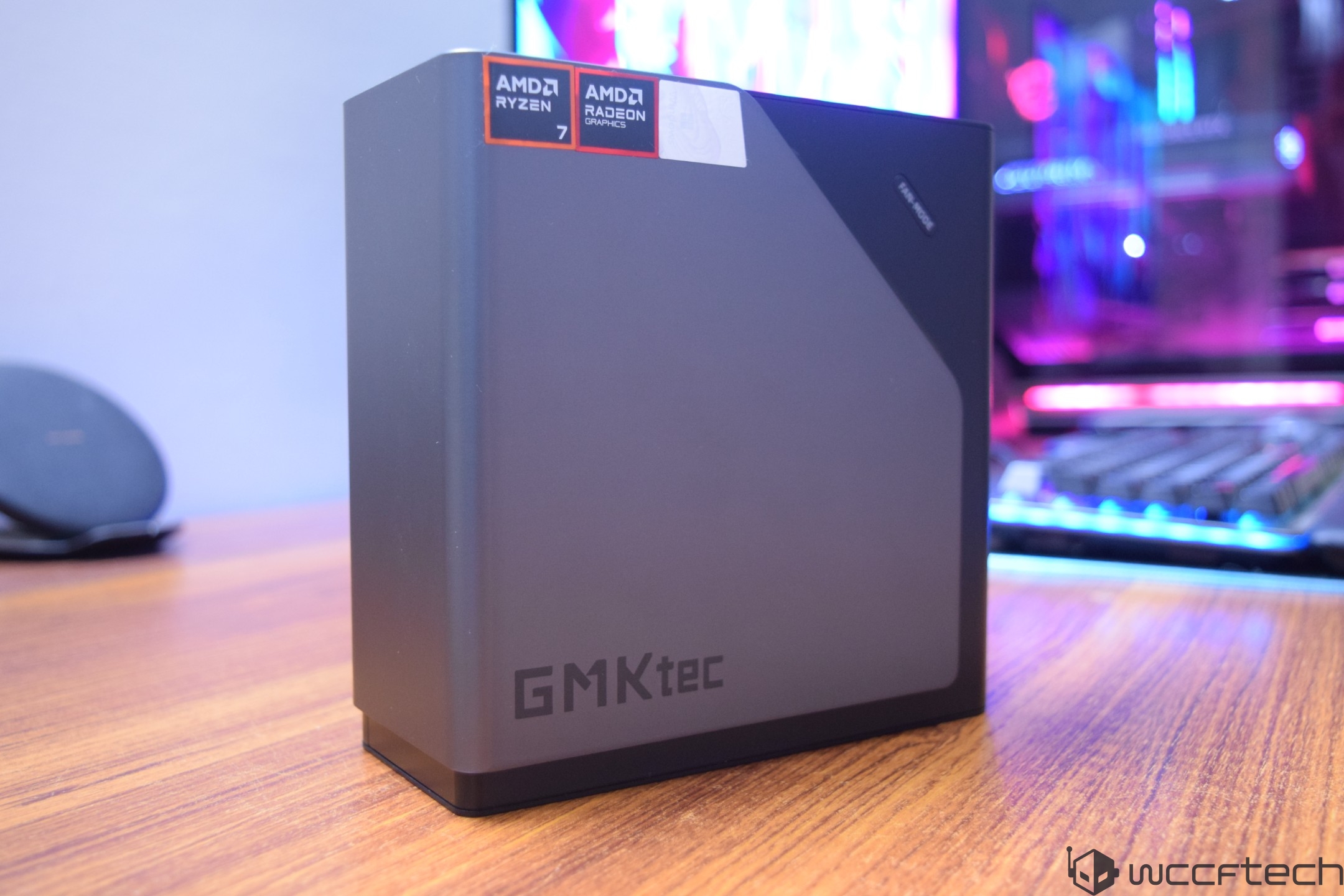
GMKtec K12 Mini PC: a compact Ryzen-powered desktop that punches above its size
Looking for a small form factor PC that actually feels high-end? The GMKtec K12 brings AMD’s latest mobile silicon, fast DDR5 memory, triple NVMe storage, and serious connectivity into a sleek, living-room-friendly box. Starting at $409.99 in barebone form, it’s built for creators, home offices, media setups, and even gaming—especially if you pair it with an external GPU.
What’s inside sets the tone. The K12 is powered by the AMD Ryzen 7 H 255, an 8-core/16-thread Zen 4 chip from the Hawk Point family, built on TSMC’s 4nm process. It carries 16 MB of L3 cache, 8 MB of L2, and boosts up to 4.9 GHz. The default TDP is 45W with options to tune down to 35W or up to 54W; the cooling system is designed to handle higher short-term power targets for extra bursty performance when you need it.
Graphics are handled by the integrated Radeon 780M, AMD’s RDNA 3 iGPU with 12 compute units clocking up to 2.6 GHz. It supports modern APIs, hardware-accelerated video, and AMD’s software technologies including FSR 2, FSR 3 with Frame Generation, AFMF, and Anti-Lag 2. There’s no dedicated NPU on this APU, but for everyday AI-assisted workloads that lean on the GPU, the 780M is a capable partner.
Memory and storage are standout features. The K12 uses dual-channel DDR5-5600 SO-DIMMs with configurations at 32 GB or 64 GB out of the box and support up to 128 GB. Storage is unusually generous for a mini PC: three M.2 2280 slots in total—one PCIe 4.0 x4 and two PCIe 4.0 x2—each supporting up to 8 TB, for as much as 24 TB of ultra-fast NVMe capacity. One slot can come pre-populated with a 1 TB PCIe 4.0 x4 SSD.
Connectivity is where the K12 separates itself:
– Front: 3.5 mm combo audio jack, USB-C 3.2 Gen2, 2x USB-A 3.2 Gen2, 1x USB 2.0, power button with LED, and a handy Clear CMOS switch for quick resets
– Back: DC power, second 3.5 mm combo jack, HDMI 2.1, DisplayPort 1.4, USB4, USB 3.2 Gen2, USB 2.0, dual 2.5 GbE LAN ports, plus an OCuLink port (PCIe Gen4 x4)
– Wireless: Wi‑Fi 6E and Bluetooth 5.2
– Display: up to four displays with support for ultra-high resolutions up to 8K at 120 Hz, ideal for multi-monitor productivity or a premium home theater setup
The OCuLink port is a big deal for gamers and creators. It provides a direct PCIe Gen4 x4 link to an external GPU enclosure, letting you pair the K12 with cards like an RTX 4060 for a true AAA gaming experience or accelerated rendering. You also get USB4 for fast peripherals and additional display options.
Thermals and acoustics were clearly prioritized. The K12 uses a vapor chamber heatsink and a dual-fan design: a blower for the CPU and a 92 mm fan for the memory and SSD side. GMKtec’s cooling solution is tuned for quiet operation and can sustain higher performance envelopes without turning the box into a desktop hairdryer. Venting along the top frame, rear I/O shroud, and sides keeps airflow consistent; rubber feet on the side allow for stable vertical placement if you prefer a tower look. Power is handled by a 120W adapter that offers plenty of headroom.
Unboxing is straightforward and clean. The unit arrives in a minimalist silver box, with the power brick, cord, and HDMI cable included. Four bottom screws give you access to the internals in seconds, making memory and storage upgrades painless.
Key highlights at a glance
– AMD Ryzen 7 H 255 (8C/16T, Zen 4, up to 4.9 GHz, 45W default TDP, configurable)
– Radeon 780M iGPU (12 CUs up to 2.6 GHz, RDNA 3, modern API and AMD feature support)
– 2x DDR5-5600 SO-DIMM slots, up to 128 GB
– Three M.2 2280 slots (1x PCIe 4.0 x4, 2x PCIe 4.0 x2), up to 24 TB total
– OCuLink PCIe Gen4 x4 for high-bandwidth eGPU connectivity
– USB4, HDMI 2.1, DP 1.4, front USB-C 3.2 Gen2, quad-display support up to 8K 120 Hz
– Dual 2.5G Ethernet, Wi‑Fi 6E, Bluetooth 5.2
– Vapor chamber cooling with dual fans for quiet, sustained performance
– Clear CMOS button for easy recovery and tuning
– Starting at $409.99 in barebone configuration
Who is the GMKtec K12 for?
– Power users who want desktop-class responsiveness in a tiny footprint
– Gamers who prefer a stealthy setup and plan to add an external GPU via OCuLink
– Creators who need fast DDR5 memory, tons of NVMe storage, and robust display output
– Home theater enthusiasts aiming for a silent 4K/8K media hub with multi-screen flexibility
– Network-focused users who benefit from dual 2.5 GbE for routing, NAS, or lab projects
The bottom line: the GMKtec K12 blends modern AMD performance with exceptional expandability and connectivity in a refined chassis. If you’ve been waiting for a mini PC that doesn’t force compromises—on memory capacity, storage lanes, display support, or eGPU bandwidth—this one should be high on your shortlist.1080p integrated graphics have finally grown up. Today’s mini PCs pair efficient CPUs with surprisingly capable iGPUs, letting you play esports titles smoothly and even tackle modern AAA games with smart settings, upscaling, and the right power and memory configuration. Here’s how the latest compact systems stack up based on the hardware and configurations listed.
The new performance ceiling: Radeon 890M
– The Radeon 890M, found in Ryzen AI 9 HX 370 systems such as the Beelink SER9, sets the pace for integrated graphics. With LPDDR5X-8000 memory overclocks and higher GPU clocks, it climbs to the top of 1080p charts.
– Add frame generation where supported and the 890M stretches its lead even more, flirting with older dedicated GPU territory like the GeForce GTX 1060 6 GB in many titles.
– Memory bandwidth is everything for iGPUs. LPDDR5X-8000 and careful tuning are key reasons the 890M shines.
Intel’s Arc 8 Xe makes a strong showing at 65W
– Core Ultra 9 185H mini PCs (for example, Minisforum AtomMan X7 Ti and Geekom GT1 Mega AI) and Core Ultra 7 155H units deliver competitive 1080p results when allowed a 65W power budget.
– With XeSS enabled, Intel’s Arc 8 Xe pushes into high playable frame rates in esports and can handle many AAA games at tuned settings.
– In raw positioning, Arc 8 Xe at 65W typically trades blows with well-tuned Radeon 780M systems, and in some titles it edges ahead thanks to XeSS.
Radeon 780M is the value and consistency champ
– If you want reliable 1080p gaming without fiddling with overclocks, the Radeon 780M (RDNA 3) at 60–65W is the sweet spot.
– Popular mini PCs using this GPU include Geekom A8 and A7, Beelink SER7, and GMKtec K12. The 65W variants lead; the same silicon at 54–60W trails slightly but remains very capable.
– Expect excellent esports performance and playable AAA with medium-to-high settings, plus big gains from FSR.
Radeon 680M remains a strong mid-tier pick
– Systems powered by the Radeon 680M (RDNA 2)—such as Geekom AS6, Geekom A6, and various Minisforum Venus models—still deliver smooth 1080p in competitive games and respectable AAA performance with balanced presets.
– For buyers eyeing value or slightly older hardware, 680M rigs are a solid, cost-effective choice.
Legacy iGPUs and Iris Xe trail for modern AAA
– Older AMD Vega iGPUs (Vega 8/7/6) and Intel Iris Xe from 12th/13th Gen parts are fine for lighter esports and indie games but struggle in demanding AAA titles at 1080p without heavy compromises.
– Iris Xe-LP platforms sit at the bottom of the modern gaming stack.
Why power limits and memory matter so much
– TDP headroom: Mini PCs configured at 65W (for example, Intel Core i9-12900H, i9-13900HK, Core Ultra 9 185H, AMD Ryzen 9 8945HS/7940HS, and Ryzen 7 7840HS at 60–65W) sustain higher GPU clocks and better frame times.
– Memory bandwidth: LPDDR5X-8000 or fast dual-channel DDR5 is critical. The Beelink SER9 with LPDDR5X-8000 OC is a clear example of how bandwidth supercharges iGPU performance.
– Upscaling and FG: Enabling XeSS/FSR—and frame generation where supported—can transform borderline 1080p results into smooth, console-like experiences.
Notable mini PCs by category
– Top-end integrated performance
– Beelink SER9 with Ryzen AI 9 HX 370 and LPDDR5X-8000 OC (Radeon 890M)
– Minisforum AtomMan X7 Ti and Geekom GT1 Mega AI (Core Ultra 9 185H, Arc 8 Xe @ 65W)
– ACEPC WizBox AI F1M (Core Ultra 7 155H @ 65W)
– High-value 1080p gaming
– Geekom A8 and A7 (Ryzen 9 8945HS/7940HS @ 60W, Radeon 780M)
– Beelink SER7 (Ryzen 7 7840HS @ 65W or 54W, Radeon 780M)
– GMKtec K12 (AMD 780M at 65W; strong all-around 1080p)
– Proven performers from the previous gen
– Geekom AS6 and Minisforum UM690 (Ryzen 9 6900HX, Radeon 680M)
– Geekom A6 (Ryzen 7 6800H, Radeon 680M)
– Intel H-series all-rounders at 45W
– Geekom GT13 Pro (Core i9-13900H)
– Beelink EQi13 Pro (Core i7-13620H)
– Geekom Mini IT12 and EYERTEC AD650I (Core i7-12650H)
– Great for productivity with decent light-to-moderate gaming via Iris Xe
– Other notable 65W Intel H-series options
– Beelink SEi13 Pro and Geekom IT13 2025 (Core i9-13900HK @ 65W)
– Beelink GTi12 Ultra (Core i9-12900H @ 65W)
– Geekom XT12 Pro (Core i9-12900H @ 35W for quieter, efficient operation)
Practical buying tips for 1080p integrated gaming
– Aim for 60–65W configurations if gaming is a priority; they deliver the best sustained clocks and smoother frame times.
– Prefer LPDDR5X-7500/8000 or dual-channel DDR5-5600+ memory. Avoid single-channel.
– Enable upscalers like FSR or XeSS. Use frame generation when available to raise perceived smoothness.
– For maximum longevity, target Radeon 890M or Arc 8 Xe. For best price-to-performance, look at Radeon 780M at 60–65W. For balanced value, the Radeon 680M still holds up.
– Consider thermals and acoustics. A larger chassis or better cooling allows higher sustained performance at lower noise.
Bottom line
Mini PCs have entered a new era where integrated graphics can deliver real 1080p gaming. The Radeon 890M currently leads the pack—especially with fast LPDDR5X and tuning—while Intel’s Arc 8 Xe at 65W is a compelling alternative, boosted by XeSS. The Radeon 780M remains the best all-round option for most people, and the 680M continues to offer excellent value. Choose the right power budget and memory configuration, and these palm-sized PCs can replace a bulky desktop for both work and play.GMKtec K12 review: a compact, cool-running Ryzen-powered mini PC that punches above its price
If you’ve been waiting for a small desktop that can handle real work by day and smooth 1080p gaming by night, the GMKtec K12 deserves a serious look. This 65W mini PC pairs an 8-core Zen 4 CPU with the Radeon 780M iGPU, then wraps it in a feature-rich chassis packed with fast connectivity and room to grow. The result is a capable, quiet, and highly upgradable setup that starts well under five hundred dollars.
Performance that feels bigger than its footprint
– 8 Zen 4 cores deliver snappy everyday performance, quick compile times, and strong multitasking across creative and productivity workloads.
– The integrated Radeon 780M holds its own for esports and popular AAA titles at 1080p with sensible settings, and it really shines when you enable modern AMD features like FSR 3, Anti-Lag 2, and AFMF 2 for smoother, more responsive gameplay.
– In the 65W performance profile, the K12 maintains consistent clocks without the abrupt throttling you might expect from compact systems.
Stays cool and composed under load
– A dual-fan cooling system keeps the CPU below 70°C throughout stress tests, an impressive feat for a small-form-factor PC running at this power level.
– The balanced thermal design translates to stable performance and quieter operation, making it ideal for a living room, dorm, or space-constrained office.
Connectivity and expansion that outclass the category
– USB4 support opens the door to high-speed peripherals and next-gen docks.
– Dual 2.5GbE LAN lets you max out network throughput, perfect for fast file transfers, NAS access, or advanced networking setups.
– Oculink support provides a high-bandwidth option for external devices, giving enthusiasts a flexible pathway for performance add-ons.
– Triple M.2 slots mean storage is anything but an afterthought; you can scale from a lean setup to several terabytes without breaking a sweat.
– High-capacity memory support ensures you’re not boxed in as workloads grow.
How it stacks up
Within the 65W class, the K12 hangs right with other Ryzen 7000-series mini PCs using the 780M, while offering a richer port selection than many rivals. Against systems built around integrated Intel graphics or older AMD Vega solutions, the uplift in GPU capability is noticeable in both games and GPU-accelerated tasks. And while discrete GPUs still lead in raw frame rates, upscaling and frame generation on the 780M narrow the gap enough to make this a satisfying tabletop gaming experience.
Who it’s for
– Gamers who want a tidy 1080p setup for esports and popular titles with modern upscaling.
– Students, creators, and professionals who need strong CPU performance in a compact, quiet machine.
– Tinkerers who value future-ready I/O, fast networking, and abundant storage options in a small chassis.
Price and value
The GMKtec K12 is available starting at $409.99, with a base configuration around $549.99. Considering its 8-core Zen 4 CPU, Radeon 780M graphics, USB4, dual 2.5GbE, Oculink, and triple M.2 expansion, the value proposition is excellent. You’re getting a mini PC that’s not just fast out of the box, but also thoughtfully equipped for long-term use.
Bottom line
GMKtec’s K12 delivers the performance, thermals, and connectivity that power users and gamers actually want in a compact desktop. With its cool-running 65W profile, capable 780M graphics, and standout I/O, it’s one of the most well-rounded mini PCs you can buy in this price range—an easy recommendation for anyone seeking maximum capability per dollar and per inch.