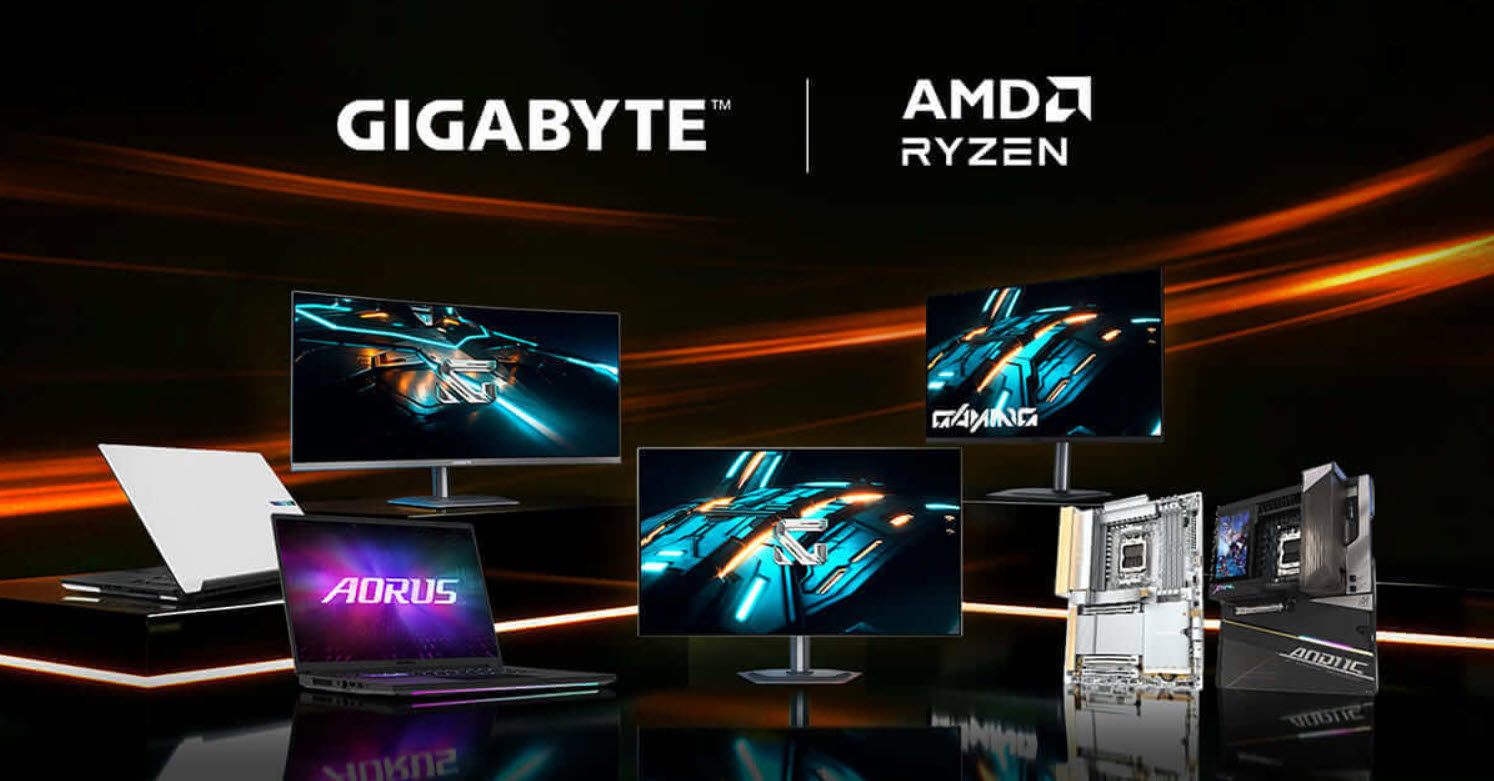
Gigabyte is stepping up its push into AI-powered PC gaming by expanding its partnership with AMD, rolling out new technology across gaming laptops, desktop motherboards, and high-refresh OLED monitors. The goal is simple: bring faster, smoother gaming performance and more efficient on-device AI features to everyday players and creators—without forcing users to constantly tweak settings to get the best results.
On the laptop side, Gigabyte is highlighting two major systems built around AMD platforms. The AORUS MASTER 16 is powered by the AMD Ryzen 9 9955HX3D processor, which uses AMD 3D V-Cache technology. That extra cache is designed to help stabilize frame rates in fast-moving games while also speeding up demanding workloads that creators care about, such as heavier production tasks and multitasking scenarios.
There’s also the Gigabyte AERO X16, positioned as a Copilot+ PC using AMD Ryzen AI 400 Series processors. These chips include a built-in NPU (neural processing unit) that can handle certain AI tasks directly on the device, improving efficiency and helping deliver smoother day-to-day AI experiences without relying as heavily on the cloud.
To make sure the AMD hardware can maintain strong performance during real gameplay and workloads, Gigabyte is leaning on its own thermal and software ecosystem. The AORUS MASTER 16 uses WINDFORCE Infinity EX cooling, rated for up to 230W maximum total thermal power, aiming to sustain high performance under pressure. Gigabyte also points to GiMATE, its in-house AI agent designed to simplify key system controls—bringing power, performance, and AI-related settings together in a more streamlined way, so users spend less time tuning and more time playing or creating.
Desktop builders also get new upgrades aimed at AMD’s latest processors. Gigabyte’s X870E X3D series motherboards are built to unlock the potential of AMD Ryzen 9000 Series processors with AMD 3D V-Cache technology. Because motherboard tuning can affect things like gaming responsiveness and stability, Gigabyte is introducing an AI-powered feature called X3D Turbo Mode 2.0. It’s described as a tighter hardware-software approach tuned specifically to match the behavior of AMD’s 3D V-Cache designs. Combined with a robust power setup, refined BIOS work, and builder-friendly features, the idea is to improve consistent gaming performance while reducing trial-and-error tweaking.
Gigabyte’s AMD-focused push also extends to displays, with OLED gaming monitors including the MO27Q28GR, MO34WQC36, and MO32U24. These models are certified for AMD FreeSync Premium Pro, targeting smoother variable refresh rate gameplay by syncing the monitor refresh rate to frame output. For gamers, that typically means reduced screen tearing and less stutter when frame rates fluctuate.
Beyond refresh syncing, Gigabyte is adding its own competitive-focused “Tactical Features” to enhance usability in fast-paced games. Tactical Switch 2.0 allows quick switching between resolutions and aspect ratios such as 4:3 or 5:4, which some competitive players prefer. Aim Stabilizer is designed to reduce motion blur by inserting black frames, while Game Assist tools add overlays like custom crosshairs and timers.
By expanding this collaboration across laptops, motherboards, and OLED gaming monitors, Gigabyte is positioning its lineup around a mix of AMD platform innovation and Gigabyte’s own performance engineering, system management tools, and display tuning. The bigger message: better real-world gains for AI gaming, content creation, and PC builds—built to feel faster and smoother without demanding constant manual optimization.


