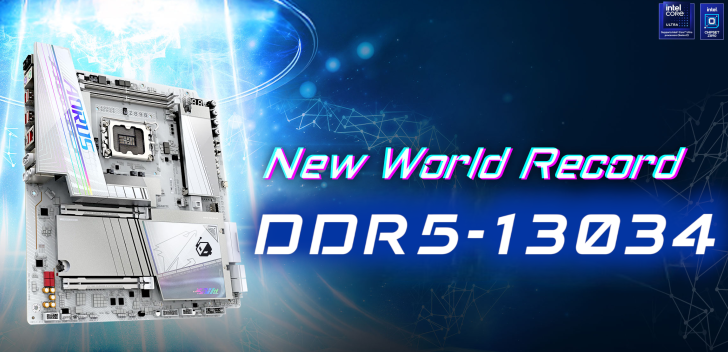
Gigabyte’s Z890 AORUS Tachyon ICE keeps rewriting the DDR5 record books. The company now holds the top three spots for DDR5 memory frequency, with in-house overclocker Hicookie pushing past the 13,000 MT/s barrier once again on the same overclocking-focused motherboard.
The latest milestone was achieved using an Intel Core Ultra 9 285K with its E-cores disabled and a single 24 GB ADATA XPG Lancer RGB DDR5 module. Under liquid nitrogen cooling for both the CPU and memory, Hicookie dialed the module to 6517.4 MHz effective, translating to a blistering 13,034 MT/s. Memory timings were set to 68-127-127-127-2, highlighting just how extreme this configuration is.
To put that into perspective, this world record more than doubles the module’s stock DDR5-6400 rating and is roughly 2.72 times faster than the original JEDEC baseline of 4800 MT/s for DDR5. These numbers aren’t about day-to-day usability—they’re about showcasing what current DDR5 silicon, memory controllers, and platform tuning can achieve at the limits with LN2.
Hicookie summed it up succinctly: “13K achieved! Huge thanks to ADATA Technology for the stellar memory and to Intel’s Core Ultra 285K—its memory controller is phenomenal. Paired with the GIGABYTE Z890 AORUS TACHYON ICE, we’ve pushed DDR5 beyond 13,000 MT/s.”
This achievement underscores that there’s still frequency headroom left in DDR5 for elite overclockers. While these speeds won’t trickle into consumer desktops any time soon, they hint at what future memory standards might deliver as platforms mature. Early DDR6 is expected to land around the 10,000 MT/s mark, with potential to exceed 20,000 MT/s down the line as controllers, IMCs, and motherboards evolve—likely starting to arrive around 2027.
Key takeaways:
– New DDR5 world record: 13,034 MT/s on a single 24 GB module
– Hardware: Z890 AORUS Tachyon ICE, Intel Core Ultra 9 285K with E-cores disabled
– Memory: ADATA XPG Lancer RGB DDR5
– Cooling: Liquid nitrogen on both CPU and memory
– Timings: 68-127-127-127-2
– Significance: Not practical for daily use, but a clear showcase of DDR5 overclocking potential and a signpost for what future memory generations could achieve


