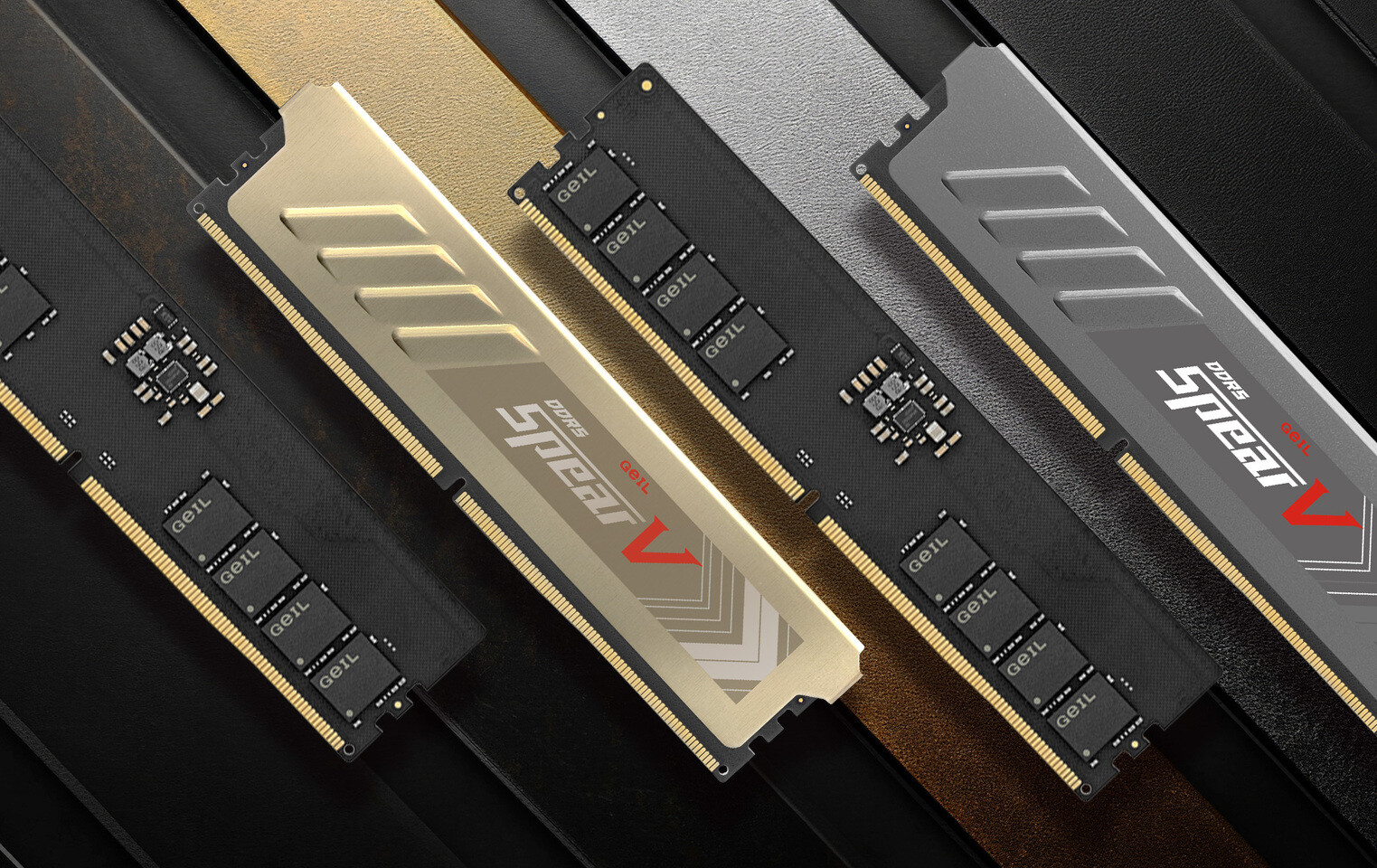
GeIL is shaking up the DDR5 memory scene with its newly announced Spear V DDR5, revealed ahead of Computex 2026. What makes this launch stand out is simple: Spear V is rated to run at 8000 MT/s right out of the box under official JEDEC standards. In a market where hitting 8000 MT/s has typically been something reserved for manual tuning and memory overclocking profiles, this is a notable shift toward making extreme DDR5 speeds far more accessible.
Since DDR5 arrived, power users have spent countless hours trying to push memory frequency beyond JEDEC’s official specifications. In most cases, reaching 8000 MT/s meant relying on Intel XMP or AMD EXPO settings, plus a bit of luck with platform compatibility and BIOS tuning. GeIL’s Spear V changes that expectation by delivering 8000 MT/s natively, without asking everyday builders to touch overclocking profiles at all.
There is, however, a trade-off. The Spear V DDR5 is listed at CL64-64-64-128 timings, which are higher than what many enthusiasts prefer—especially for workloads where memory latency matters as much as bandwidth. But the bigger goal here seems to be bringing ultra-high DDR5 frequency into the mainstream in a standards-compliant way, rather than chasing the lowest possible latency for competitive benchmarking.
Efficiency is another major talking point. GeIL says the Spear V operates at 1.1V even at 8000 MT/s, which is impressive because many DDR5 kits that reach similar speeds often do so with higher voltage when running overclocked. Lower voltage can translate into better power efficiency, improved thermals, and potentially stronger long-term reliability—benefits that matter not only to enthusiasts, but also to regular users building stable, high-performance PCs.
Compatibility has also been a sticking point for high-speed DDR5. Traditionally, even if a kit is capable of 8000 MT/s, achieving it can depend heavily on your CPU, motherboard, and memory controller quality—and it may require BIOS tweaking that isn’t guaranteed to work across systems. With Spear V aiming for JEDEC-standard operation at 8000 MT/s, the expectation is a smoother experience across supported platforms. GeIL specifically points to Intel’s Arrow Lake as a key target, while also noting it is working with industry partners to prepare for next-generation platforms—an indirect nod toward future AMD Zen 6 processors on the AM5 socket.
This announcement also hints at a broader direction for the memory market. Instead of focusing purely on extreme overclocking numbers, vendors may be putting more emphasis on pushing official standards forward. If that trend continues, mainstream PC builders could become less dependent on XMP and EXPO-style overclocking profiles just to reach high DDR5 performance. The next big step will be seeing whether future JEDEC-rated 8000 MT/s modules can come with tighter timings, which would make them even more appealing across gaming, content creation, and productivity workloads.