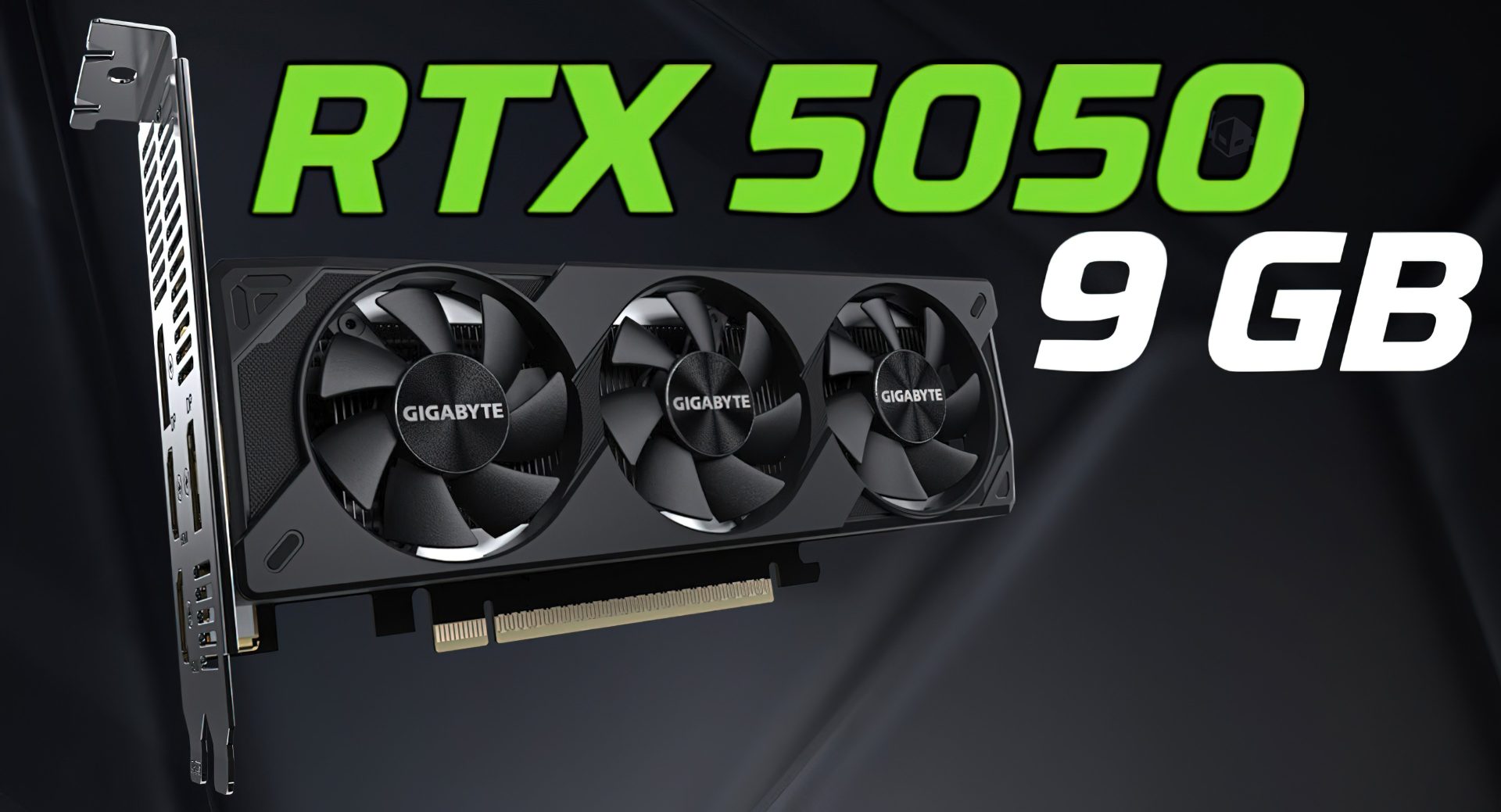
Fresh details about NVIDIA’s upcoming GeForce RTX 5050 9 GB graphics card are starting to paint a clearer picture of what this new entry-level option will deliver. While the core performance formula looks familiar, NVIDIA appears to be making a notable change where it matters most for many budget gamers: the memory configuration.
The GeForce RTX 5050 9 GB is expected to target a similar affordable price tier as the existing RTX 5050 8 GB, which has hovered around the $249 mark. It’s also rumored to arrive around the Computex 2026 timeframe, giving buyers a new option in the lower-cost Blackwell lineup.
According to the newly shared hardware configuration, the RTX 5050 9 GB will use the PG152-SKU40 board design and pair it with a Blackwell GB206-150 GPU. That’s a shift from the RTX 5050 8 GB model, which uses a GB207-based chip. On paper, that sounds like a bigger change than it actually is for raw compute, because the core specs are expected to remain the same.
Despite the move from GB207 to GB206, the RTX 5050 9 GB is still listed with 2560 CUDA cores, matching the current RTX 5050 8 GB. Power also appears unchanged, with the same 130W total board power and the same 8-pin power connector. Clock speeds are expected to remain in the same range as well, with figures circulating around a 2317 MHz base clock and a 2572 MHz boost clock—again, mirroring the existing model.
So why swap GPUs at all? The most likely reason is the memory upgrade. The 9 GB version is expected to move to GDDR7, while the current RTX 5050 8 GB is designed around GDDR6. That matters not just for speed, but also for manufacturing efficiency. Instead of designing a completely new PCB for a GDDR7-based RTX 5050, board partners may be able to reuse designs closer to the RTX 5060 family, which already supports GDDR7. That can help reduce development time and control costs—an important factor in the budget GPU segment.
The memory subsystem is where the RTX 5050 9 GB becomes more interesting. It’s expected to ship with 9 GB of GDDR7 on a 96-bit memory bus, compared to the RTX 5050 8 GB with 8 GB of GDDR6 on a wider 128-bit bus. Normally, a narrower bus can be a red flag, but the jump to faster GDDR7 helps offset that change.
Here’s how the bandwidth is expected to stack up:
– RTX 5050 8 GB: 20 Gbps GDDR6 on a 128-bit bus, delivering about 320 GB/s
– RTX 5050 9 GB: 28 Gbps GDDR7 on a 96-bit bus, delivering about 336 GB/s
That’s roughly a 5% increase in memory bandwidth, along with a 12.5% increase in VRAM capacity. For buyers, the extra 1 GB of VRAM could be more valuable than it sounds, especially as modern PC games continue to creep upward in VRAM usage at 1080p with higher texture settings. While 9 GB isn’t a massive leap, it may provide a bit more breathing room in newer titles and help reduce cases where performance dips due to memory limits.
As for pricing, expectations right now point to a similar entry-level MSRP to the RTX 5050 8 GB—around $249—but final pricing may depend on market conditions closer to launch, including memory supply and overall GPU demand.
If these specifications hold, the GeForce RTX 5050 9 GB could end up being a modest but meaningful refresh: the same general compute performance, paired with faster next-gen memory, slightly higher bandwidth, and a bit more VRAM for modern gaming workloads—while staying in an accessible price bracket.