This might be the most overpowered way to run Microsoft Paint—and it may not last long.
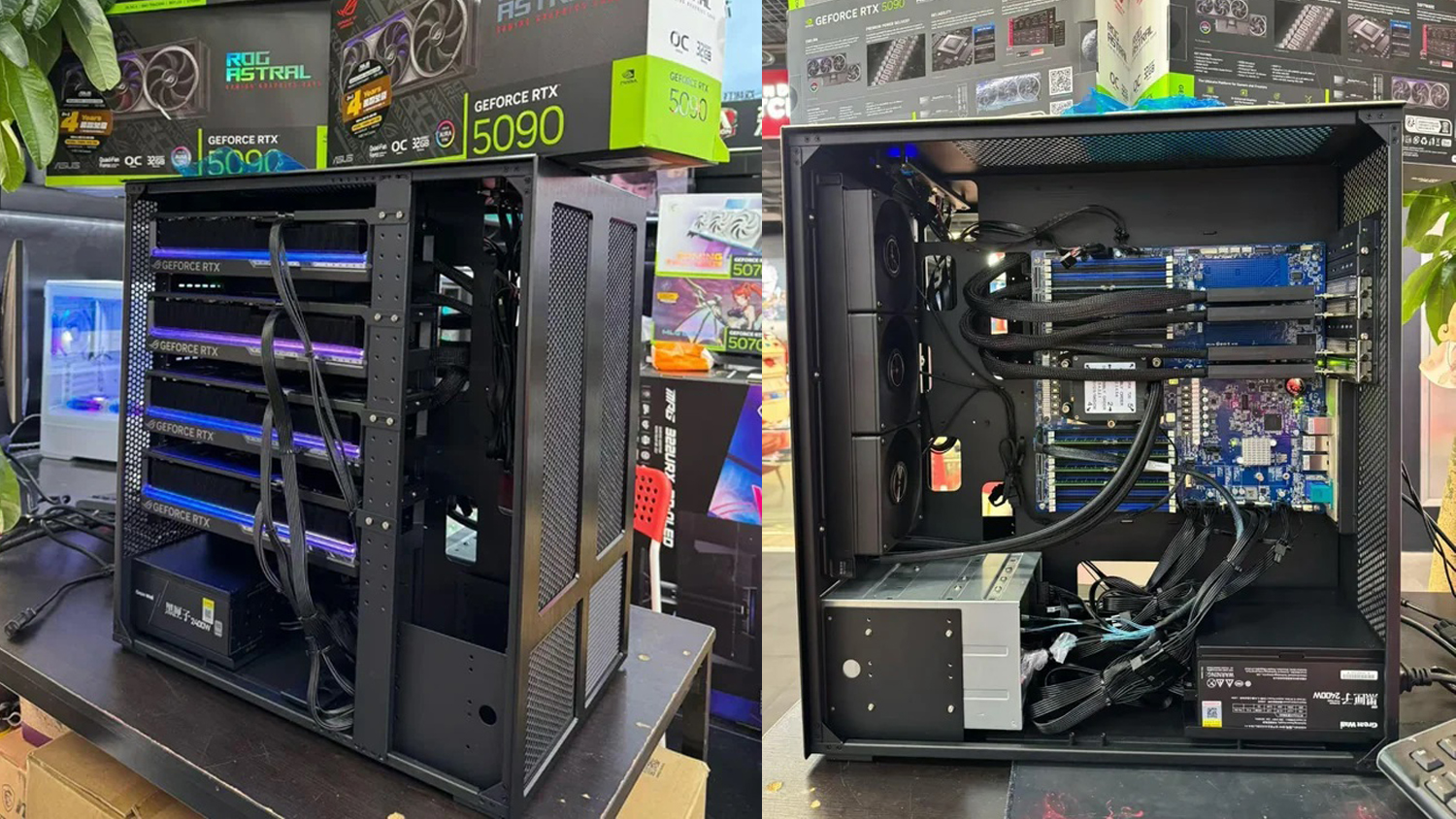
A Redditor has unveiled a wild battlestation packed with four ASUS ROG Astral GeForce RTX 5090 graphics cards. The build appears to sit on an Intel Xeon platform, with the GPUs routed into a second chamber using PCIe 5.0 riser cables. That layout keeps the motherboard area clear enough for airflow and an AIO CPU cooler, but the quartet of cards still consumes roughly three-quarters of the case’s interior, leaving just enough room for the power supply.
Each ROG Astral RTX 5090 is an almost 4-slot behemoth, so going quad effectively takes over the entire second chamber. The builder didn’t share the exact purpose, but a setup like this screams AI and compute workloads more than gaming. The power story adds to the drama: an RTX 5090 can draw up to 600W at full tilt. Multiply that by four and you’re already at around 2400W for the GPUs alone—before counting the CPU, motherboard, memory, storage, pumps, and fans.
That’s why the PSU choice raises eyebrows. The system reportedly uses a 2400W unit, which is theoretically already maxed just by the GPUs if they all hit peak draw. A configuration like this typically calls for a significantly higher-capacity power solution to provide headroom, stability, and safety under sustained load.
Then there’s the cabling. Four 16-pin GPU connectors under heavy, continuous power can become a weak point if not handled with care. Proper seating, cable quality, and bend radius are critical with high-wattage GPUs to avoid heat buildup and potential damage. With this much hardware, meticulous cable management and airflow aren’t just nice to have—they’re survival essentials.
If the price tag made you do a double take, you’re not alone. Premium variants such as the ROG Astral RTX 5090 are selling for around $3,300 or more each. That puts the GPUs alone at roughly $13,000, not counting the rest of the components or the custom riser setup.
As a showpiece, it’s jaw-dropping. As a daily driver, it’s a delicate balancing act between thermals, power delivery, and reliability. Whether it’s training models, crunching data, or just “accelerating” a masterwork in Paint, this quad-5090 rig is a flex of epic proportions—assuming it can stay cool and powered long enough to flex.