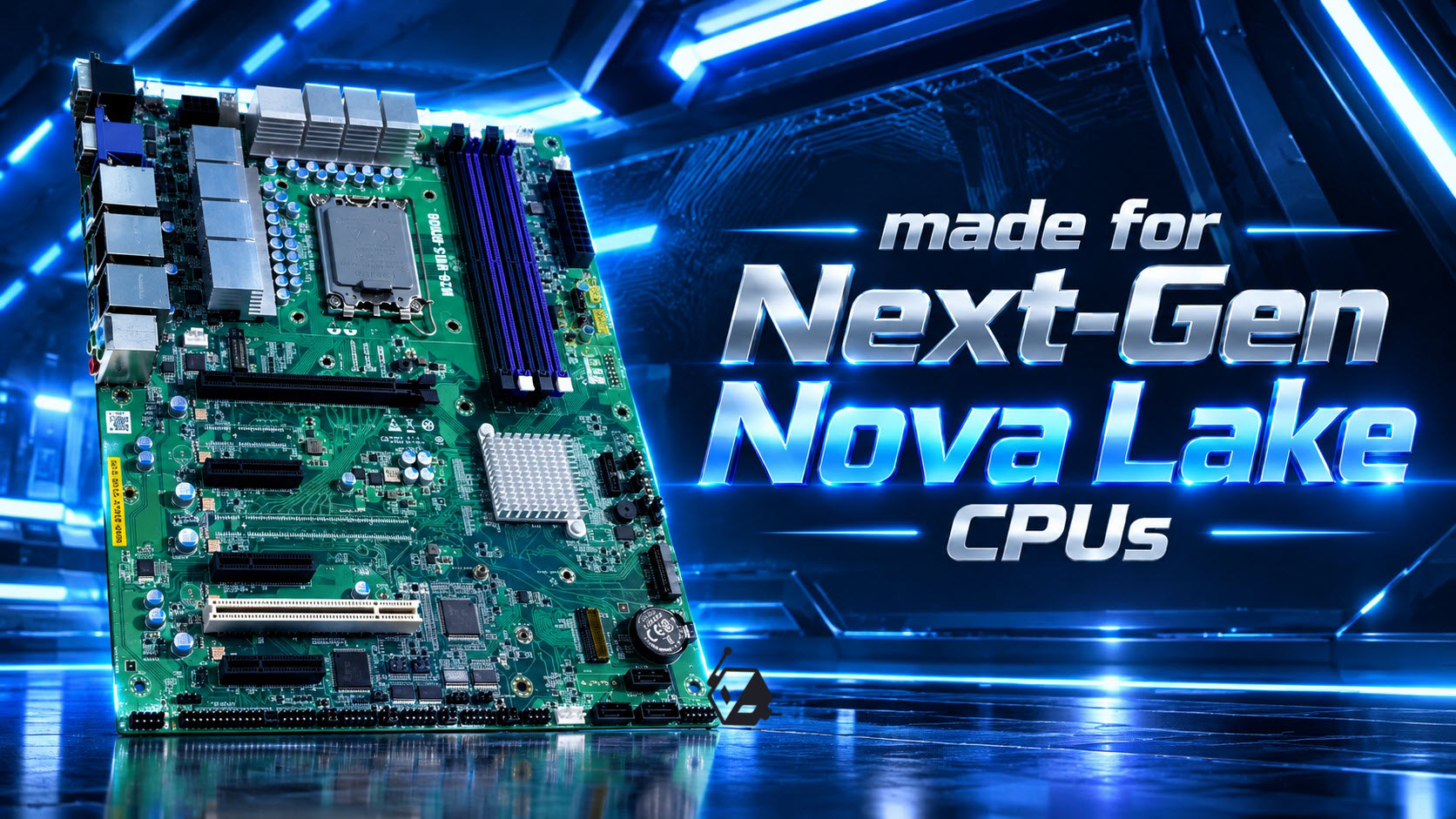
Intel LGA 1954 motherboard for Nova Lake-S CPUs appears with DDR5-6400 and Wi-Fi 7 support
A new Intel LGA 1954 motherboard has surfaced, giving an early look at what could be one of the first boards designed for Intel’s upcoming Nova Lake-S desktop processors, expected to arrive as part of the Core Series 4 lineup.
The motherboard, reportedly shown during an event in China by Digital China, appears to be aimed at business and enterprise users rather than gaming enthusiasts or extreme overclockers. While high-end consumer boards usually attract most of the attention, this early appearance suggests that Intel’s next desktop platform is already moving through partner channels.
The board is listed as the M26-NVLS-ATX09 and uses Intel’s new LGA 1954 socket. This socket is expected to support Nova Lake-S CPUs, marking another major platform change for Intel desktop processors. One of the more interesting details is the socket retention design. Previous reports suggested that LGA 1954 could use a 2L-ILM mechanism, but this particular motherboard appears to feature a more traditional single-lever design.
That difference may indicate that Intel is reserving the more advanced retention design for premium motherboards or higher-power desktop platforms where cooling pressure and thermal stability are more important. Business-class motherboards, especially those based on more efficiency-focused chipsets, may instead use standard socket hardware for simpler installation and lower cost.
The motherboard appears to be based on either the Q970 or B960 chipset. These chipsets are typically used in office PCs, corporate desktops, industrial systems, and long-life business machines. That makes the board more focused on reliability, manageability, and 24/7 operation rather than enthusiast features.
Memory support is listed at up to DDR5-6400, with a maximum capacity of 256 GB across four DIMM slots. That is a strong configuration for business desktops and workstations, especially for users handling virtualization, large spreadsheets, development workloads, data-heavy office tasks, or professional software.
Expansion options also look solid for an enterprise-focused ATX board. The board reportedly includes two PCIe 5.0 x16 slots configured as one full x16 slot and one x8 slot, along with two PCIe 5.0 x4 slots. Storage support includes two Gen5 x4 NVMe M.2 slots, allowing for very fast SSD performance. A legacy PCI slot is also present, which could be useful for businesses that still rely on older add-in cards for specialized hardware.
Wireless connectivity is handled through a dedicated M.2 E-Key 2230 slot, designed for a Wi-Fi 7 module. This suggests that even mainstream and business-focused Nova Lake-S motherboards could support newer connectivity standards, making them suitable for modern office networks and high-speed wireless environments.
The board uses a conventional ATX layout and includes heatsinks over the VRM area. Power delivery appears to use an 8+4 pin CPU power connector setup, which should be sufficient for the type of processors likely to be paired with Q-series or B-series chipsets.
What stands out most is how different this board may be compared to future Z-series Nova Lake-S motherboards. Intel’s enthusiast-focused Z-series boards are expected to offer more aggressive power delivery, stronger cooling hardware, more premium materials, and expanded overclocking features. In contrast, this early LGA 1954 model looks practical, functional, and built for business deployment.
Pricing has not been confirmed, but next-generation motherboards may arrive at higher prices than current models. Component costs have risen across the PC hardware market, and newer features such as PCIe 5.0, DDR5-6400 support, Wi-Fi 7 readiness, and updated socket designs could contribute to higher launch prices.
The appearance of this LGA 1954 motherboard is an important sign that Intel’s Nova Lake-S desktop platform is progressing. While this particular model is not designed for flashy gaming builds, it gives a useful early look at the foundation of Intel’s next CPU generation. For businesses, system integrators, and workstation users, Nova Lake-S could bring faster memory, newer connectivity, improved expansion, and a fresh platform built around the upcoming Core Series 4 processors.