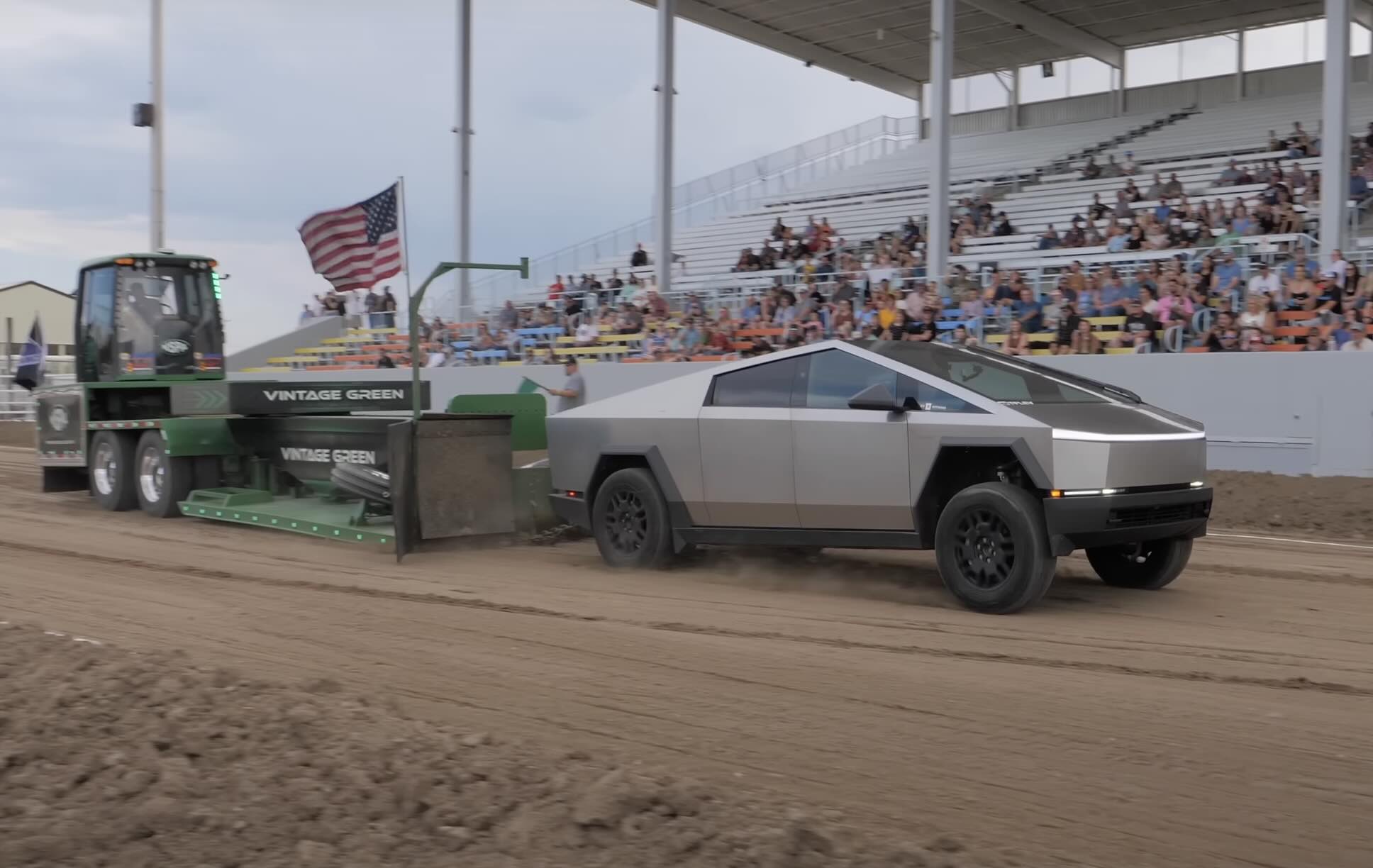
When it comes to demonstrating sheer power and traction capabilities, tractor pulls are a classic showcase. Recently, an interesting matchup took the stage: A Tesla Cybertruck went head to head with a diesel-powered RAM Cummins in a tractor pull competition, highlighting the strengths and weaknesses of electric and diesel powertrains.
The competition involved hauling a 33,000-pound sled—a weight equivalent to roughly 15 tons—down a 300-foot track. The first contender to take on the daunting challenge was the RAM Cummins driven by Andre. The pickup truck, equipped with a stock 6.7 L diesel engine boasting 370 horsepower and 850 lb-ft of torque, impressively managed to drag the sled about 280 feet before grinding to a stop. Even more remarkable was that the RAM was not modified for the event, unlike the specialized vehicles typically used in tractor pulls, and yet it performed exceptionally well.
Following the diesel powerhouse, Roman took the stage with the Tesla Cybertruck. In theory, the Cybertruck had certain advantages. Electric vehicles are known for their incredible instant torque, which the Cybertruck leverages through its dual electric motors cumulatively generating an impressive 700 horsepower. However, when put to the test, the electric pickup could only muster pulling the sled approximately 230 feet, falling short of the RAM by nearly 50 feet.
Several factor played into the Cybertruck’s performance. Notably, the vehicle’s weight—or lack thereof compared to the diesel RAM—proved to be a significant disadvantage. Traction is essential in a tractor pull, and the heavier RAM Cummins benefited from its massive engine that kept it more firmly planted on the track. Although the Tesla Cybertruck churned out a formidable 700 HP, it lacked the additional weight to counteract the increasing resistance from the sled, showcasing that power is not the only ingredient for success in tractor pulls.
The Cybertruck’s marginally lower torque of 743 lb-ft also might have played a role in this result. As the resistance from the heavy sled mounted, the Cybertruck’s relatively lighter build and slightly less torque became liabilities, culminating in its defeat to the traditional combustion engine.
Despite the outcome of this particular event, both the competitors expressed an eagerness to try again later with more powerful configurations, suggesting a potential rematch in the future that could yield different results.
Such a competition underscores the evolving landscape of vehicle engineering and performance. Electric vehicles continue to push boundaries, and while in this particular instance the diesel-powered RAM prevailed, ongoing advancements in EV technology could see electric vehicles becoming strong competitors in events traditionally dominated by combustion engines.