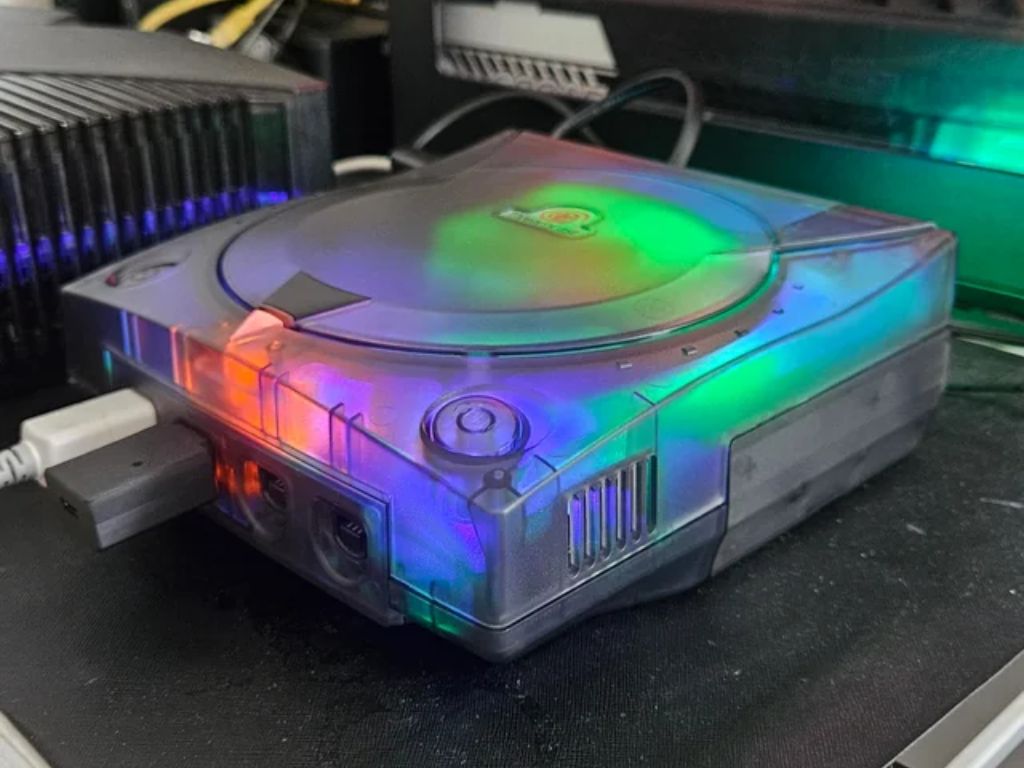
The MiSTer FPGA community has once again found a way to push beyond what many thought was possible. For years, enthusiasts have debated the limits of the DE10-Nano board, the hardware at the center of the MiSTer project. Just when the conversation seemed settled, a new experiment has arrived to challenge expectations: DreamSTer, a hybrid Sega Dreamcast emulator for MiSTer FPGA.
DreamSTer comes from developer skmp, known for work on the Reicast Dreamcast emulator. The project is especially exciting because the Sega Dreamcast has long been seen as too demanding for the DE10-Nano to handle in a traditional FPGA core. The console’s hardware, particularly its graphics system, presents a major challenge for accurate recreation on MiSTer.
Instead of attempting a standard MiSTer core, DreamSTer takes a different approach. It uses a hybrid emulation method that splits the workload between the DE10-Nano’s onboard ARM processor and the FPGA. This setup combines polly2-rtl with minicast and a custom MiSTer launcher, allowing part of the Sega Dreamcast’s hardware behavior to be handled through software while the FPGA recreates elements of the PowerVR2 graphics chip.
That makes DreamSTer an unusual project in the MiSTer FPGA world. It is not a pure FPGA implementation, and it does not run like a typical MiSTer core. In fact, DreamSTer temporarily shuts down the standard MiSTer process, takes control of the FPGA to run Dreamcast software, and then restarts the normal MiSTer environment afterward. It is unconventional, but the fact that it works at all has caught the attention of retro gaming fans and FPGA enthusiasts.
At the moment, DreamSTer is still in an early testing phase. It is not yet a polished, plug-and-play Dreamcast solution for MiSTer users. However, progress has been moving quickly. Recent community updates have improved performance, and the latest r1 pre-release from July 17 added input support through minicast along with in-app controller configuration. These are important steps toward making DreamSTer more practical for real gameplay.
Compatibility is still limited, with only a small selection of Sega Dreamcast games currently running. Performance can vary significantly from one title to another, and some users have reported issues with HDMI output. Because of this, DreamSTer is best suited for experienced MiSTer users, developers, and retro gaming hobbyists who enjoy testing experimental software rather than those looking for a simple way to play Dreamcast classics.
Setting it up also requires extra effort. Users need the correct Dreamcast BIOS and flash files, game images must be dumped and imported through an SD card or external storage, and DreamSTer has to be launched manually instead of through the standard MiSTer menu. For casual users, that may be a barrier. For enthusiasts, it is part of the appeal of exploring a project at the edge of what the hardware can do.
Even with its current limitations, DreamSTer represents an impressive milestone for Sega Dreamcast emulation on MiSTer FPGA. The Dreamcast has always been considered a difficult target, and seeing games boot and run through a hybrid FPGA setup shows that the platform still has room for surprises.
For now, DreamSTer is less of a finished Dreamcast replacement and more of a promising proof of concept. But with active development, community testing, and continued performance improvements, it could become one of the most fascinating MiSTer FPGA projects to watch. The idea of running Sega Dreamcast games on MiSTer once seemed out of reach, but DreamSTer proves that creative engineering can sometimes bend the limits of the hardware.