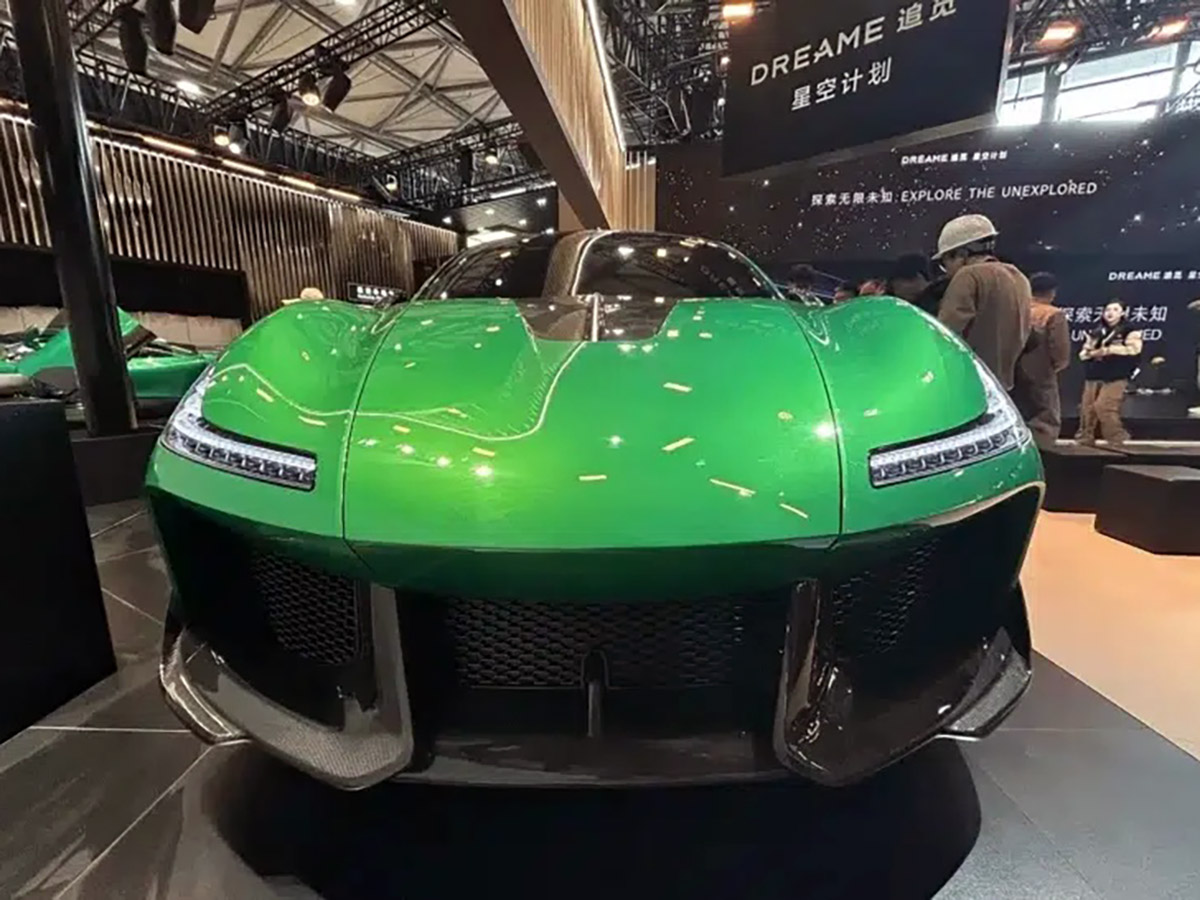
Dreame is making a bold leap beyond the home. Known primarily for robotic vacuums and smart household gadgets, the company has also built a reputation for pushing hardware limits with ultra-high-speed 200,000 rpm electric motors. Now it’s stretching into even bigger categories, including televisions and, most notably, electric vehicles—an expansion that signals ambitions far beyond cleaning tech.
Its most surprising announcement is the Dreame Nebula Next 01X, a premium electric liftback positioned like a high-end electric SUV and advertised with hypercar-level acceleration. Dreame claims the vehicle can sprint from 0 to 62 mph in as little as 1.8 seconds, and it’s being introduced as the first premium electric SUV equipped with a mass-produced solid-state battery.
The real spotlight, though, is on Dreame’s battery technology and powertrain. The company calls its 60 Ah solid-state cells the Starry Sky Crystal Core Power Battery, describing it as a solid-state pack designed for mass production rather than a lab prototype. Dreame says it uses a dry electrode process—similar in concept to the manufacturing direction some major EV players are pursuing—paired with a sulfide-based electrolyte.
According to Dreame, this combination is meant to balance cost, safety, and energy density. It may not reach the theoretical ceiling often promised by solid-state designs, but the company argues it can deliver significantly more driving range in the same physical space compared with today’s mainstream EV batteries.
On paper, the claimed specs are attention-grabbing. Dreame lists energy density exceeding 450 Wh/kg, pack integration efficiency of 85%, and fast charging that goes from 30% to 80% in 10 minutes. Heat resistance is rated up to 300°C. Looking beyond the first generation, Dreame also sets aggressive targets for the near future: a 2C charge/discharge rate and up to 800 Wh/kg cell energy density by the end of 2027.
That timeline matters because the broader auto industry has also been circling 2027 as a likely point when solid-state batteries begin appearing in retail electric cars. Those early models are widely expected to be premium-priced, largely because solid-state packs are still far more expensive to manufacture than conventional lithium-ion batteries. Dreame’s Nebula Next 01X seems tailored to that high-end reality from the outset.
The vehicle itself is loaded with performance and chassis tech. Dreame says it will use a Starry Sky Tianxun intelligent chassis based on a 14-degree-of-freedom non-linear control system, aiming for 1 millisecond full-domain synchronization across the powertrain and chassis. It also includes an EMAD electromagnetic active suspension system with a claimed 10x faster response while reducing energy consumption by 50%.
In the Ultra Luxury trim, the Nebula Next 01X is said to hit 0–62 mph in 1.8 seconds when using a high-discharge “Super Track” mode. Braking is also a major focus, with an intelligent braking system that supposedly cuts response time to under 80 milliseconds and delivers pressure precision of 0.1 MPa. For compute and autonomy, Dreame mentions a 2 nm process chipset delivering 2,000 TOPS of single-core computing power, enabling what it describes as L4 self-driving hardware integration across its EV lineup under the company’s “Starry Sky Plan.”
Dreame’s pitch is that this jump—from robotic vacuum motors to an electric performance drivetrain—may be more logical than it sounds. Fields like precision motor control, thermal management, and AI-assisted sensor analysis are areas where consumer robotics companies have built real experience over years of product development. Dreame is betting that this foundation can translate into competitive electric vehicles, especially in an era when software, sensors, and control systems are increasingly central to car performance and safety.
Whether that expertise—and Dreame’s track record with flagship products like powerful robot vacuums—can win over premium EV buyers is the big unknown. But by tying its debut vehicle to a mass-production solid-state battery claim and headline acceleration numbers, Dreame is clearly aiming to enter the electric car conversation with maximum impact.