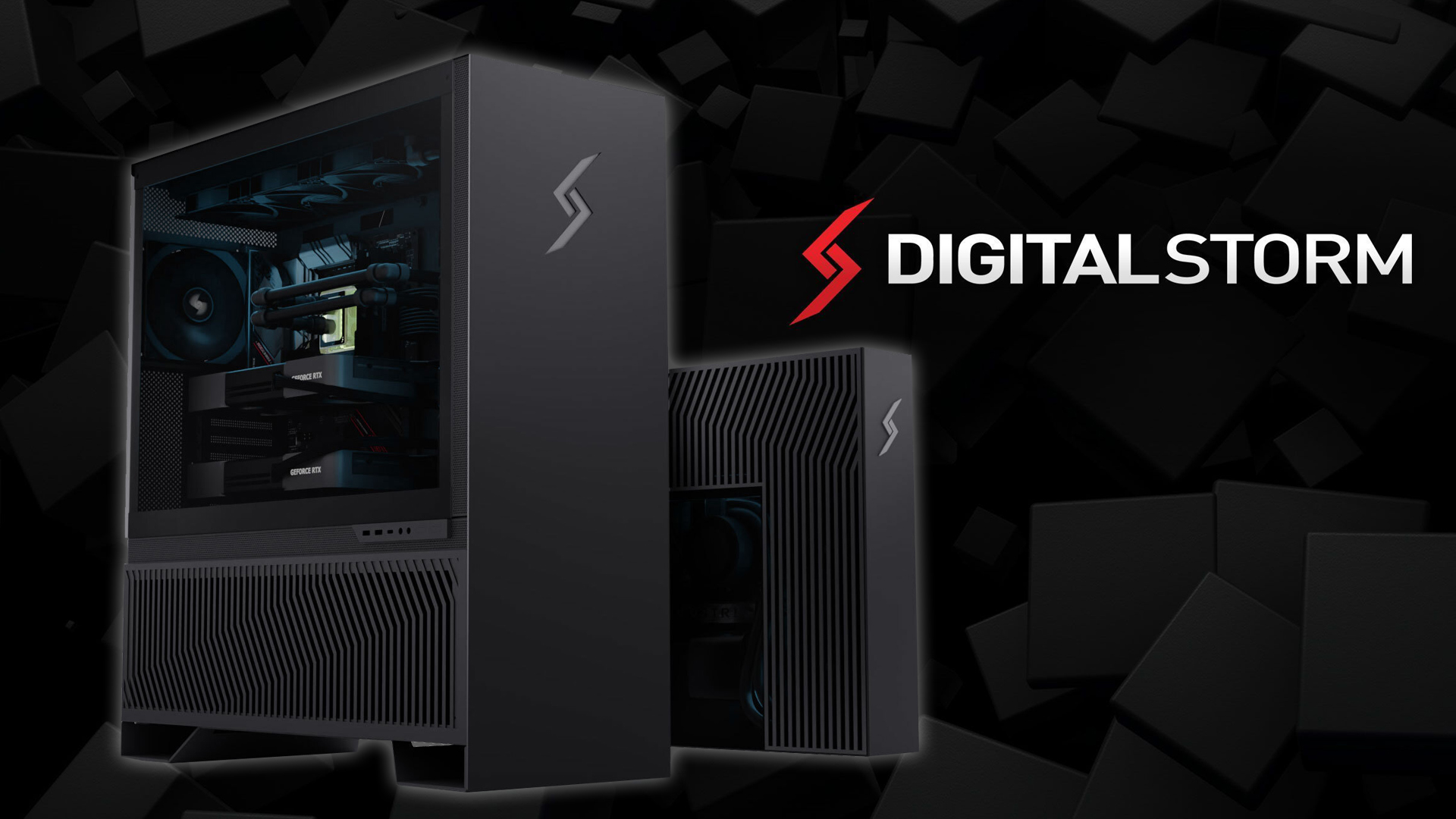
Digital Storm is making a bold claim at CES: you don’t need a massive tower to run today’s most demanding PC hardware. As GPUs and CPUs continue to grow larger, hotter, and more power-hungry, most gaming desktop makers respond with bigger cases to fit oversized graphics cards, large power supplies, and hefty cooling. Digital Storm is going in the opposite direction with two new high-end systems designed to shrink the footprint without giving up performance.
The standout is the Digital Storm Vector, a compact gaming desktop built around a slim chassis measuring 473 x 335 x 99 mm. That ultra-narrow design is what immediately separates it from traditional towers, but the real attention-grabber is what it can fit inside. Digital Storm says the Vector can be configured with up to an NVIDIA RTX PRO 6000 Blackwell GPU, paired with either AMD’s Ryzen 9 9950X or Intel’s Core Ultra 9 285K—flagship-level components typically seen in much larger builds.
To make the tight layout work, the internal design places the GPU at the top while the motherboard, AIO cooler, and other components sit in the lower section. Packing this level of hardware into such a small enclosure usually raises concerns about heat buildup, airflow restrictions, and fan noise. Digital Storm, however, says the Vector is engineered to manage thermals, airflow, and acoustics effectively despite the compact arrangement—an ambitious promise for a system this thin.
For buyers who want maximum performance with fewer compromises, Digital Storm is also introducing the Aventum 5. This larger desktop is aimed at enthusiasts and professional users who need serious sustained performance, featuring an enthusiast-grade custom liquid-cooling setup designed for fast heat dissipation. The Aventum 5 also appears geared toward heavy workloads and advanced configurations, including multi-GPU potential for users who need more horsepower for professional compute tasks and demanding applications.
One of the more eye-catching additions to the Aventum 5 is a large display integrated into the chassis. It’s designed for real-time hardware monitoring—useful for tracking temperatures, system load, and performance metrics—or for showing custom visuals to personalize the build.
Digital Storm expects both the Vector and Aventum 5 to launch in multiple configurations through its official sales channels, with broader retail availability targeted for Q2 2026.