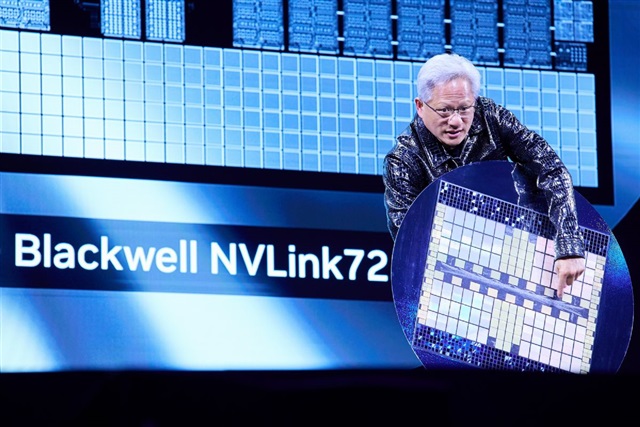
Trump-era tech policy is accelerating fast, and the AI chip world is squarely in its path. Since taking office in January 2025, the administration has moved to tighten technology flows to China with a level of force not seen before. On top of dramatic hikes to overseas H-1B visa application fees—now pegged at an eye-popping US$100,000—and a demand that Nvidia and AMD remit 15% of their advanced chip revenues from China to the U.S. Treasury, Washington has issued a full ban on sales of Nvidia’s cutting-edge Blackwell AI chips to China.
This one-two-three punch lands in the heart of the global semiconductor and AI ecosystem. Blackwell-class GPUs power the training and deployment of large AI models, data center workloads, and high-performance computing. Blocking access to these flagship accelerators effectively cuts Chinese buyers off from Nvidia’s most advanced performance tier, reshaping procurement strategies for cloud providers, research labs, and AI startups across the region.
For Nvidia and AMD, the calculus is complicated. China has been a major market for AI hardware, and a 15% revenue remittance on advanced chip sales—combined with a total Blackwell ban—could compress margins, force product mix reshuffles, and accelerate efforts to tailor “compliant” offerings for non-restricted markets. The immediate upside for the U.S. Treasury is straightforward: more direct revenue capture from sales that do proceed under the new rules. The long-term risk is that customers pivot to alternative supply chains, reducing U.S. influence over the highest rungs of AI compute.
China’s AI sector faces a different kind of pressure. A total block on Blackwell means longer timelines for training cutting-edge models on the latest U.S. hardware, potential delays in data center rollouts, and upward pressure on compute costs. In response, buyers are likely to lean harder on legacy or mid-tier accelerators, explore gray-market channels at greater risk, and double down on domestic silicon development. None of these moves replicate Blackwell performance overnight, but they can blunt near-term impact while local alternatives scale.
The H-1B fee surge adds another dimension to the talent equation. By pushing overseas applications to US$100,000, the policy could deter cross-border hiring and relocation, especially for early-stage ventures and academic labs that rely on global expertise. The likely result is a more fragmented talent landscape: firms expand satellite teams abroad, universities adjust collaboration models, and skilled workers weigh remote roles over relocation. In aggregate, that may slow knowledge exchange even as it encourages new hubs to grow outside the U.S.
For global AI buyers and builders, the practical questions start now. Procurement teams will revisit multi-year hardware roadmaps, diversify suppliers, and lock in inventories where possible. Compliance officers will scrutinize sales flows to avoid penalties. CTOs will tune model sizes, quantization strategies, and training schedules around what is actually available and affordable. Expect higher demand for compute-efficient model architectures and software optimizations designed to squeeze more performance from non-Blackwell hardware.
Market ripple effects are inevitable. Scarcity at the top of the performance stack typically lifts prices downstream, pulling forward demand for second-tier accelerators and pushing system integrators to reconfigure racks around what ships. Investors will watch for revenue mix changes at major chipmakers and for signs of accelerated capex among non-U.S. data center operators. Meanwhile, AI software vendors positioned to cut compute costs—through better compilers, scheduling, and inference tooling—stand to gain.
Geopolitically, the move underscores a broader decoupling trend in critical tech. By tying revenue remittances to sales, ratcheting visa costs, and cordoning off the most advanced GPUs, Washington aims to slow China’s ascent at the AI frontier while asserting greater control over value flows. Whether that produces strategic leverage or drives faster substitution depends on how quickly alternative ecosystems mature—and how strictly enforcement is maintained.
Bottom line: the Blackwell ban, the 15% revenue remittance, and the H-1B fee spike collectively mark a new phase in the U.S.-China tech standoff. The near-term impact will be felt in procurement headaches, higher compute prices, and slower access to state-of-the-art AI hardware in China. The long-term outcome will hinge on how industry adapts—through supply chain diversification, software efficiency gains, and the pace at which non-U.S. chip offerings close the gap at the top end of AI performance.


