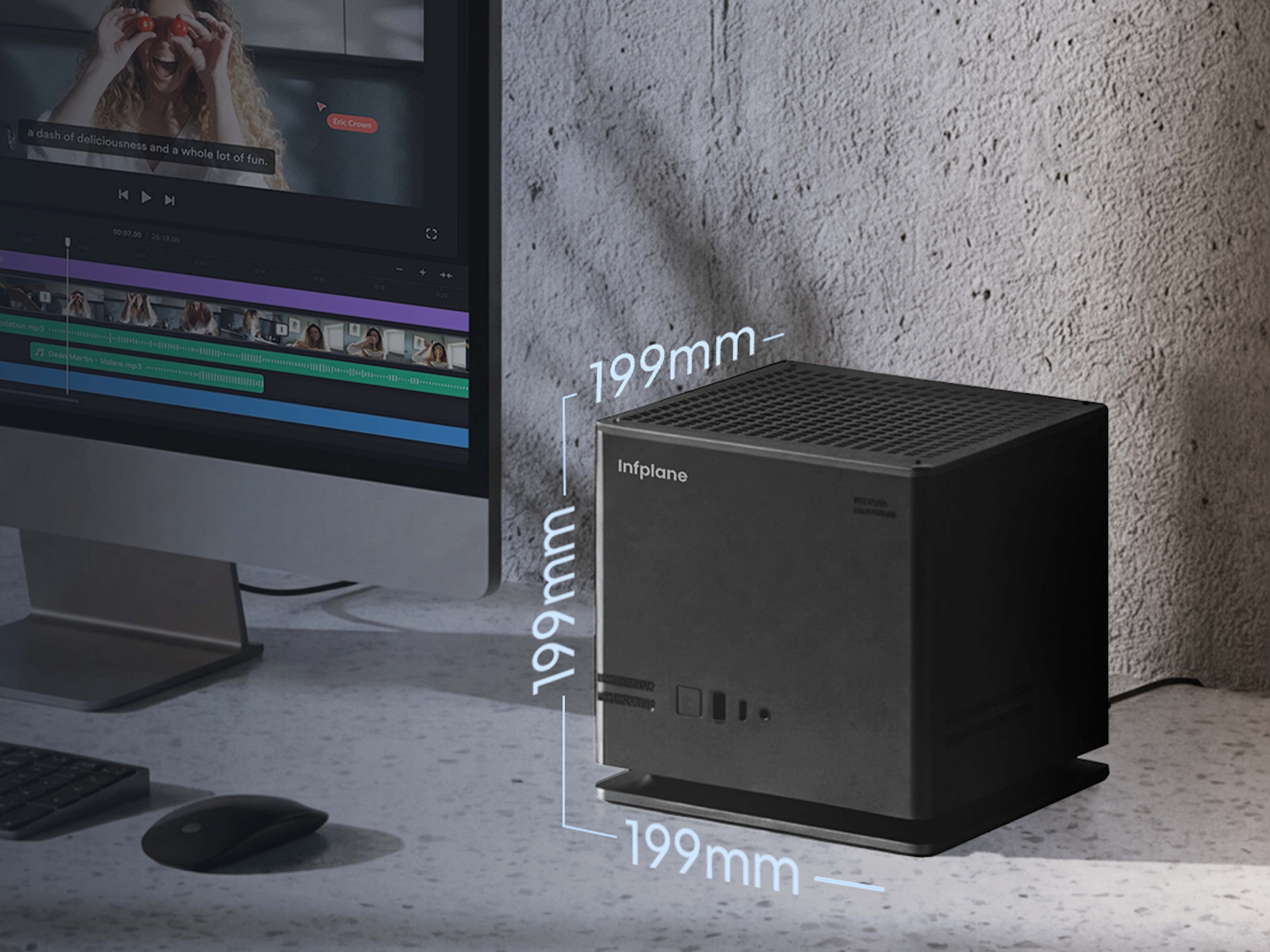
A new compact desktop aiming to be a serious Steam Machine-style alternative is turning heads thanks to an unusually high-end spec sheet designed for AI workloads, gaming, and everyday productivity. Called the Hilbert Agentic Computer, this small cube-shaped PC is now open for pre-order through a crowdfunding campaign, with an early discount that puts the entry price at around $3,000. Deliveries are currently projected to begin in June 2026.
As with any crowdfunding hardware project, it’s smart to treat the timeline and final shipping details with caution and to understand the financial risk involved. That said, the project doesn’t look like a purely conceptual pitch—working sample units already exist, which typically makes the product feel more tangible than many crowd-funded PCs.
What makes the Hilbert Agentic Computer stand out is how much performance it aims to pack into an ultra-compact 7.8 x 7.8 x 7.8-inch chassis. It’s positioned as a true full PC rather than a basic mini computer, and the maker explicitly claims it can handle gaming. At the heart of the system is the AMD Ryzen AI Max+ 395 system-on-chip paired with AMD Radeon 8060S graphics, a combination meant to balance modern CPU performance with competent integrated graphics horsepower for games and creative work.
Memory is one of the big talking points. The Hilbert Agentic Computer is configured with 128GB of DDR5X RAM, with listed speeds up to 8,533MHz. That’s far beyond what most compact desktops offer today, and it’s a major reason this machine is being marketed for local AI tasks and heavy multitasking. Storage is also ready for serious workloads, with a 2TB SSD included.
Connectivity is another area where this mini desktop tries to outclass typical small-form-factor PCs. It includes DisplayPort 1.4 and HDMI 2.1 for modern monitor and TV support, along with two USB4 ports for fast peripherals, docks, and external storage. Wireless is up to date with WiFi 7, and the wired networking options are notably advanced for a small PC: both 10Gbps Ethernet and 2.5Gbps Ethernet are included, which is especially attractive for creators moving huge files over a local network or anyone running a home lab setup.
AI performance is clearly central to the pitch. Infplane Computing claims the system can run very large AI models locally, including models beyond 200 billion parameters, while keeping the overall experience approachable through commonly used tools like LM Studio or ComfyUI. To support these claims with something concrete, the company also shares a performance figure: it says Qwen3-235B can generate around 15 tokens per second on the machine.
Taken together, the Hilbert Agentic Computer is trying to fill a very specific gap in the market: a truly compact desktop that doesn’t compromise on memory capacity, modern I/O, or networking, while still being capable of gaming and strong local AI acceleration. For buyers who want a small but powerful PC for AI projects, content creation, and high-speed networking—without stepping up to a full-size tower—this is one to watch as it moves closer to its expected 2026 launch window.