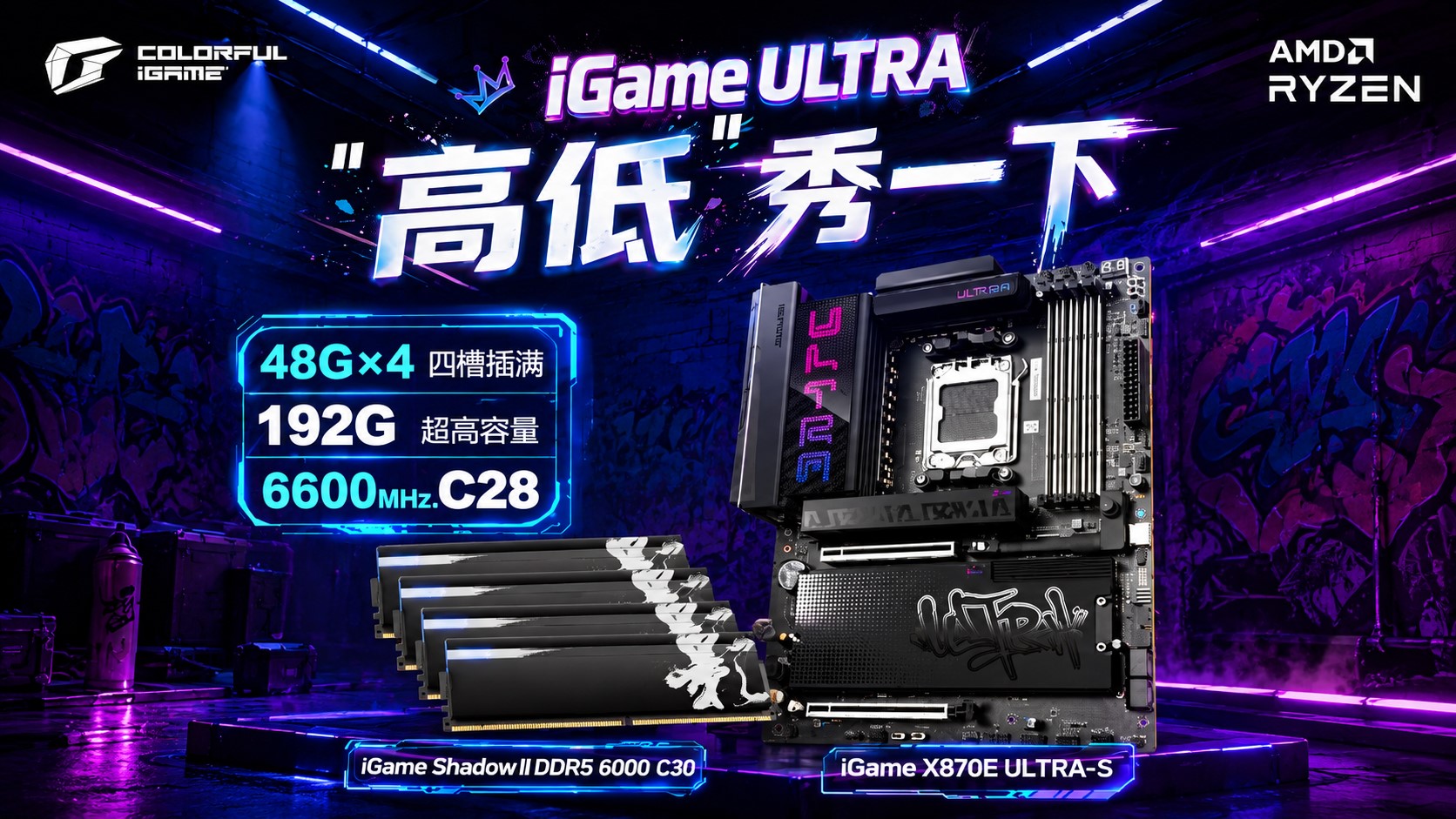
Colorful Shows 192 GB DDR5 Memory Running at 6600 MT/s CL28 on New iGame X870E Ultra-S V14 Motherboard
High-capacity DDR5 memory is becoming faster, but pushing a massive 192 GB kit beyond 6000 MT/s while keeping latency below CL30 is still a serious challenge. Colorful has now shown an impressive breakthrough with its upcoming iGame X870E Ultra-S V14 motherboard, demonstrating a 192 GB DDR5 configuration running at 6600 MT/s with tight CL28 timings.
This is a notable achievement for the AMD AM5 platform, where memory overclocking has improved significantly since the arrival of the Ryzen 9000 series. In the early days, reaching 8000 MT/s or higher was difficult, even for experienced overclockers. Since then, better DDR5 modules, improved BIOS tuning, and motherboards designed specifically for memory performance have helped enthusiasts push the platform much further.
Today, some DDR5 kits have managed to reach extreme speeds near 10,000 MT/s on AM5 systems. However, those records are usually achieved with lower-capacity configurations, often using fewer memory sticks. Running a large 192 GB setup at high speed is far more demanding because it places much heavier electrical stress on the CPU’s memory controller and the motherboard’s memory traces.
Colorful’s latest demonstration stands out because it combines three difficult goals at once: high capacity, high frequency, and low latency.
The test system used a 192 GB DDR5 kit made up of four 48 GB modules from Colorful’s iGame Shadow II DDR5 6000 CL30 memory lineup. Instead of simply running the kit at its rated 6000 MT/s speed, Colorful pushed it to 6600 MT/s. Even more impressive, the company reduced the latency from CL30 to CL28.
For PC enthusiasts, creators, and workstation users, this kind of result is exciting. A 192 GB memory capacity is useful for demanding workloads such as 3D rendering, large-scale video editing, software development, virtualization, AI workloads, and heavy multitasking. Getting that much memory to run at 6600 MT/s with CL28 latency could offer a strong balance of capacity and responsiveness.
Stability is often the biggest concern with memory overclocking, especially when all four DIMM slots are populated. Colorful also shared stability validation, including a RunMemTestPro result showing that the configuration passed testing successfully. That suggests the setup was not just a quick boot or screenshot attempt, but a working high-performance configuration.
The processor used in the system was the AMD Ryzen 7 9850X3D, which appears to have a strong memory controller. Still, the CPU is only one part of the equation. Achieving stable speeds with four high-capacity DDR5 modules also depends heavily on motherboard design.
Signal integrity is critical at these speeds. The quality of the PCB layout, memory trace routing, power delivery, BIOS tuning, and overall board engineering all play a major role in whether a system can handle fast DDR5 memory reliably. Colorful’s iGame X870E Ultra-S V14 seems to be designed with this type of memory tuning in mind.
The X870E platform is aimed at high-end AM5 builds, offering support for the latest AMD Ryzen processors, fast DDR5 memory, and advanced connectivity. With this demonstration, Colorful is clearly positioning the iGame X870E Ultra-S V14 as a motherboard for enthusiasts who want to push memory performance beyond standard settings.
The launch timing is also important. Colorful has confirmed that the iGame X870E Ultra-S is expected to arrive shortly before China’s November 11 Singles’ Day shopping festival, one of the biggest retail events of the year.
If the retail version can deliver similar memory performance, the iGame X870E Ultra-S V14 could become an interesting option for builders who need both high RAM capacity and strong memory speeds. While most users may not need 192 GB of DDR5, this achievement shows how quickly the AM5 platform is maturing and how far DDR5 tuning has come.
Colorful’s 192 GB DDR5 6600 MT/s CL28 demonstration is more than just a memory overclocking milestone. It highlights the growing potential of AMD’s latest desktop platform, the importance of motherboard engineering, and the future of high-capacity DDR5 performance for enthusiast PCs and professional workstations.


