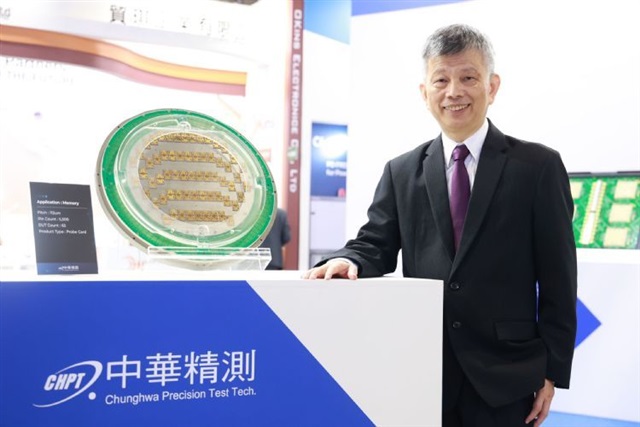
Chunghwa Precision Test Tech Highlights Advanced Testing Solutions for AI Chips and HPC at SEMICON Taiwan 2026
Chunghwa Precision Test Tech presented its latest semiconductor testing technologies at SEMICON Taiwan 2026, putting a strong spotlight on solutions designed for artificial intelligence chips and high-performance computing applications.
As demand for AI accelerators, custom ASICs, and advanced computing processors continues to grow, chip testing has become a critical part of ensuring performance, reliability, and production quality. At the event, the company showcased a broad portfolio of test interface products built to support increasingly complex semiconductor designs.
Among the key products on display were AI probe cards, memory probe cards, and high-pin-count probe cards. These tools are essential for wafer-level testing, helping manufacturers verify chip performance before packaging. With AI processors becoming larger, faster, and more power-hungry, accurate testing at the wafer stage is becoming more important than ever.
The company also introduced a high-power burn-in board developed for AI ASICs. Burn-in testing is used to detect early failures and confirm that chips can operate reliably under demanding conditions. For AI and HPC hardware, where stability and efficiency are crucial, this type of testing plays a major role in improving product quality before devices reach the market.
Chunghwa Precision Test Tech’s latest offerings reflect the growing needs of the semiconductor industry as AI computing pushes chip designs to new levels of complexity. From wafer-level inspection to system-level validation, advanced test interface solutions are becoming a key part of the AI chip supply chain.
By focusing on AI chips, memory devices, high-pin-count components, and high-power ASIC testing, the company is positioning itself to support the next generation of semiconductor manufacturing. Its presence at SEMICON Taiwan 2026 highlights how important precision testing has become in the race to deliver faster, more reliable, and more efficient computing technology.