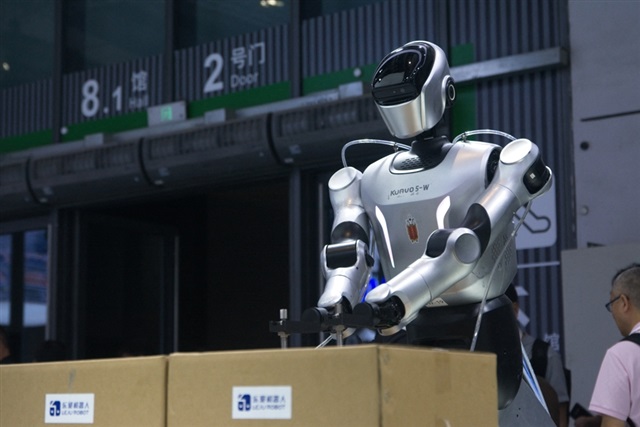
Chinese Automakers Push Into Humanoid Robots as AI and EV Technology Converge
Chinese automakers are moving quickly into the humanoid robotics market, using their experience in electric vehicles, artificial intelligence, advanced manufacturing, and large-scale supply chains to compete in one of the next major technology frontiers.
The shift reflects a growing belief across China’s auto industry that the future of mobility will not be limited to cars. As electric vehicles become smarter and more software-driven, many of the technologies used in modern EVs can also be adapted for humanoid robots. These include electric motors, battery systems, sensors, control units, AI algorithms, and precision manufacturing techniques.
For carmakers, humanoid robots represent a natural extension of their existing strengths. EV companies already understand how to build complex machines that combine hardware, software, energy management, and real-time decision-making. That knowledge can be applied to robots designed to walk, navigate environments, recognize objects, interact with people, and perform physical tasks.
Artificial intelligence is one of the biggest drivers behind this expansion. Automakers have invested heavily in AI for autonomous driving, driver-assistance systems, voice control, smart cabins, and connected vehicle platforms. These same AI capabilities can help humanoid robots understand surroundings, make decisions, and respond more naturally to human instructions.
Electric drive systems are another key advantage. Humanoid robots depend on compact, efficient, and reliable motion components. Chinese EV makers already work with electric motors, power electronics, batteries, and thermal management systems, giving them a strong technical foundation for robot development. The ability to produce these parts at scale could help reduce costs and speed up commercialization.
Supply chain strength also plays a major role. China’s automotive sector has built a deep ecosystem of suppliers for chips, sensors, batteries, actuators, cameras, and lightweight materials. This network can support faster prototyping and mass production of humanoid robots, especially as companies look for ways to move beyond concept models and into real-world applications.
The interest in humanoid robotics also comes as automakers search for new growth opportunities. Competition in China’s EV market is intense, with pressure on pricing, margins, and product differentiation. By entering robotics, car companies can open new business lines in industrial automation, logistics, healthcare, retail, home assistance, and smart manufacturing.
Factories may be among the first places where these robots gain traction. Automakers could deploy humanoid robots in their own production facilities to assist with repetitive, physically demanding, or hazardous tasks. This would allow companies to test robot performance in controlled environments while improving efficiency and collecting valuable operational data.
Over time, humanoid robots could move into broader commercial and consumer roles. If costs fall and AI improves, robots may be able to assist in warehouses, service centers, hospitals, hotels, and eventually homes. Chinese automakers appear to be positioning themselves early for that possibility.
The move also highlights a larger trend: the boundaries between the automotive, AI, and robotics industries are becoming less distinct. Future technology companies may not be defined only by the vehicles they produce, but by their ability to create intelligent machines of many forms.
China’s automakers are entering the humanoid robot race with strong advantages in manufacturing scale, EV engineering, software development, and supply chain coordination. While the market is still in an early stage, their rapid involvement suggests that humanoid robotics could become an important part of the next wave of intelligent hardware innovation.