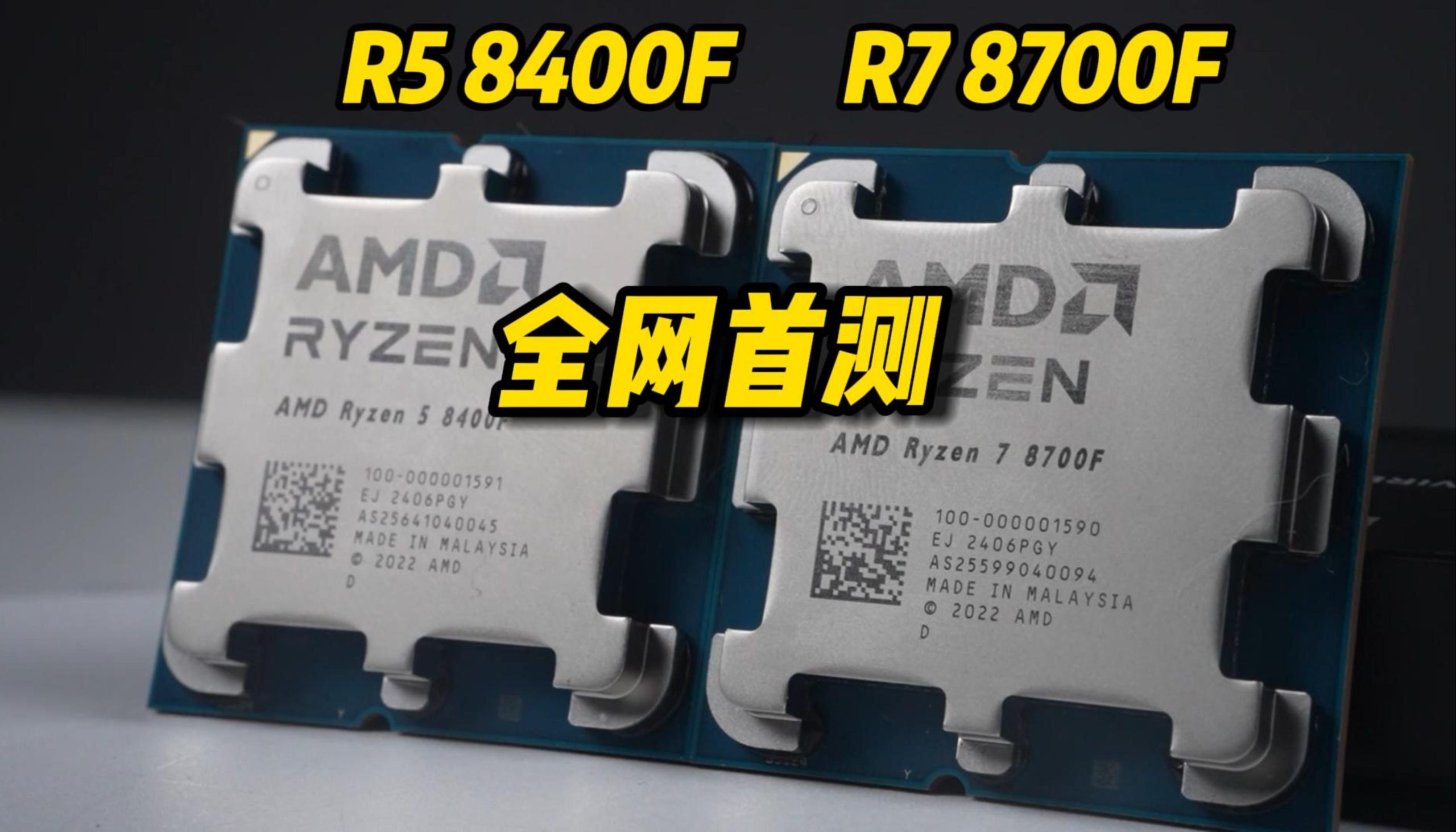
## AMD’s Ryzen 7 8700F & Ryzen 5 8400F APUs: Performance At An Affordable Price
AMD has recently been expanding its line of processors with the introduction of the Ryzen 7 8700F and Ryzen 5 8400F desktop APUs, aimed particularly at the Chinese market and for the AM5 socket. These new APUs are designed to appeal to the mainstream and budget gaming market by offering a more cost-effective solution while maintaining a performance standard that is close to their “G” series counterparts.
### Specifications Reveal Performance Similarities at Lower Costs
The Ryzen 7 8700F APU is built with 8 cores and 16 threads, aligning with the Zen 4 core architecture. It stands out with a base clock of 4.1 GHz and a boost clock of 5.05 GHz. Although the boost clock is slightly less than the Ryzen 7 8700G, the difference is a mere 0.05 GHz. Similarly, the base clock is only 0.10 GHz less than the Ryzen 7 8700G model. This APU also boasts 16 MB of L3 cache and foregoes an integrated RDNA 3 iGPU, emphasizing its focus on cost-efficiency over extra graphical power.
The Ryzen 5 8400F also packs a punch with 6 cores and 12 threads, matching the Zen 4 architecture. The APU comes with a base clock of 4.2 GHz and a boost clock of 4.75 GHz, which is a reduction of 0.25 GHz in boost clock compared to the Ryzen 5 8500G but a slight increase in the base clock. Equipped with the same 16 MB of L3 cache and 6 MB L2 cache as its sibling, it is also without the RDNA 3 iGPU. Both these APUs are configured with a thermal design power (TDP) of 65W.
### Testing and Performance Analysis
In testing, both the Ryzen 7 8700F and Ryzen 5 8400F have shown minimal difference in performance compared to their “G” variants. The Ryzen 7 8700F trails behind by about 2% at maximum, with differences being more pronounced in multi-threaded tasks. The Ryzen 5 8400F keeps pace in single-threaded applications but shows an 11% decrease in performance in multi-threading tasks, largely due to the 7000 series having an edge with more advanced chiplet architecture and doubled L3 cache.
### A Good Deal for the AM5 Platform Users
Though the prices for these chips have not been disclosed, expectations veer towards a slightly lower price point than the Ryzen 7 8700G and Ryzen 5 8500G. With the cost considered, these APUs could represent a smart choice for users who are looking to upgrade to or build on the AM5 platform without breaking the bank.
The Ryzen 8000G series highlights several APU options that target different segments of the desktop market. Each iteration offers varying core and thread counts, clock speeds, cache sizes, graphics units and power draws designed for specific use cases. While some are available widely, others are labeled OEM only, indicating that they may be limited to pre-built systems.
The introduction of these APUs underscores AMD’s strategic approach to providing varied options for diverse market needs, with an emphasis on delivering solid performance at a reduced cost for certain markets. Consumers considering a new or upgraded system based on the AM5 platform now have additional choices that could offer considerable value depending on their performance requirements and budget constraints.


