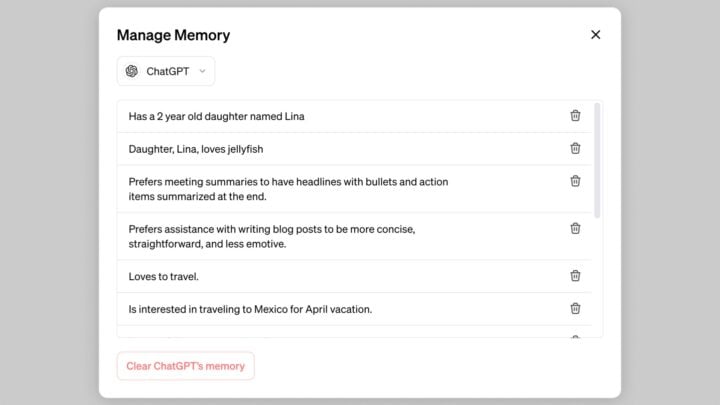
OpenAI has recently rolled out an exciting new feature for ChatGPT, which allows it to remember past interactions with users. This new functionality is designed to prevent users from having to repeat themselves, thereby enhancing the chatbot’s ability to conduct more meaningful and useful conversations, ultimately improving the overall user experience.
How ChatGPT’s Memory Works
ChatGPT’s enhanced memory capabilities work in two distinct ways:
First, the chatbot is now able to retain details from users’ conversations. For instance, if a user tells ChatGPT to write a birthday message for their wife named Anna, the chatbot will remember the user’s wife’s name moving forward. Consequently, if the user requests another birthday message for his wife in the future, ChatGPT will automatically personalize it using her name, Anna.
Secondly, users have the option to direct ChatGPT to remember specific information. If a user prefers information in bullet points, they can explicitly tell ChatGPT to remember this preference. Next time the user requests information on a topic, ChatGPT will deliver it in bullet-point format.
Managing ChatGPT’s Memory
If users decide they no longer want ChatGPT to retain certain details, they have the ability to instruct the chatbot to forget the information or remove these items directly from the settings page. Additionally, OpenAI has introduced a “temporary chat” feature, likened to an incognito mode, where details from the conversation are not remembered at all, and the data from these chats is not used for training the AI models. Those preferring not to utilize ChatGPT’s memory feature at all have the option to disable it completely in the settings.
Data Privacy and Feature Availability
OpenAI is proactive about user privacy, ensuring that sensitive information, particularly health-related data, is not stored unless a user specifically requests it to be remembered. Currently available to a select group of users, the timeframe for a broader rollout of this memory feature remains unclear. OpenAI plans to extend the feature to Team and Enterprise clients, as well as users of Custom GPT versions, following the initial deployment phase.
In conclusion, with the integration of this new feature, OpenAI aims to elevate the capabilities of ChatGPT, pushing the boundaries of AI-driven conversational excellence.