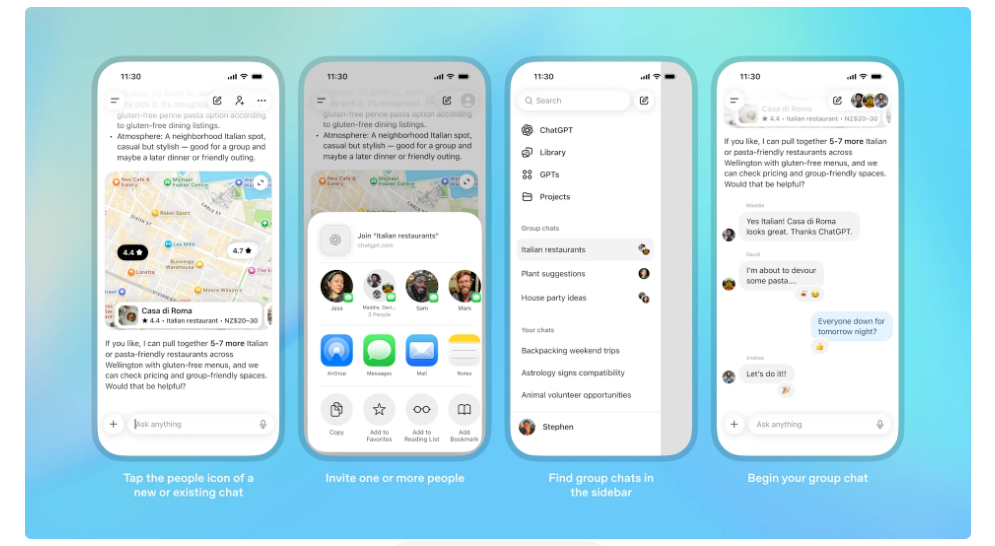
OpenAI is piloting a new group chat feature for ChatGPT that brings real-time collaboration directly into the app. Rolling out first in select regions—Japan, New Zealand, South Korea, and Taiwan—the trial is available on both mobile and web for Free, Plus, and Team users. The company describes this as a small first step toward a more shared experience in ChatGPT, with early feedback guiding how the feature scales to more regions and plans.
The concept is simple: multiple people can chat together with ChatGPT participating when needed. You can tag “ChatGPT” to prompt a response, and the assistant has been tuned with new social skills so it knows when to speak up and when to stay quiet. It can react with emojis and even use profile photos to create personalized images for the group, adding a more social, expressive layer to conversations.
Privacy and safety are central to the pilot. Private one-on-one chats and your personal ChatGPT memory remain completely private. Group chats are invitation-only, and members can leave at any time. Most participants can remove others if needed, while the group’s creator can only leave voluntarily. For users under 18, content is filtered and backed by extra safeguards and parental controls.
Starting a group is straightforward. Tap the people icon, then add participants directly or share an invitation link. Each group can include 1 to 20 people. If you add someone to an existing chat, ChatGPT automatically creates a new group so the original thread remains unchanged. Every group also has a short profile, and all conversations are neatly organized in a labeled sidebar for easy access.
Group chats work just like a regular ChatGPT thread but with multiple people in the mix. GPT‑5.1 Auto powers responses and supports a full toolkit of features: search, image generation, file uploads, and dictation. Usage limits are calculated fairly in group settings—only messages where ChatGPT replies count toward your hourly limits. Messages between human participants don’t count, so teams can discuss freely without burning through AI responses.
OpenAI is using this pilot to observe how people naturally collaborate with AI. Whether you’re brainstorming ideas, planning projects, organizing study sessions, or coordinating events, group chat puts the assistant in the same room as your colleagues, classmates, or friends. The early test will help refine moderation, controls, and participation dynamics before wider release.
The launch also reflects a broader shift in how the assistant is evolving—from a single-user tool to a more social, interactive platform. In late September, the company introduced Sora 2, a standalone social app centered on AI-generated videos. It features a TikTok-style feed with algorithmic recommendations based on activity and location, plus parental controls and direct messaging. Paired with group chat, these additions suggest a future where AI is woven into shared experiences, not just solo queries.
For now, if you’re in the initial rollout regions, you can start experimenting with group chat right away. Create a group, invite your collaborators, and tag “ChatGPT” when you want AI to chime in. With privacy protections, flexible controls, and powerful tools like image generation and search built in, this pilot is designed to make everyday coordination and creativity faster, more social, and more fun.