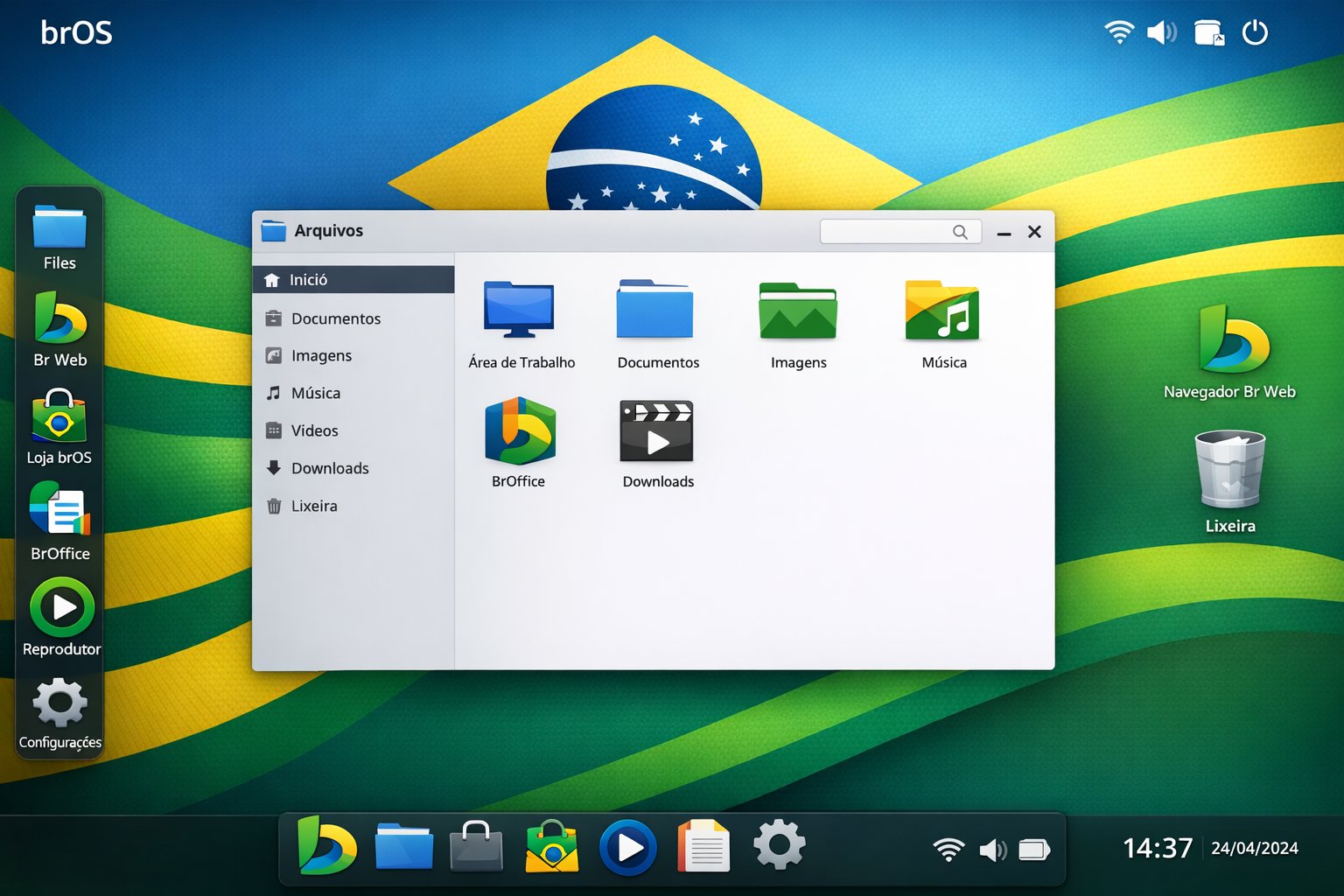
Br OS 13.4 has just landed, bringing a fresh update to this long-running Linux desktop distribution from Brazil. After years of being built on Ubuntu, Br OS has now firmly embraced Debian as its base, and this new release follows closely behind the arrival of Debian 13.4 “Trixie.” Even though the project hasn’t posted an official announcement yet, the new Br OS 13.4 ISO is already available to download, signaling that the upgrade is ready for users who want an up-to-date, software-packed desktop experience.
Br OS has always aimed to feel “fully loaded,” offering a complete desktop setup right out of the box rather than forcing users to hunt down essentials after installation. The distro’s journey has been a steady evolution: the first Br OS 20.05 was essentially a reengineered system built on Ubuntu 20.05, and it continued along that path through version 24.10. In mid-2025, the project made a major shift by switching to Debian with Br OS 12.11, and now Br OS 13.4 continues that Debian-based direction with the improvements that come along with the newer upstream release.
Because it’s tied closely to Debian 13.4, Br OS 13.4 should inherit many of the same key upgrades and fixes. That includes essential security updates touching widely used components like Wget2, glibc, OpenSSH, Wireshark, and PostgreSQL—important for anyone who cares about a safer daily driver system for work, browsing, development, or general home use. It also includes the latest Linux kernel version listed for Debian 13.4, 6.12.73, which typically means better hardware support, stability improvements, and ongoing security hardening.
Beyond security and the kernel, the update also brings a wave of fixes and refinements across well-known Linux desktop and server components. Users can expect various non-essential tweaks affecting software such as GNOME Shell, Apache2, Samba, Xen, and OpenSSL. KDE mail users get a specific quality-of-life improvement as well: Kmail should now display all folders correctly thanks to fixes in the akonadi package. On top of that, many packages were rebuilt against the updated glibc, including tools and utilities such as tripwire, tsocks, zsh, sash, and integrit, which helps keep the overall system consistent and compatible.
The Br OS 13.4 ISO comes in at about 4.2 GB, slightly smaller than the previous 4.3 GB image. Hardware requirements remain fairly accessible for a modern lightweight-to-midrange PC. The distro lists a dual-core 64-bit processor, 2 GB of RAM, and a graphics card with at least 128 MB of video memory as a baseline. For a smoother experience, the recommended specs include processors like the Intel Core i3-3220 or AMD Athlon X4 845, along with 4 GB of memory and entry-level dedicated graphics such as the Nvidia GT 610 or Radeon HD 5450.
For Linux users who prefer a desktop-focused system that arrives with plenty of software preinstalled—and for anyone curious about how Br OS is evolving now that it’s Debian-based—Br OS 13.4 looks like a timely update worth a closer look. As more official release details emerge, users can expect a clearer list of Br OS-specific changes beyond the Debian 13.4 foundation, but the security fixes, kernel update, and broad package improvements already make this release a meaningful step forward.


