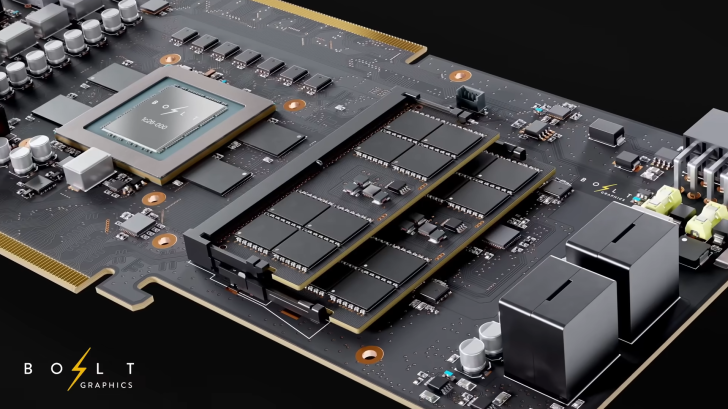
Bolt Graphics is shaking up the tech world with its ambitious new project, the “Zeus” GPU, promising to deliver unprecedented performance leaps that sound straight out of a science fiction novel. Built to outshine existing industry giants NVIDIA and AMD, the Zeus is designed for rendering, High-Performance Computing (HPC), and gaming, claiming to be a game-changer in every sense.
Founded by Darwesh Singh in 2020, Bolt Graphics initially focused on enhancing hardware-accelerated ray tracing technology in movies and gaming. With the introduction of Zeus, the company has set its sights on breaking performance barriers. According to their bold claims, Zeus offers up to 10 times the performance of the futuristic GeForce RTX 5090 and is reportedly 12 times faster in FP64 HPC tasks. An eyebrow-raising claim is its EM Simulation Performance, which the company suggests surpasses NVIDIA’s Blackwell B200 by 300 times. However, these are pre-silicon benchmarks conducted in emulation, and concrete proof remains absent until the product hits the market.
What’s truly fascinating about the Zeus is its innovative modular design. This powerhouse features LPDDR5X memory and, impressively, two additional DDR5 SODIMM slots, allowing VRAM expansion up to a colossal 384 GB. Even more intriguing is its incorporation of an RJ-45 network port, a rarity in consumer graphics cards, alongside two PCI-E 5.0 x16 connectors.
Despite its high-performance capabilities, Zeus defies expectations by maintaining energy efficiency. Surprisingly, it reportedly operates on just a single 8-pin PCI-E connector, drawing only 120W of power. The Zeus GPU lineup will include three variants: a single-chiplet option, and more powerful dual and quad chiplet configurations. These designs boast TDPs from 120W to 500W, with ray tracing power ranging from 77 up to 307 Gigarays and on-chip cache varying from 128 MB to 512 MB.
While the product teases technology that seems ahead of its time, skepticism remains about its feasibility until Zeus is officially unveiled and tested. The anticipation surrounding Bolt Graphics’ Zeus is palpable, and if it’s anything as extraordinary as the company claims, it could redefine what’s possible in the world of consumer graphics technology. For now, we can only wait and watch with cautious excitement.


