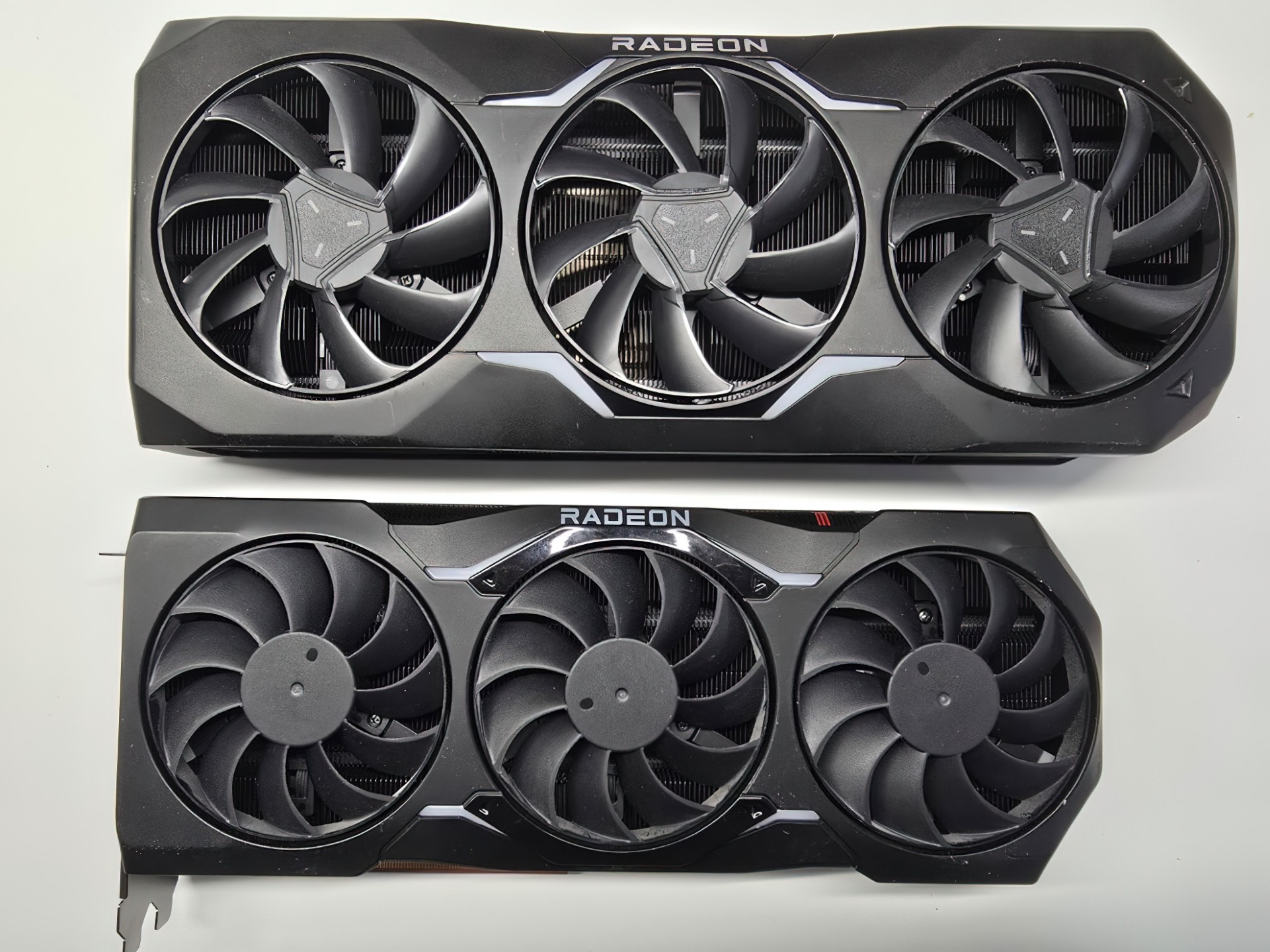
An intriguing discovery has surfaced online: a prototype cooler for an unreleased AMD Radeon RX 7000 GPU. This cooler, boasting a hefty 3-slot design, suggests that at some point, AMD might have been developing a rival for NVIDIA’s RTX 4090 during its Radeon RX 7000 series.
A member of the Quasarzone forum found this prototype cooler on a Chinese marketplace, not realizing its uniqueness until comparing it with a Radeon RX 7900 XTX. The prototype is notably larger, featuring some fascinating modifications.
The first noticeable difference is its thickness. This cooler is significantly bulkier than the standard Radeon RX 7900 XTX and adopts a triple-slot design. Its LED setup is altered, yet it retains a look similar to the existing reference cards. Noteworthy are the three aluminum fins, painted red to signify the “RDNA 3” series. The card extends to 33cm, contrasting with the 29cm length of the 7900 XTX.
A particularly intriguing aspect is the cutout area designed for power connectors, accommodating three 8-pin connectors—one more than the existing top-tier 7900 XTX. While some models do feature three connectors, this setup is less common.
The heatsink in this prototype utilizes a copper-based baseplate with dedicated connections for both the VRAM and GPU, hinting at a larger baseplate than what’s found on the 7900 XTX’s reference model.
Although this is speculative, AMD has previously indicated the possibility of crafting an RTX 4090 competitor within the RDNA 3 series, a venture they decided against. Could this cooler be linked to the development of such a high-powered graphics card? While we may never have concrete answers, the clues are tantalizing.
AMD cited power and cost as primary factors for not venturing beyond the Navi 31 die within RDNA 3. Whether the intention was to overclock the Navi 31 GPU—leading to higher temperatures and power use—or to introduce a new GPU that didn’t reach the market remains unclear.
Prototype GPU coolers often emerge long before or after product launches. NVIDIA’s own unreleased models for the RTX 4090, Titan, and 4090 Ti are examples. This process underscores the extensive evaluation and testing that occurs before a product hits the shelves.
Ultimately, GPU prototypes frequently undergo multiple revisions, and what we see online can significantly differ from the final retail product. This discovery serves as a fascinating glimpse into what could have been in the world of high-performance computing.