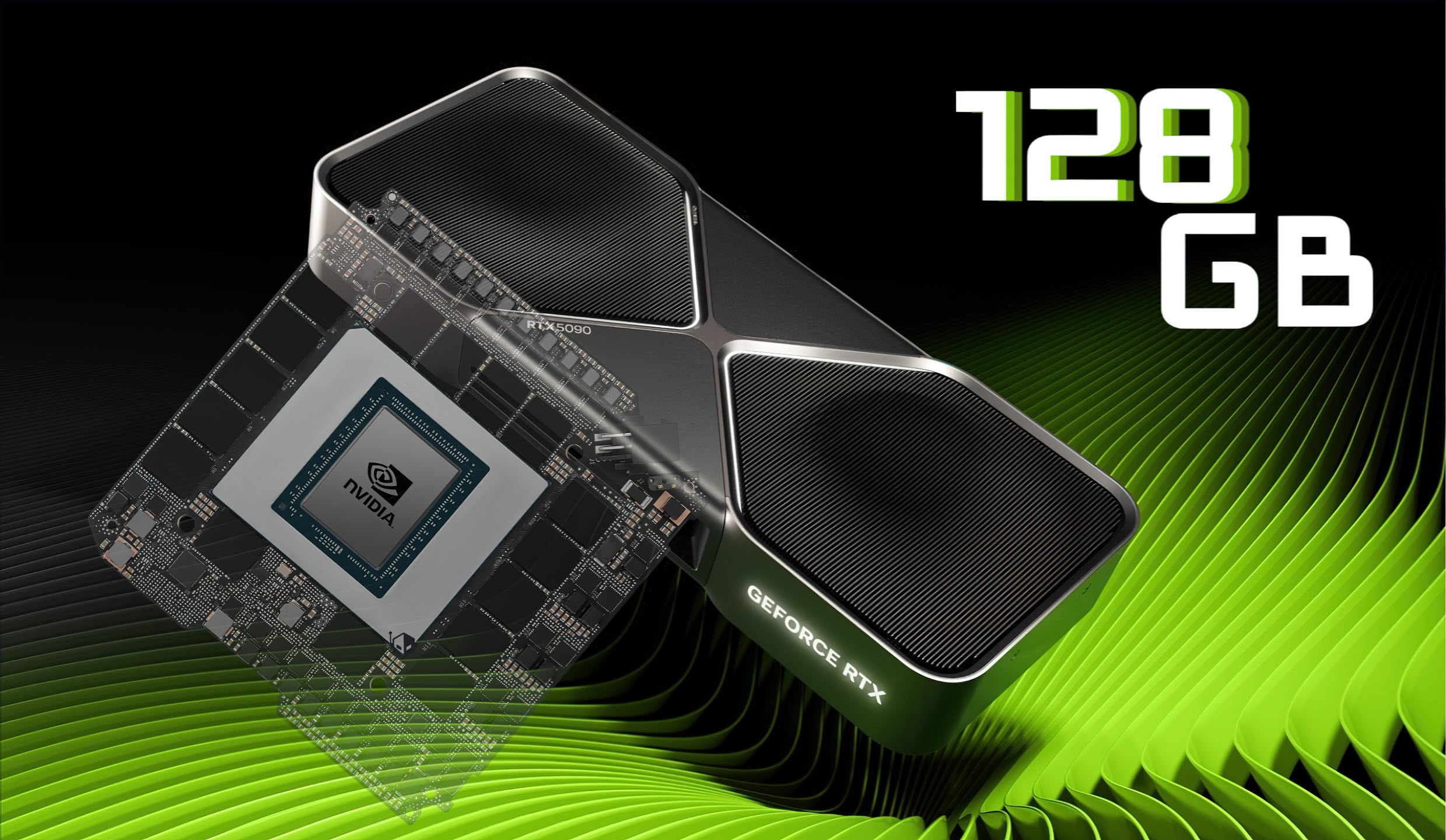
Custom NVIDIA GeForce RTX 5090 with 128 GB VRAM reportedly surfaces in China, targeting AI buyers at a premium price
China’s gray-market AI hardware scene is pushing the limits again. According to a recent leak, the NVIDIA GeForce RTX 5090 is the latest gaming GPU to undergo a heavy-duty makeover, emerging with a staggering 128 GB of GDDR7 memory. That’s four times the stock 32 GB configuration and aimed squarely at AI workloads, not gaming.
How these ultra-high-VRAM cards are made
– Factories salvage GPUs and memory from retail graphics cards and mount them on custom PCBs designed for dual-sided memory layouts.
– They pair the hardware with modified firmware and BIOS to ensure the GPU can address the expanded memory.
– Many of these conversions also adopt a two-slot blower-style cooler that’s friendlier for racks, workstations, and dense server environments.
The memory math and why it’s controversial
– Stock RTX 5090: 32 GB GDDR7.
– The leaked build claims 128 GB using a dual-sided PCB and higher-density GDDR7 modules.
– Here’s the catch: publicly available GDDR7 densities today are widely known at 16 Gb and 24 Gb per chip (roughly 2 GB and 3 GB per module). Even with dual-sided designs, that typically caps out at 96 GB, similar to pro-grade cards like the RTX PRO 6000.
– Hitting 128 GB suggests either access to 32 Gb GDDR7 modules that aren’t broadly available, a very unconventional memory configuration, or the possibility that the claim is inaccurate.
Despite the skepticism, the screenshot shared by the source shows the card detected with 128 GB of VRAM and running driver version 550.144.03.
Pricing, availability, and who it’s for
– Standard RTX 5090 MSRP is listed at $1,999, though real-world pricing often lands between $2,500 and $3,000.
– The custom 128 GB variant is reportedly around $13,200, roughly 6.6 times the MSRP for four times the memory.
– For comparison, the RTX PRO 6000 Blackwell with 96 GB VRAM sits near $10,000. This custom 5090 is about 33% more expensive for roughly 33% more memory.
– These units are not official NVIDIA products and are reportedly sold directly by the factories to AI and data science customers who prioritize massive VRAM pools for large models, fine-tuning, and high-resolution inference. For gaming, 128 GB brings no practical benefit today.
Why this market exists
– Demand for AI-capable GPUs in parts of Asia is intense, while official enterprise accelerators remain pricey, tariff-burdened, or restricted.
– As a result, custom conversions of gaming cards have surged, offering more VRAM, server-friendly coolers, and firmware tweaks that bridge the gap for AI users on tighter timelines.
What to watch next
– Proof will hinge on PCB photos, memory module close-ups, and sustained performance validation under AI workloads.
– If 32 Gb GDDR7 dies are indeed in play, it would be a notable development for the broader GPU ecosystem. If not, expect this claim to face further scrutiny.
Bottom line
A 128 GB GeForce RTX 5090 is an eye-catching proposition for AI practitioners who crave VRAM capacity above all else, but the technical feasibility of hitting that number with today’s known GDDR7 densities remains the biggest question. Until there’s hard evidence from teardown images or independent testing, treat the claims with caution—even as the price and positioning make sense in a market hungry for more memory at any cost.