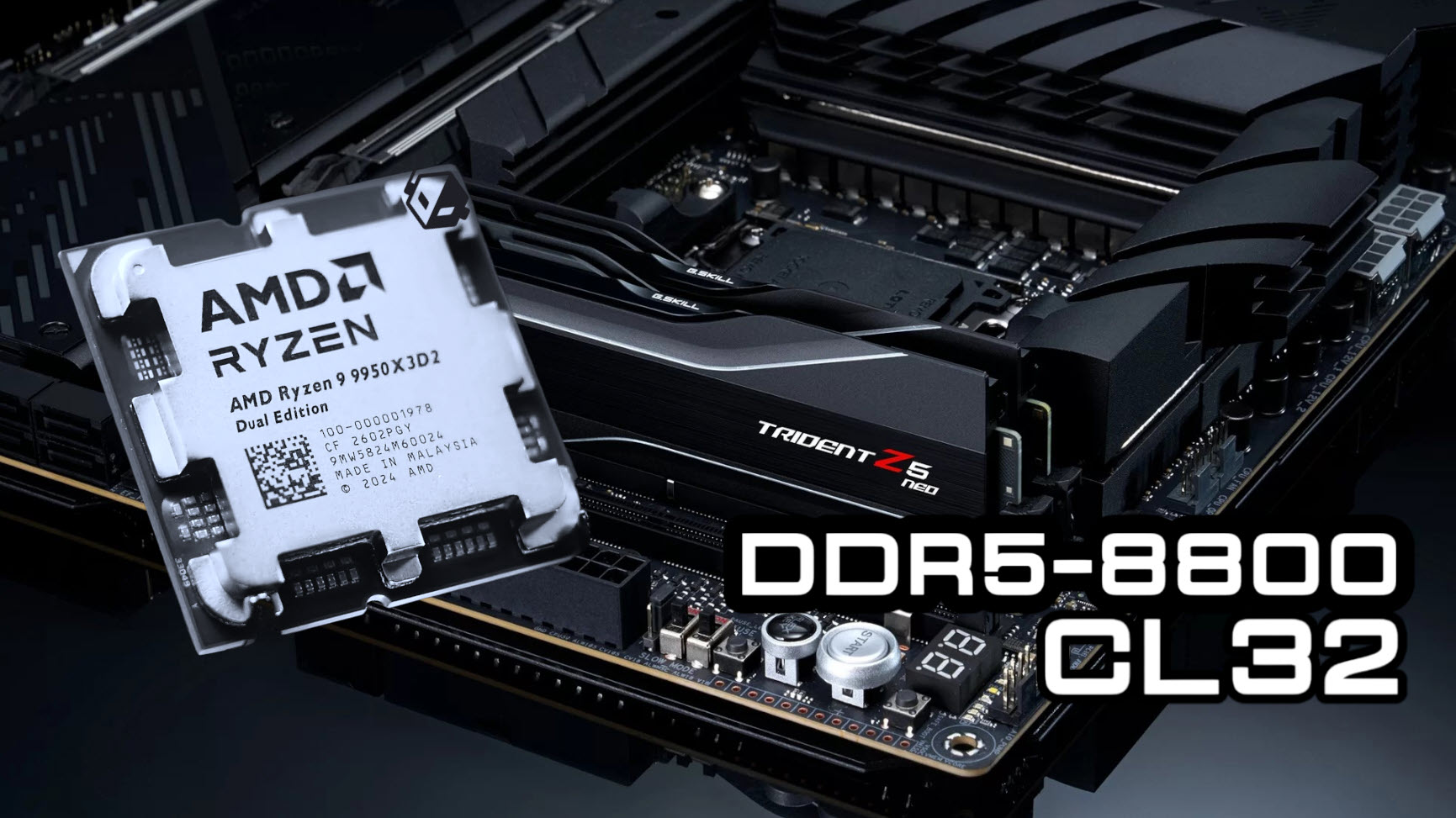
ASUS has given overclockers something new to get excited about on AMD’s AM5 platform. When paired with AMD’s upcoming Ryzen 9 9950X3D2 Dual Edition, the ASUS ROG Crosshair X870E APEX is showing eye-catching DDR5 overclocking results that highlight just how far Ryzen memory tuning has come.
The Ryzen 9 9950X3D2 Dual Edition is being positioned as an enthusiast-class powerhouse, combining top-end CPU performance with a massive cache configuration enabled by AMD’s 2nd Gen 3D V-Cache technology. With that kind of hardware at the center of an AM5 build, it’s no surprise that early testing is drawing attention—especially from users who care about high-frequency DDR5 and tight timings.
In a recent DDR5 overclock showcase, the test system used the ASUS ROG Crosshair X870E APEX motherboard, the Ryzen 9 9950X3D2 Dual Edition CPU, and a 32GB DDR5 memory setup. What makes the results more impressive is that the overclock was achieved on air cooling rather than extreme cooling methods.
The motherboard was running a fresh AMD firmware update as well, using the latest AGESA 1.3.0.1 BIOS (ASUS 2201 BETA). With this combination of new BIOS support and AMD’s newest flagship Ryzen chip, the platform reportedly hit DDR5-8800 while maintaining CL32 timings. For anyone familiar with DDR5 tuning, that pairing of high speed and low latency is a big deal.
While it’s true that record-breaking DDR5 overclocks can push far beyond 10,000 MT/s under specialized conditions, DDR5-8800 at CL32 stands out because it balances frequency with unusually tight timings. Many DDR5-8000 kits commonly run around CL40, and timings lower than CL40 are generally more typical at lower frequencies. Seeing CL32 at 8800 MT/s signals strong memory controller behavior and solid motherboard-level tuning.
The memory used in the test was from G.Skill, labeled F5-6000J2636G16G, which corresponds to a Trident Z5 NEO kit rated for DDR5-6000 with CL26 timings. Jumping from 6000 MT/s to 8800 MT/s represents a 46.6% increase in memory speed while still keeping latency in a highly competitive range—exactly the kind of gain performance enthusiasts chase when building a high-end Ryzen gaming and productivity PC.
Overall, these early numbers suggest AMD’s AM5 platform is continuing to mature rapidly in memory compatibility and overclocking headroom. Intel may still hold certain advantages with technologies like CUDIMM and CQDIMM support, but expectations are building that similar memory advancements could arrive for AM5 in future motherboard generations—especially as the industry looks ahead to next-wave platforms and upcoming CPU architectures.
For anyone planning a premium AM5 build, the combination of a Ryzen 9 9950X3D2 Dual Edition and an ASUS ROG Crosshair X870E APEX is shaping up to be a serious contender for elite DDR5 performance, especially for users who want high frequency without giving up tight timings.


