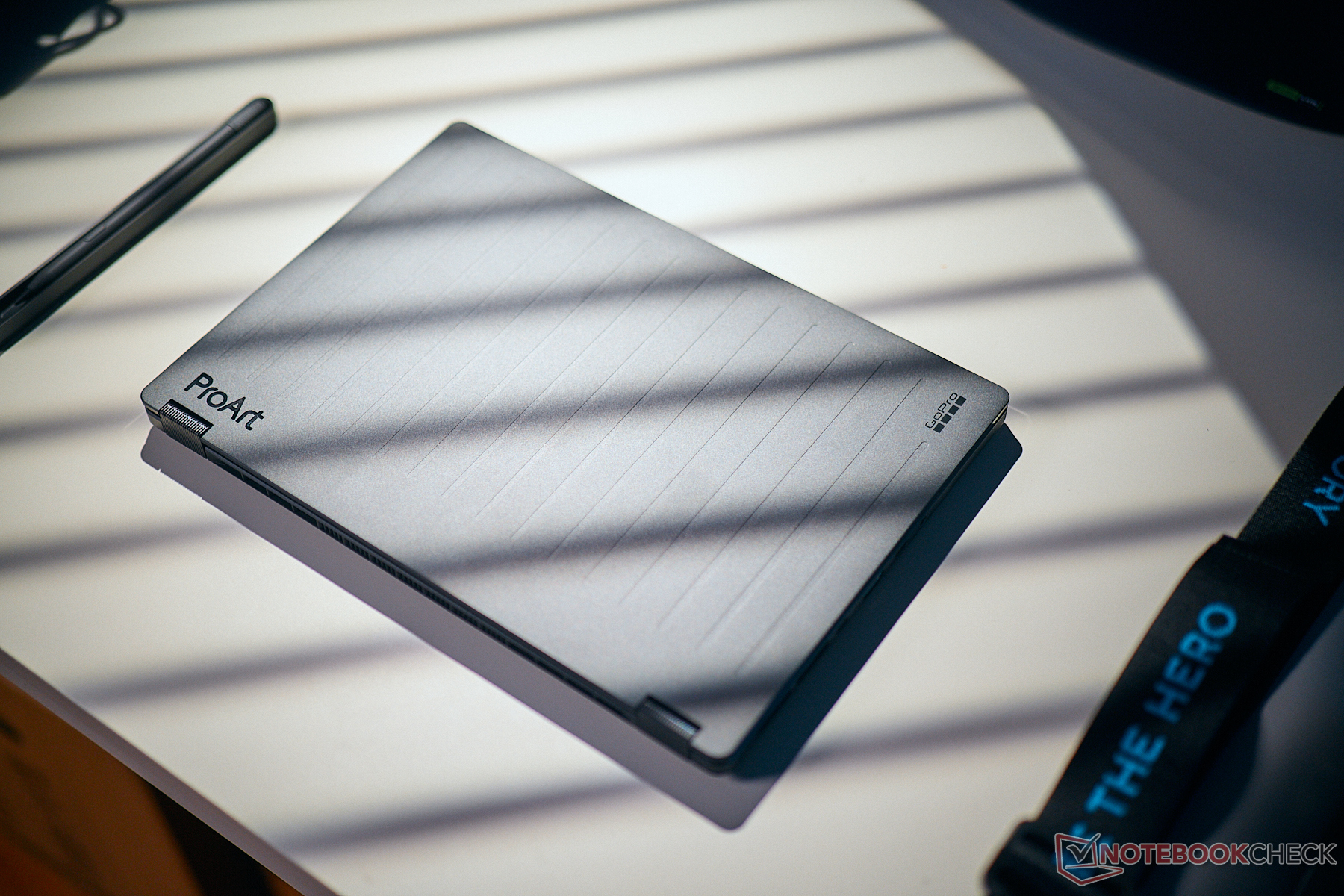
Asus has refreshed its compact 13.3-inch convertible ProArt PX13 for 2026, and the biggest change is under the hood. The new ProArt PX13 GoPro Edition moves away from a dedicated Nvidia laptop graphics card and instead adopts AMD’s high-end Strix Halo platform, pairing the Ryzen AI Max+ 395 with the Radeon 8060S graphics and a massive 128GB of RAM. While the updated model brings clear gains in certain creator-focused workloads, the generational leap won’t look the same in every scenario.
Despite the updated GoPro Edition styling, the core design remains familiar. The chassis construction is essentially unchanged from the earlier ProArt PX13 configuration, keeping the same compact, portable convertible concept aimed squarely at creative professionals who want a powerful machine in a small form factor.
Where the new ProArt PX13 really shifts direction is performance strategy. The previous model combined an AMD Ryzen AI 9 HX 370 with an Nvidia GeForce RTX 4070 Laptop GPU. The 2026 version instead leans on AMD’s Ryzen AI Max+ 395, a Zen 5-based chip, with integrated Radeon 8060S graphics. For daily use, single-core performance doesn’t meaningfully change because both chips are built on Zen 5, so general responsiveness and light creative work will feel similar.
The larger improvement appears when you push sustained multi-core workloads. With 16 Zen 5 cores—four more than the earlier configuration—the new model can deliver roughly a 30% to 50% uplift in multi-threaded benchmarks, depending on the test. That makes it especially appealing for tasks like heavy multitasking, CPU-based rendering, exporting large batches of photos, or other applications that scale well with more cores.
Graphics performance is where expectations may need recalibrating. On paper, the Radeon 8060S is powerful, but in practice its raw GPU performance is only marginally better than the older model’s RTX 4070 Laptop. Gaming performance also ends up looking very similar between the two versions, meaning this update isn’t a clear “upgrade” if gaming is your priority. In fact, newer dedicated GPU options in the market can still pull ahead.
That said, the AMD approach brings an advantage that matters a lot to certain creative workflows: memory flexibility. With an iGPU design that uses shared memory, the system isn’t restricted to a fixed 8GB VRAM pool like many dedicated laptop GPUs in this class. For large video timelines, high-resolution textures, complex photo composites, or other memory-hungry projects, having far more memory available to the graphics portion of the system can be a genuine benefit. On the flip side, Nvidia still tends to retain an edge in CGI-focused performance, which may influence users whose software stack heavily favors those acceleration paths.
Overall, the 2026 Asus ProArt PX13 GoPro Edition positions itself as a powerful, compact 2-in-1 laptop for creative users who value strong multi-core CPU performance and very high memory capacity in a portable convertible. It doesn’t dramatically change everyday speed, and it won’t necessarily deliver a big jump in gaming, but it does meaningfully broaden capability for heavier creation workloads—especially projects that can benefit from more cores and more accessible memory.