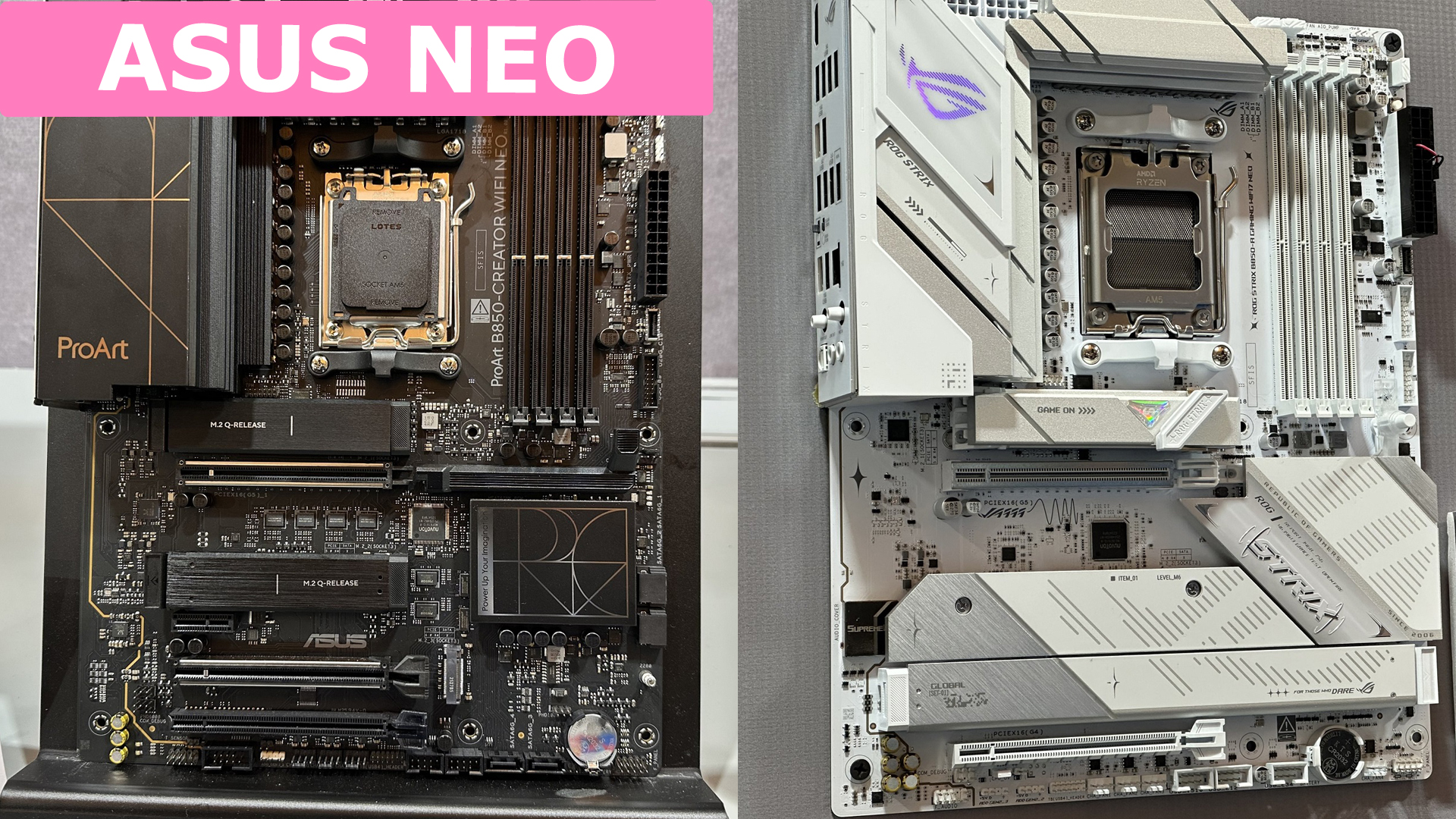
ASUS is expanding its NEO motherboard lineup for AMD’s latest 800-series chipsets, and while the overall approach remains familiar, a handful of smart layout tweaks and builder-friendly upgrades make these boards worth a closer look. Shown off around CES, the new NEO range targets both B850 and X870 platforms and spans several popular ASUS families, including ROG Strix, TUF Gaming, and ProArt. The biggest focus is clearly on the mid-range, where ASUS is refreshing existing favorites with updated connectors, refined placement, and easier upgrade paths.
ROG Strix gets the most attention in this launch, with four NEO boards in total: two based on the X870E chipset and two using B850. The X870E options are the ROG Strix X870E-E Gaming WiFi7 NEO and the ROG Strix X870E-A Gaming WiFi7 NEO, and they show the most visible changes compared to their non-NEO counterparts. The X870E-E model in particular stands out with a more distinctive look, plus a new connector positioned close to the CPU socket.
That extra connector is designed for ASUS’s new AIO Q-Connector, aimed specifically at AIO liquid coolers. The idea is to simplify installation and reduce cable clutter by enabling a wireless-style connection between select ASUS all-in-one coolers, including the ROG Strix LC IV series, and the motherboard. For PC builders who care about a clean, streamlined build, this is one of the most interesting practical upgrades in the NEO refresh.
Across the ROG Strix NEO boards, ASUS is also leaning into its DIY-friendly theme, with changes meant to make building and upgrading less stressful. One notable move is the return of the earlier PCIe Q-Release button mechanism. ASUS previously adjusted this feature, but the existing version was reportedly linked to PCB scratching. The NEO boards go back to the older approach to make graphics card removal safer and more comfortable.
This same PCIe Q-Release change also appears on the B850-based ROG Strix models: the ROG Strix B850-A Gaming WiFi7 NEO and the ROG Strix B850-F Gaming WiFi7 NEO. Visually, these boards don’t introduce major redesigns, but ASUS says the NEO versions include an optimized PCIe lane layout intended to improve upgrade flexibility—something that matters for anyone planning multiple storage additions or future GPU and expansion card swaps.
The TUF Gaming side of the lineup currently includes one NEO model: the TUF Gaming B850-PRO WiFi7 W NEO. This board is built to appeal to users who want a more rugged, practical design with strong power delivery. ASUS equips it with a 14+2+1 VRM setup featuring 80A DrMOS stages, and it also includes a 64 MB BIOS chip. According to ASUS, that BIOS capacity is meant to support both current AMD Ryzen processors and upcoming next-gen Ryzen CPUs. It continues the brand’s easy-build approach with helpful placement decisions and clearly defined heatsinks, including a standout heatsink design for M.2 SSD cooling. The board also leans heavily into an all-white theme while offering plenty of connector options for expansion and upgrades.
For creators and workstation-focused buyers, the ProArt B850-CREATOR WiFi NEO rounds out the set. ASUS positions it as a strong mid-range B850 motherboard aimed at professional workloads, with an emphasis on connectivity and expansion. It includes multiple PCIe x16 slots and features M.2 Q-Release slots to speed up SSD installation and removal—useful for builders who frequently upgrade storage or manage multiple drives.
ASUS hasn’t shared official pricing or exact release dates yet, but the expectation is that these 800-series NEO motherboards will start appearing at retailers soon.
One additional detail that may matter to long-term owners: ASUS has mentioned that future BIOS updates could demand more onboard storage space to maintain and expand CPU support. If that happens, ASUS may need to remove the onboard WiFi driver from the BIOS storage to make room, though the company says it will include the driver as long as space allows. For most users this won’t be a deal-breaker, but it’s worth knowing—especially for anyone who prefers the convenience of having WiFi drivers embedded and ready during a fresh Windows install.
Overall, the ASUS 800-series NEO lineup looks like a refinement pass rather than a full reinvention: small but meaningful quality-of-life improvements, better component placement, and a continued push toward easier building and cleaner setups—especially for AMD Ryzen users planning a modern WiFi 7-ready PC build.


