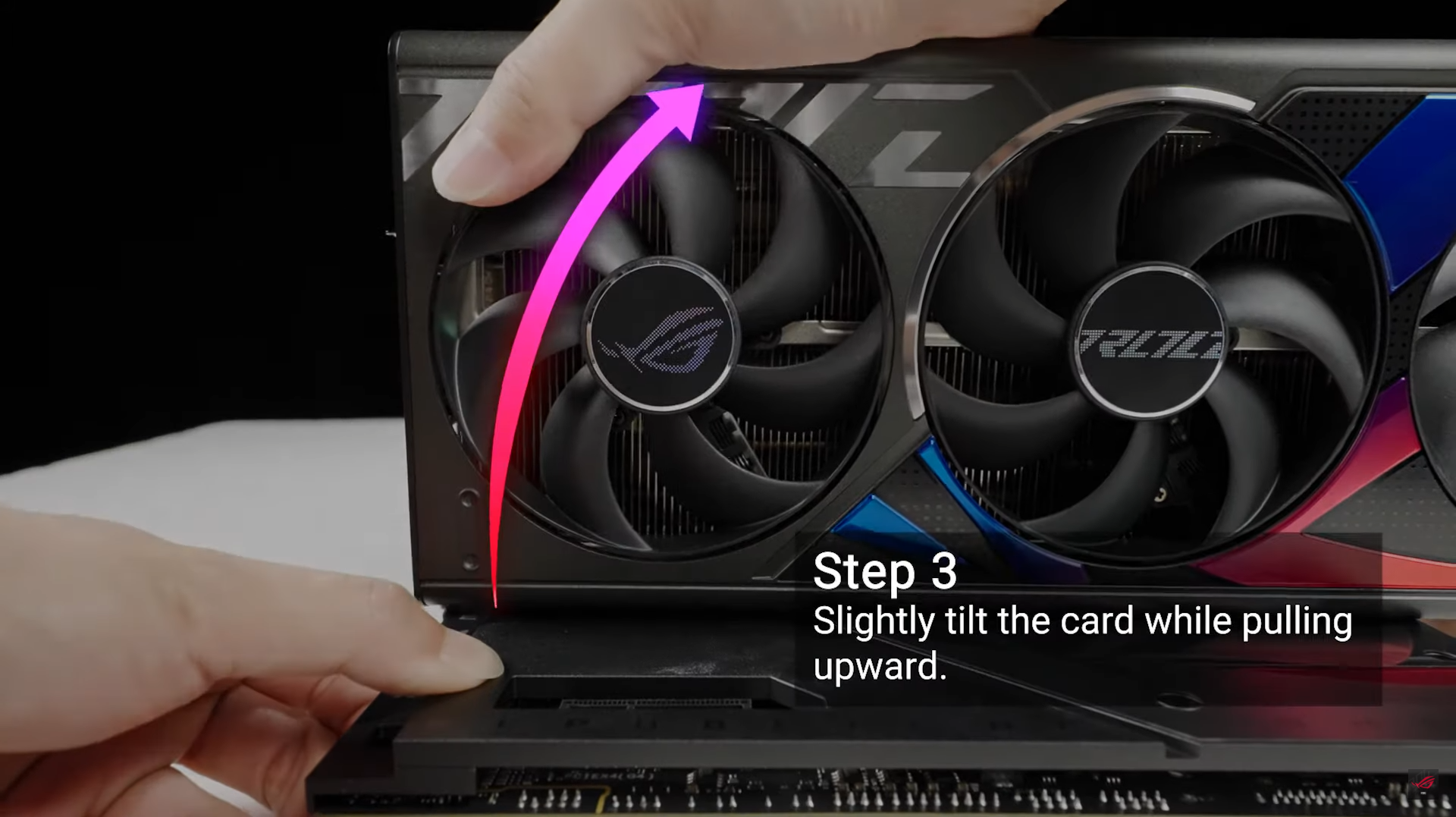
The bustling world of technology is facing a new challenge: ASUS’s innovative Q-Release mechanism on their Intel and AMD 800 Series motherboards has been reported to cause permanent damage to the PCIe interface of GPUs. This issue has caught the attention of many tech enthusiasts and professionals who have experienced firsthand the detrimental effects on their precious graphics cards.
The Q-Release mechanism, introduced by ASUS, was designed with convenience in mind. It allows users to extract their graphics cards easily without manually maneuvering the switch at the PCIe x16 slot’s end. While this concept came across as a game-changer on paper, in reality, several users across forums and tech communities have expressed serious concerns. Unfortunately, the very feature that promised ease has inadvertently led to physical damages, specifically to the PCIe connectors of various GPUs.
Illustrations of the problem reveal that when GPUs are removed using this mechanism, the connectors at the base, which fit into the PEG slot, can get severely damaged. For instance, a user who employed the RTX 4070 Ti Super HOF OC LAB on an ROG Strix B850-A Gaming Wi-Fi S motherboard reported damage. Similar tales of woe continue with a user on Chiphell witnessing damage to their RX 7900 XTX GPU when detached from an ROG Crosshair X870E Hero motherboard.
Andreas Schilling, from HardwareLuxx, also experienced issues with his brand-new RTX 5090 graphics card while using an ASUS ROG STRIX X870E-E Gaming motherboard. Schilling shared his discontent, noting that repeated card removals resulted in visible damage, highlighting the problem’s widespread and recurring nature.
Currently, ASUS has been informed of these incidents and is reportedly working on a solution. However, there’s no word yet on whether ASUS will compensate those affected by these damages. As a precaution, users with ASUS 800 series motherboards equipped with the Q-Release mechanism are advised to minimize the removal and reinstallation of their GPUs until further instructions from ASUS are provided.
The tech community remains hopeful that ASUS will address the issue promptly and provide a robust solution to regain the trust of its users and ensure that such situations do not recur. As always in the realm of technology, innovation needs to be tempered with careful execution to ensure it enhances user experiences rather than hinders them.