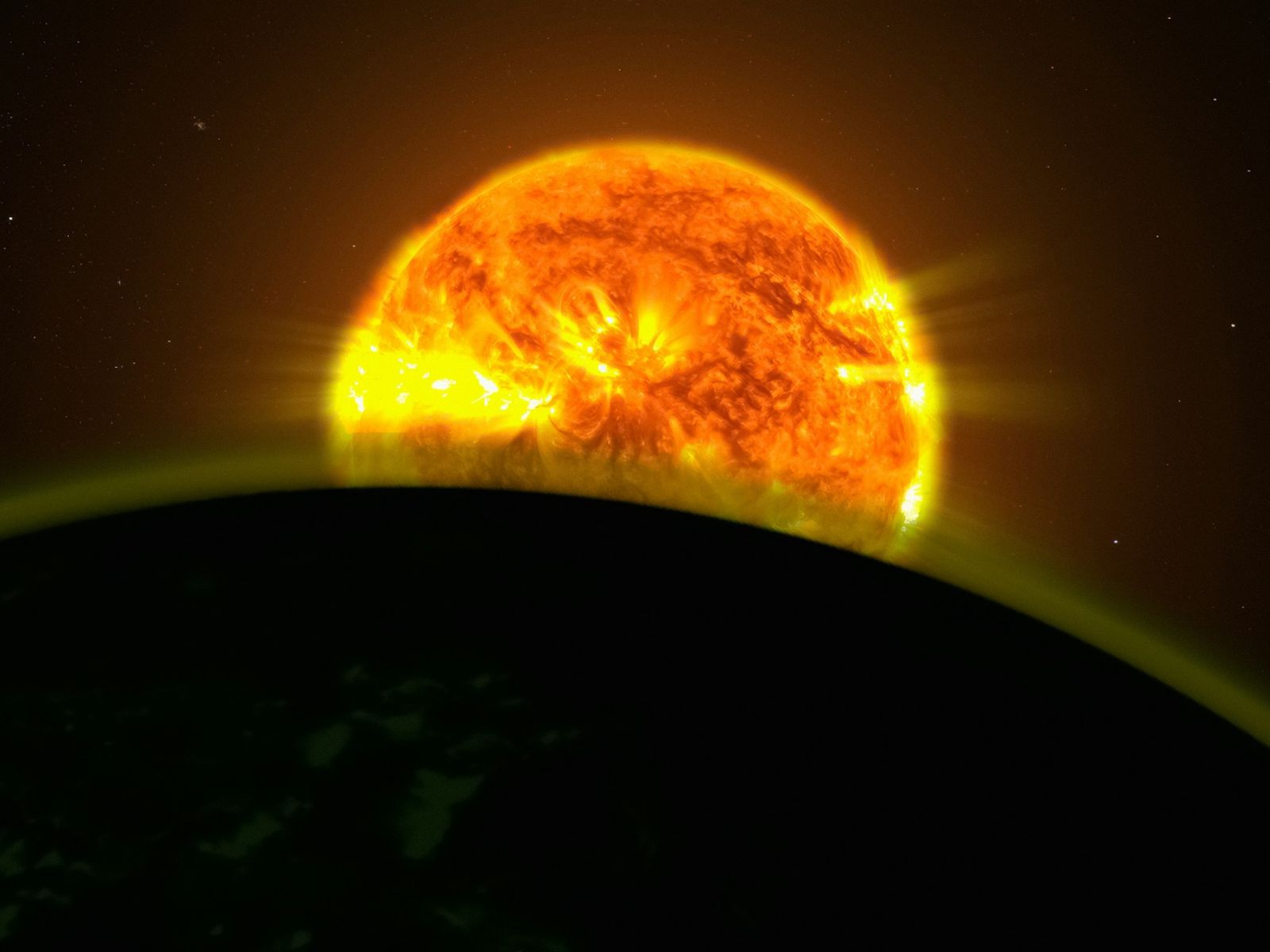
Betelgeuse surprises astronomers with a strange, uneven surface
Betelgeuse, the famous red supergiant in the constellation Orion, has fascinated skywatchers for centuries. Easily recognized as one of Orion’s brightest stars, it has long been studied because of its enormous size, unstable behavior, and potential to one day explode as a supernova. Now, new observations have revealed something even more intriguing: Betelgeuse’s surface is far from smooth.
Using the Atacama Large Millimeter/submillimeter Array, better known as ALMA, astronomers examined the star in remarkable detail. The observations show that Betelgeuse has an irregular, bumpy surface along with two unusually hot regions. This makes it very different from the Sun, whose surface activity is shaped by much smaller-scale processes compared with the dramatic conditions found on a red supergiant.
Betelgeuse is nearing the final chapter of its stellar life. It has already used up the hydrogen in its core, a major sign that the star has moved into an advanced stage of evolution. Although it has about 20 times the mass of the Sun, its radius is roughly 800 times larger, making it one of the most extreme stars visible to the naked eye.
The strange shape seen on Betelgeuse may be caused by huge movements of hot plasma inside the star. As this plasma rises and shifts, it can create powerful shock waves that travel through the star’s atmosphere. These shock waves may be responsible for the uneven appearance detected in the latest observations.
One of the most interesting findings comes from comparing ALMA observations taken in 2023 with earlier images from 2015. Astronomers found that one of the hot regions on Betelgeuse appears to have lasted for at least seven years. That suggests these surface features are not just short-lived disturbances, but may be part of deeper, longer-lasting activity within the star.
Researchers also studied the star’s atmosphere and estimated its temperature at about 3,680 degrees Fahrenheit, or 2,030 degrees Celsius. While that is much cooler than the surface of the Sun, Betelgeuse’s massive size and unstable outer layers make it an extraordinary object for studying the late stages of stellar evolution.
Betelgeuse often makes headlines because it is expected to explode as a supernova at some point in the future. When that happens, it could become one of the most spectacular astronomical events ever seen from Earth. The explosion would likely be bright enough to be visible in the daytime sky and would give scientists a rare opportunity to study a nearby supernova in exceptional detail.
However, the timing remains uncertain. Betelgeuse could explode tomorrow, or it may not happen for thousands of years. For now, astronomers continue to monitor this giant star closely, hoping that every new observation will reveal more about how massive stars live, change, and eventually die.
The latest findings confirm that Betelgeuse is not only one of the most recognizable stars in the night sky, but also one of the most scientifically valuable. Its strange surface, persistent hot spots, and turbulent atmosphere offer a fascinating glimpse into the final stages of a massive star’s life.