Astronomers Spot a Star Slowly Devouring a Brown Dwarf in the Milky Way
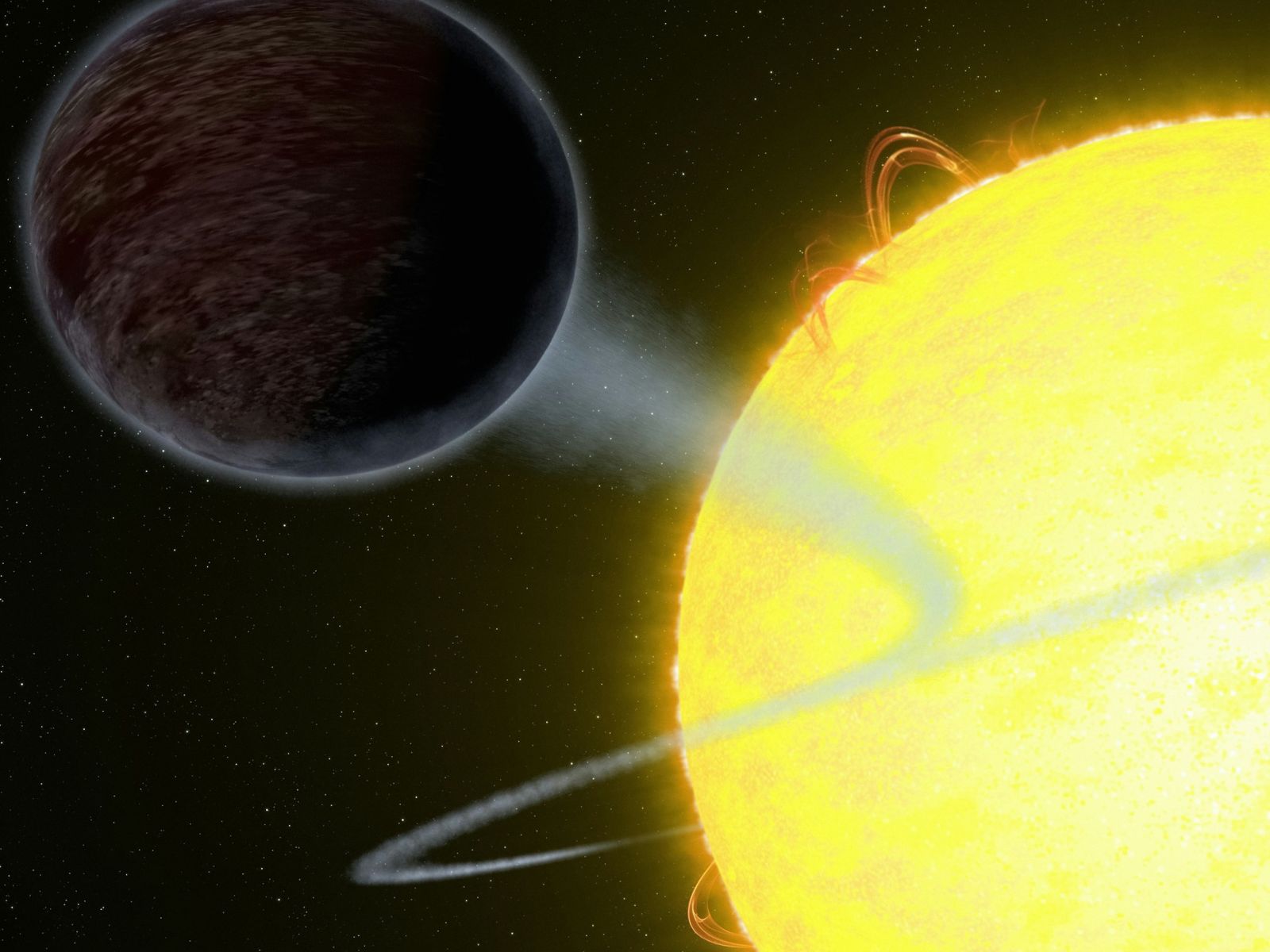
Astronomers have identified a remarkable cosmic system in our own Milky Way where a small star is gradually consuming a nearby brown dwarf. Even more astonishing, this slow-motion stellar feeding process may continue for billions of years.
The system, known as ZTF J0440+2325, is located roughly 300 light-years from Earth. It contains two unusual objects locked in an extremely tight orbit: a low-mass star and a brown dwarf, often described as a “failed star.”
Brown dwarfs sit in the space between giant planets and true stars. They are far more massive than Jupiter, typically ranging from about 13 to 80 Jupiter masses, but they do not have enough mass to sustain stable hydrogen fusion in their cores. That means they never fully ignite like ordinary stars.
In this case, the brown dwarf appears to be losing material to its stellar companion. The star is pulling matter away from the brown dwarf and adding it to itself, a process known as accretion.
The unusual system was first detected through data from the Zwicky Transient Facility, a sky survey designed to spot changing objects in space. Researchers noticed a strange brightness pattern that stood out from the data. The variation had a sharp, triangular appearance, suggesting that something unusual was happening between two closely orbiting objects.
At first, scientists considered whether the signal could come from a so-called black widow binary, a system in which a dense neutron star strips material from a companion star. However, further observations revealed a different and equally fascinating explanation.
The system appears to consist of a star with a mass of about 85 times that of Jupiter and a brown dwarf with a mass of around 25 times Jupiter’s mass. The brown dwarf orbits the star incredibly quickly, completing one full orbit in just 86.65 minutes.
That means the two objects are separated by a very small distance on astronomical scales. Their close orbit allows the star to draw material from the brown dwarf, slowly eroding it over time.
Simulations suggest that the star is consuming matter from the brown dwarf at a rate of about one hundred-thousandth of Earth’s mass per year. While that may sound tiny, it is significant over cosmic timescales. Given enough time, the transfer of material could dramatically alter the brown dwarf’s future.
What makes ZTF J0440+2325 especially intriguing is how long this stellar feeding process may continue. Astronomers estimate that the interaction could persist for several billion years, offering a rare glimpse into a long-lived stage of stellar evolution.
Systems like this are valuable because they help scientists better understand how low-mass stars, brown dwarfs, and compact binary systems evolve. They also reveal how gravitational interactions can reshape celestial bodies over immense periods of time.
The discovery adds another strange chapter to the story of brown dwarfs. Although they are sometimes called failed stars, these objects can still play dramatic roles in the universe. In ZTF J0440+2325, the brown dwarf is not simply drifting through space. It is caught in a tight gravitational dance with a hungry star that is slowly stripping it away.
For astronomers, this nearby system provides an exciting opportunity to study matter transfer, stellar companions, and the fate of brown dwarfs in extreme environments. For the rest of us, it is a reminder that even relatively quiet corners of the Milky Way can host extraordinary cosmic events.